

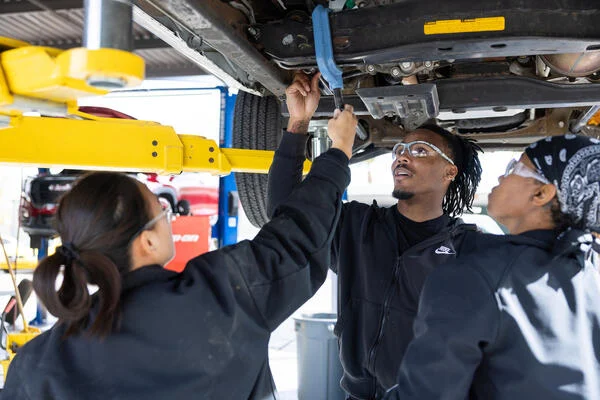
Career readiness has become a central focus for institutions nationwide as students seek more opportunities to gain real-world experience while earning a degree.
From internships and apprenticeships to work-based learning initiatives, two- and four-year colleges are expanding opportunities designed to give students hands-on experience and career direction before graduation.
Here are four things Inside Higher Ed has learned about the state of career readiness—and the institutions leading the way.
- Degree apprenticeships are fast-growing, but access to them remains limited and uneven.
The increasingly popular programs combine paid work experience, on-the-job training and employer-aligned classroom instruction, culminating in a recognized credential and an associate, bachelor’s or master’s degree.
A recent report from New America’s Center on Education & Labor found that about 350 institutions nationwide offer nearly 600 degree apprenticeship programs tied to a degree, preparing students for 91 different occupations.
But among the institutions that offer them, degree apprenticeships are concentrated in a small number of fields. K–12 teaching and registered nursing account for the largest share; programs that prepare teachers made up 156 of the nearly 600 degree apprenticeships identified, while registered nursing programs accounted for 51. Other occupations include electricians, electro-mechanical and mechatronics technologists and technicians, and industrial engineering technologists and technicians.
Despite their growth, degree apprenticeships remain relatively rare across the higher education landscape, with access varying widely by institution, field and region.
- Most degree apprenticeship and work-based learning opportunities are concentrated at the associate degree level.
Two-thirds of the degree apprenticeship programs identified in the New America report awarded associate degrees, 29 percent awarded bachelor’s degrees and 4 percent awarded master’s degrees.
“Community colleges have been really involved in degree apprenticeships, many of them for quite some time,” said Ivy Love, a senior policy analyst at New America. While some four-year institutions offer degree apprenticeships, she said community colleges’ “workforce orientation” gives them greater familiarity with the model, and two-year institutions are often more closely connected to employers in technical fields.
Some community colleges are also collaborating regionally to expand work-based learning tied to these pathways. In Los Angeles, institutions such as West L.A. College, Compton College, El Camino College and Los Angeles Southwest College have developed a cross-sector strategy aimed at expanding career opportunities for community college students.
The four colleges meet quarterly to compare approaches to work-based learning and identify opportunities to collaborate. A key focus has been mapping the industries and employers each college works with. When programs overlap, the colleges coordinate outreach so employers don’t have to repeat the same conversation with multiple institutions.
- Many students want their institutions to offer more targeted career-readiness efforts.
In Inside Higher Ed’s latest Student Voice survey of more than 1,000 students from two- and four-year institutions, nearly all reported interest in participating in some form of work-integrated learning. Roughly 80 percent said they are somewhat or very interested in these experiences, and 82 percent of students who have already participated said they want to engage in more of them in the future.
In response, institutions and divisions like the University of Virginia’s College of Arts and Sciences have launched initiatives to embed career design directly into the student experience. Building on a redesigned pre-major advising model, UVA introduced a collegewide effort to integrate advising, academics and experiential learning for all students, with the broader goal of moving away from a service model and toward a more blended approach.
Southwestern University is rolling out a similar career-readiness model: the Pirate Plan, a universitywide four-year student success framework that integrates career development into the college experience. Beginning this fall, every student will be paired with a student success coach who will provide ongoing guidance through graduation, helping students make informed decisions about majors, extracurricular experiences and career pathways.
“We believe very strongly that it’s important, especially as a student starting in college, to have reinforced guidance and a shared conversation on the complementary nature of both academic and professional development,” said Adrian Ramirez, director of the center for career and professional development at Southwestern University.
- As generative AI becomes more prevalent, many students believe hands-on experience with AI tools is more important than ever.
According to the Student Voice survey, about 55 percent of students said hands-on experience is more important than ever when asked how the rise of AI and automation have influenced their views on work-integrated learning. Only 8 percent said AI has not influenced how they think about these experiences.
Institutions like DeVry University have responded by embedding AI literacy and skill building into every course by the end of the year. The effort expands on the automation and machine learning curriculum DeVry launched in 2020, adding new AI-focused courses and credentials while introducing AI-powered learning assistants across classes.
“What I’ve realized from talking to employers and watching workforce trends is AI skills are going to be a baseline and a necessity, and perhaps may even be a basic requirement for job descriptions,” said Elise Awwad, president and chief executive officer of DeVry University. “So we’ve got to take ownership of that as educators, and we’ve got to get our students prepared for what’s happening.”
Taken together, these developments reflect a broader shift in higher education toward embedding career preparation more directly into the college experience. As students seek more hands-on experience and employers increasingly value practical skills, colleges are expanding apprenticeships, work-based learning and career guidance designed to help students transition more smoothly into the workforce.
Get more content like this directly to your inbox. Subscribe here.
