

Get stories like this delivered straight to your inbox. Sign up for The 74 Newsletter
Reading achievement is in the dumps. Unlike math, where kids appear to be making at least some signs of progress, reading scores continue their long-term slide.
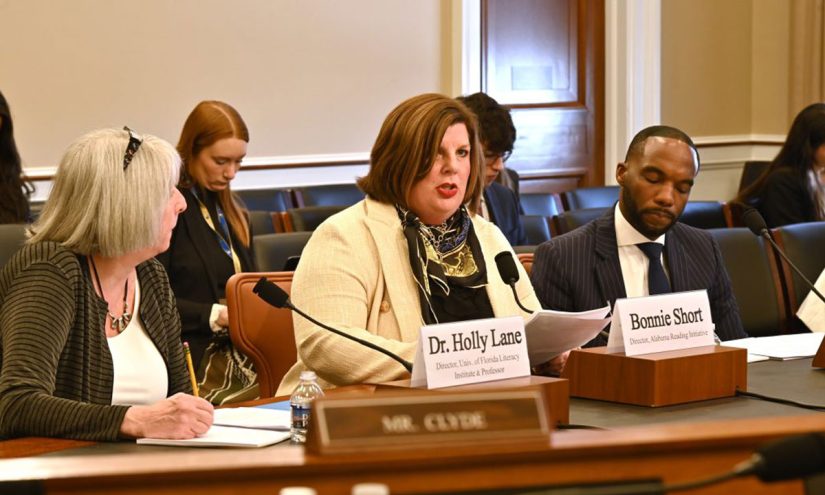
Policymakers in Washington are starting to pay attention. Last year, Secretary of Education Linda McMahon officially named “Evidence-Based Literacy” as her No. 1 academic priority. And this month, the House Appropriations Committee held a hearing on the science of reading.
So what role should the federal government play in reading policy?
Unfortunately, it’s not as simple as stealing the playbook from the best-performing states. The so-called “Southern surge” states of Mississippi, Tennessee, Alabama,and Louisiana have seen the biggest gains in recent years, and many states have tried to copy them with their own science of reading bills — to varying degrees of success.
The federal government also has a pretty spotty record of big investments in reading not leading to improved outcomes. That’s at least partly because reading policy is tricky, given all the potential reasons a child may or may not understand the words on the page.
Student Achievement Is Down Overall — But Kids at the Bottom Are Sinking Faster
But that doesn’t mean federal leaders are helpless. They just need to find the right levers. Here are five potential ideas:
1. Create a new national reading panel
In 1997, Congress brought together a group of experts to “assess the status of research-based knowledge, including the effectiveness of various approaches to teaching children to read.” After reviewing thousands of research articles, the group focused on five critical components of reading instruction — phonemic awareness, phonics, fluency, vocabulary and comprehension.
The document that came out of that work, the National Reading Panel, became a foundational text for the field. But it’s now decades old, and researchers know a lot more today than they did back then. It would be useful to have an update and a new consensus document from an esteemed body of experts.
2. Expand the National Assessment of Educational Progress
The NAEP exams have been instrumental in documenting the extent of students’ challenges, but they don’t say much about the underlying reasons why kids are having such reading comprehension problems.
For example, on the 2024 test, 46% of fourth graders couldn’t accurately understand the meaning of the word “conform” in a passage from the book The Tale of Despereaux by Kate DiCamillo. Was it because they didn’t understand the question, didn’t know the meaning of the word “conform” or got misled in some other way?
Reading researchers like Hugh Catts have been raising the alarm that most reading comprehension exams are not well equipped to pinpoint the reasons behind a student’s literacy mistakes. NAEP could take the lead here by introducing other types of assessments that seek to unpack the root causes of reading struggles, and how they might differ across age groups.
6-Year-Olds in England Get a Phonics Check. American Kids Should Get One, Too
For example, young students might get a phonics check like the one England administers to its 6-year-olds. Older students might benefit from an age-appropriate version of this, as researchers have found that even middle and high school students can struggle with complex words.
3. Give states flexibility on English Language Arts assessments
Building on the point above, the federal government currently requires states to administer their own reading or language arts assessments annually in grades 3 to 8 and once in high school. Right now, the states have all interpreted that requirement to mean that they must give generic reading comprehension tests.
But states could be given flexibility to interpret this differently. Educators might gain better insights into students’ reading challenges if they were tested on discrete skills like decoding, fluency and vocabulary, and comprehension questions were left to specific content areas like social studies and science. Louisiana attempted something like this a few years ago, but the feds could give states much more leniency to pursue this line of inquiry.
4. Nudge states on accountability
Congressional leaders probably don’t have much appetite to rewrite the Every Student Succeeds Act, which requires states to draft goals for student achievement and plans for holding schools accountable. But those original state plans were written nearly a decade ago, and conditions have changed (for the worse) since then. The Department of Education can’t force states to revisit their plans if they don’t want to, but it could signal that it would be open to letting states amend them in light of the declines of the last decade, especially among the lowest-performing students.
5. Empower parents with information
Despite their best intentions, schools are not good at helping students who fall behind in reading catch up. According to the latest data from Amplify’s DIBELS early literacy screener, just 49% of students who start kindergarten well behind in reading get on track by the end of third grade. And the odds get worse every year that schools wait. Last year, among third graders who were far behind at the beginning of the term, just 5% caught up by the end of the year.
Thanks to another federal law, parents already have access to their child’s education records, but only if they request them. To bring greater urgency to this issue, Congress could require schools to inform parents when their child is behind in reading and to work with families to develop specific improvement plans.
Louisiana Pilot Program Tests New Kind of Reading Exam That Could Be a Model
If reading scores are a crisis, policymakers should treat it accordingly. But they also have to be realistic in accepting that there’s only so much they can do, and that part of the decline in performance can be traced back to the fact that kids aren’t reading for pleasure as often as they used to — and neither are adults.
So one way to improve literacy scores is for education leaders at all levels to talk about the importance of reading. People who read a lot tend to know more about the world, and people who know more about the world tend to succeed in many aspects of life. That’s not exactly a policy change, but leadership can shape behavior to make knowledge — and reading — cool again.
Did you use this article in your work?
We’d love to hear how The 74’s reporting is helping educators, researchers, and policymakers. Tell us how
