

Get stories like this delivered straight to your inbox. Sign up for The 74 Newsletter
More than 50 Minnesota school districts continue to use so-called seclusion rooms, according to data obtained by the Minnesota Disability Law Center. Districts use seclusion rooms for children with a disability and who are at risk of harming themselves or others.
This practice is banned or extremely limited in 21 states.
The 50 school districts maintain 194 registered seclusion rooms across 100 school buildings across the state, according to the records.
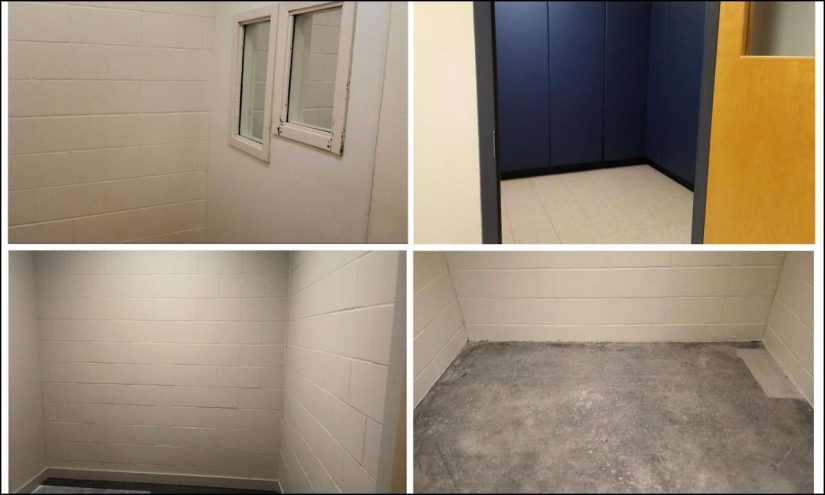
For the first time, the Minnesota Disability Law Center set out to document the state’s seclusion rooms, photographing more than 80 of them and documenting their locations in a report titled “Children in Confinement: Seclusion in Schools.”
“I think the average person does not know this is happening in their schools. When they see the rooms and they find out how they’re used, the average person is appalled and is very upset and curious as to why this antiquated and traumatizing practice is still allowed in our schools,” said Jessica Heiser of the Minnesota Disability Law Center in an interview with the Reformer.
Multiple school districts in Minnesota do not practice seclusion, including Minneapolis Public Schools and Fridley Public Schools. Neither Spiro Academy nor Intermediate District 287 — which both specialize in serving students with disabilities — use seclusion.
Children With Disabilities Particularly Vulnerable to Minneapolis ICE Crackdown
During the 2023-24 school year, state data show that 553 students with disabilities were subjected to 3,451 instances of seclusion. In the 2024-25 school year, after seclusion was banned for students in third grade and below, 358 students were subjected to 1,867 episodes of seclusion.
The most recent policy guidance from the U.S. Department of Education Office of Civil Rights states that repeated use of seclusion for the same student by a school is likely a violation of the student’s rights.
Heiser said she believes one reason Minnesota has been slow to eliminate seclusion is because the policy affects a small number of students, and remains mostly hidden from the general public — and even from educators, school staff and parents of school-age children.
“Nobody wants their kids in one of these rooms. As a parent, I cannot look at this room and say in good grace that there is a single child that deserves to be locked in a cinder block room in a school,” Heiser said.
In 2023, the Minnesota Legislature passed a law that banned seclusion for students with disabilities from birth through third grade. At the time, the Minnesota Department of Education recommended that the state work towards eliminating the practice entirely by the start of the 2026-27 school year.
But progress towards that goal has halted in the Legislature. Sen. Judy Seeburger, DFL-Afton, proposed legislation last year to rollback the 2023 law banning seclusion for the youngest students. Seeburger also led a Seclusion Working Group, which met 11 times between August and January. In the group’s August 13, 2025 meeting, Seeburger explained how her adult son was subject to seclusion as a student and why she believes the practice was beneficial.
“The seclusion working group, everybody around the table, except Sen. Seeberger, said ‘We don’t want this practice,’” said Jessica Webster, an attorney at Mid-Minnesota Legal Aid. “What a bizarre place for us to be standing that all of the voices agree that this is a harmful and traumatic practice that we shouldn’t be using, but we’re still using it.”
Seeberger did not respond to an interview request.
The working group’s meeting materials show a dozen letters that support letting schools continue to use seclusion, with varying degrees of support for rolling back the 2023 ban on using them on younger students. Five of the letters come from a single school district, Intermediate School District 917, which serves as a special education cooperative for nine districts in the south metro. Another five come from other special education cooperatives around the state. Intermediate and cooperative districts typically provide services for students with disabilities who often require services that are provided in separate school buildings.
Black students with disabilities are disproportionately subjected to seclusion, making up just 12% of students with disabilities in Minnesota but subject to 22% of all instances of seclusion.
“It is unquestionable in every state, including our own, that seclusion and restrictive procedures in general, like holds on children and locking children in rooms by themselves, is used against boys of color with disabilities more so than any other demographic,” Heiser said.
Advocates Fear Minnesota Students Will Again Be Subject to Restraint Used on George Floyd
Heiser added that multiple federal investigations have led to banning seclusion in particular states or school districts because data show it is disproportionately used on boys of color.
Seclusion is primarily used on students between the ages of 6 and 10. Before the ban was implemented for students in third grade and below, these children with disabilities made up about one-third of students with disabilities in Minnesota, but were subject to more than two-thirds of all episodes of seclusion. In the same year, 16% of students with disabilities were ages 16-21, but they made up just 7% of the students subjected to seclusion.
After the K-3 seclusion ban, in the 2024-25 school year, 6 to 10 year olds still made up about one-third of students with disabilities, but they accounted for only 46% of all episodes of seclusion.
Heiser says that some defenders of seclusion say it is necessary because the children can become violent and could hurt someone if not locked in a room. But she calls this a “red herring.” She said it is “common sense” that an older child would be bigger and stronger, and thus more likely to cause injury to another person. She said there’s a simple explanation for why younger children are more likely to be subjected to seclusion: They’re smaller.
“It really just comes down to how easy is it to grab a kid and put them in the closet? It’s easier when they’re littler,” Heiser said.
Students with autism or whose disabilities are categorized as emotional or behavioral disorder are disproportionately more likely to experience seclusion. Just 10% of students with disabilities are in the emotional or behavioral disability category, while they experience about 2 of every 5 seclusion episodes. Students with autism make up about 16% of students with disabilities but experience more than one-third of all seclusion episodes. This did not change after seclusion was banned for K-3 students.
Minnesota Reformer is part of States Newsroom, a nonprofit news network supported by grants and a coalition of donors as a 501c(3) public charity. Minnesota Reformer maintains editorial independence. Contact Editor J. Patrick Coolican for questions: [email protected].
Did you use this article in your work?
We’d love to hear how The 74’s reporting is helping educators, researchers, and policymakers. Tell us how
