

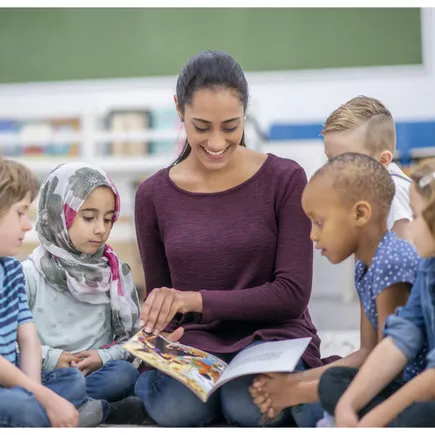
Books are more than tools for teaching children how to read. They are often the reason children want to read at all. Carefully chosen children’s literature gives students a shared experience to talk about, reflect on and learn from together—helping them make sense of themselves, understand others and engage more fully in classroom life.
Research shows that shared reading experiences in elementary classrooms support both academic growth and classroom connection, with measurable effects on comprehension, participation and readiness for learning.
As a longtime teacher, I have seen how children’s books can serve as a practical, everyday way to strengthen both learning and connection. A few classroom tips:
- Make reading a shared experience, not just an independent task.
- Encourage talk, reflection and connection after reading.
- Use stories consistently to build common reference points in the classroom.
Here are seven books that offer elementary educators concrete opportunities to build classrooms where students are engaged readers and part of a community of learners.
1. My Papi Has a Motorcycle by Isabel Quintero, illustrated by Zeke Peña
Daisy Ramona zooms through her changing neighborhood on the back of her father’s motorcycle. Every turn, every page, is a celebration of how deeply she is embraced by and embedded within her family, her culture and her community. She knows where she belongs.
2. Yoshi and the Ocean: A Sea Turtle’s Incredible Journey Home by Lindsay Moore
This is the true story of a loggerhead sea turtle who was rescued by oceanographers. After a long career in an aquarium, Yoshi was released back into the wild. Yoshi traveled over 25,000 miles to find her way back home. She knew in her bones where she belonged.
3. The Wild Robot by Peter Brown
Who could be more of an outsider than an AI-powered robot on an island of wild animals? With every encounter, the robot learns more about the island’s inhabitants – their needs, their fears, their delights and over time finds ways to belong among them.
4. Gondra’s Treasure by Linda Sue Park, illustrated by Jennifer Black Reinhardt
In a family of dragons, Mom is from the West while Dad is from the East. Gondra is … well, herself! Children will delight in this depiction of a youngster who wonders where she belongs, given that she has inherited remarkable (and possibly incompatible) traits from both of her parents.
5. Watercress by Andrea Wang, illustrated by Jason Chen
A young girl is embarrassed when her parents stop to pick wild watercress by the side of the road. What would her friends say if they saw her? Upon returning home, her mother recounts the story of growing up in China during a famine. Andrea Wang calls this autobiographical book “both an apology and a love letter to my parents.”
6. Love by Matt de la Peña, illustrated by Loren Long
To be surrounded by love is to feel safe. Through a series of heartfelt and varied examples, this book depicts the many ways the love of those around us help us know that we belong.
7. Knoxville, Tennessee by Nikki Giovanni, illustrated by Larry Johnson
In vivid sensory detail, the poet Nikki Giovanni describes the place where she recalls feeling that she most fully belonged, “and be warm/ all the time/ not only when you go to bed/ and sleep.”
James Baldwin famously said, “You think your pain and your heartbreak are unprecedented in the history of the world, but then you read. It was books that taught me that the things that tormented me most were the very things that connected me with all the people who were alive, who had ever been alive.”
Reading is not an extracurricular activity. It is a key to the grown-ups’ children becoming and to the society they will build.
Find more books for building belonging with Harmony Academy’s literature guides and storybooks.
Carol Jago is a long-time teacher and past president of the National Council of Teachers of English. She is associate director of the California Reading and Literature Project at UCLA and the author of numerous books, including The Book in Question: Why and How Reading Is in Crisis. She works with Harmony Academy at National University to help schools and districts turn belonging into measurable gains in engagement, attendance, teacher retention and academic success.
