

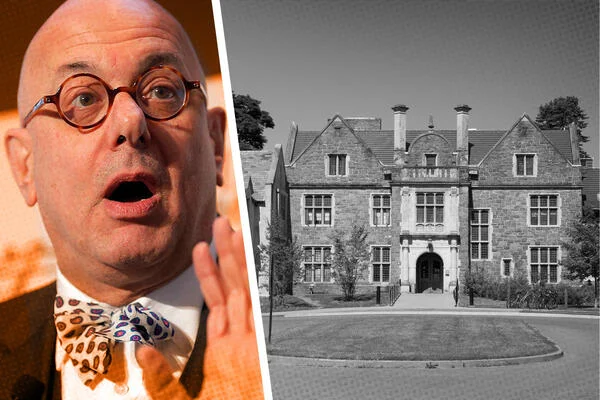
To Bard College senior Owen Denker, Leon Botstein is an imperial president.
“Botstein is a figure on this campus that has ultimate power. He is often likened to a king by faculty that can wave his wand and do whatever,” said Denker, a literature major at the liberal arts college in Annandale-on-Hudson, N.Y. Botstein has led Bard since 1975, bringing it from the brink of bankruptcy to rest on a $1 billion endowment. Now, Denker and other members of the two-month-old student group Take Back Bard are calling for Botstein’s resignation and for change to what the group calls a “culture of sexual misconduct” on campus.
In February, Bard was rocked by new evidence that Botstein’s relationship with the late financier and convicted sex offender Jeffrey Epstein ran deeper than previously thought. He has not been implicated in any of Epstein’s crimes, but Botstein’s name is mentioned thousands of times in the Epstein files released by the U.S. Justice Department. He visited Epstein’s infamous island and invited Epstein to dinner, to the opera and to campus.
In January of 2015, seven years after his first conviction, Epstein was back in the news after unsealed court documents showed new allegations that he and Andrew Mountbatten-Windsor paid for sex with minors. Botstein reached out to Epstein with a message of support: “True friendship, in my view, is among the most honorable and rare of virtues. And I value our friendship, so if there is any way I can be of help, let me know (not that royalty is quite up my proverbial alley).”
Epstein was not his friend, “he was a prospective donor,” Botstein told students, faculty and staff in a February letter. The president first connected with Epstein after he gave an unsolicited $75,000 gift to Bard High School Early College in 2011, three years after his conviction for soliciting prostitution from a minor.
“I was not following the revelatory closing chapter of Mr. Epstein’s life and the extent of his crimes until he was arrested in 2019,” Botstein wrote. “I remain shocked and appalled at the horrific nature and extent of his monstrous and criminal depravity. I am deeply sorry to have involved myself and the College with him in any way.”
Over the last few months, Bard faculty members have remained largely silent or supportive of the president. In a recent letter, the Faculty Senate stopped short of criticizing Botstein for his relationship with Epstein or calling for his resignation. One faculty member who spoke to Inside Higher Ed on the condition of anonymity said that “most people at Bard would feel that there’s a lot of positives in Leon’s history at the college.” Botstein is responsible for the Bard Prison Initiative, for creating a liberal arts program at Al Quds University in the West Bank and for raising hundreds of millions of dollars for the college, to name a few successes.
“For people who look at the entirety of President Botstein’s contributions, there’s an awful lot in the very positive side of the ledger that is weighed against a misjudgment from a dozen years ago,” the faculty member said.
A Protected President
Students have been more vocal with their disapproval of the president. The Take Back Bard group grew out of a student government committee formed to discuss and respond to Botstein’s appearance in the latest trove of Epstein files. The group has since distanced itself from student government and counts about 20 members, with dozens more students attending rallies and protests, said Denker, who is one of its founding members.
In a February letter to the Board and the broader community, Take Back Bard expressed frustration that the college had hired the Washington, D.C.–based law firm WilmerHale to investigate Botstein’s ties with Epstein “rather than listen to the voice of survivors.” Botstein has routinely declined to speak to the media since the investigation began. A Bard spokesperson told Inside Higher Ed that the president “fully supports the Board’s decision to pursue an independent review of this matter and will refrain from commenting further while this process is underway.”
But regardless of the investigation’s outcome, students say, Bard will be left with a pervasive issue: a culture of un- or underaddressed sexual harassment on campus.
“This lack of transparency coupled with the refusal to recognize the broader epidemic of Bard’s culture of sexual misconduct, ranging from administrative indifference to inappropriate treatment of students by certain professors and administrators, as well the continued reign of a man who put students in the path of a convicted sex offender, sends a clear message of where the Board’s priorities lie,” the students wrote in their letter.
Knowing which professors not to be alone in a room with—that’s normal here.”
—Owen Denker, Bard College senior
The Bard spokesperson said that “protecting the safety and dignity of our students and community members is central” to the institution.
“Our resources go beyond federal Title IX requirements—including the implementation of an anonymous hotline administered by an outside law firm—and are designed to encourage reporting through multiple, confidential pathways so every community member feels supported in coming forward,” the spokesperson said. “We are committed to providing meaningful protections and preventing harm before it occurs, by requiring annual Title IX training for faculty, staff, and students, and maintaining policies that address both on and off campus conduct. Bard takes every report seriously and looks into all claims of sexual or gender-based misconduct.”
But students believe previous efforts to combat campus sexual harassment have fallen short, Denker said. Until 2016, Botstein was the final decision-maker on all Title IX investigations. Not until 2023 did the college have a formal written policy prohibiting sexual, dating or romantic relationships between students and professors. By comparison, Yale University first adopted a similar policy in 1997 to prohibit relationships between professors and the students they do or may teach, and expanded it to include all students in 2010. William & Mary implemented a ban in 2001.
“The things that go on on this campus are normalized to the extent that students don’t think twice about it,” Denker said. “Knowing which professors not to be alone in a room with—that’s normal here.”
While their public opinions of Botstein remain rather rosy, actual faculty and staff sentiments are split, he said.
“I can say that among administrators, the opinions range quite widely,” Denker said. “There are a number that we suspect—and some that we know—favor Botstein’s resignation and broader structural change at the college; however, they are afraid of doing so publicly.”
The same is true for faculty, he said.
Botstein’s immense fundraising success and decades-long tenure appear to give him armor against criticism that would likely sink other college leaders. Former Harvard University president Larry Summers, for example, has retreated from nearly all public life since his relationship with Epstein was revealed. A handful of other prominent professors—including Chapman University paleontologist Jack Horner, Columbia University pathology and biochemistry professor Richard Axel, and School of Visual Arts department chair David Ross—have left teaching or leadership roles over their Epstein ties, even though none have been implicated in any of Epstein’s crimes.
Inside Higher Ed asked dozens of Bard faculty members to speak on or off the record about Botstein and the campus culture, and only a few replied, primarily to speak in support of Botstein or to decline to speak at all. An anonymous faculty member told The Daily Catch in February that “it is virtually impossible for people who are not tenured to say anything because the hiring and firing decisions ultimately are up to Leon.” A second anonymous faculty member also shared that concern. “For a lot of people, their own security depends on Leon,” she told The Daily Catch.
Botstein has a habit of overturning tenure decisions, one now-retired professor told the Daily Freeman in 2002. “In many schools, the president has the final say [on tenure], but I don’t know of any school where the president overturns as many decisions,” he said.
To alum Tallulah Woitach, fear for job security is no excuse for remaining silent. Woitach has been calling for Botstein’s resignation for years. The professors’ silence is a classic hypocrisy in elite liberal arts education, they said. “So many Bard professors are writing op-eds about how we can resist in the age of Trump. Meanwhile, we have our mini version of that, and no one is willing to do anything about it,” Woitach said. “The excuses are endless.”
Old Words, New Impact
As part of their demands, Take Back Bard is calling for Botstein’s immediate resignation. Though the group has broader goals, Botstein is inextricably tied to the identity of the college and ousting him is a first step, Denker said. In building their case against Botstein—and against the campus culture that they say facilitates sexual harassment—no stone has been left unturned.
Students, alumni and media are examining decades-old interviews and writings of Botstein’s with new scrutiny in light of his relationship with Epstein. In a 1990 interview with Lingua Franca, excerpted in Harper’s Magazine, Botstein criticized “The Defense Guard,” a group of 25 high school–age students, mostly women, that campaigned against sexual harassment at Simon’s Rock at Bard College, which served then as an early college for 10th and 11th graders. Sixteen of those students publicly confronted four faculty members and repeated, “It has come to our attention that you have been sexually harassing students on this campus. Sexual harassment is a crime and will not be tolerated. It will stop,” The New York Times reported. The college suspended all 16 students, but those suspensions were later overturned.
The group’s tactics were “a theatrical gesture of radical politics” and “extremely reminiscent of fascism,” Botstein told the now-shuttered Lingua Franca. He said the students had not made any formal complaints of harassment to administrators.
Later in the interview, the president said that teachers and students often feel attraction toward each other and suggested that all good student-teacher relationships contain some kind of “libidinal component.”
“Either we own up to this sexual dimension and try to manage it or we have to change our ideal, teach with distance, impersonally, by television or in huge lecture halls,” Botstein said.
He also said that the teacher-student power dynamic “works both ways.”
“Yes, in general the faculty member has more power. The point of having rules guarding against sexual harassment is to avoid the corruption of the power inherent in academic evaluation,” he said. “Yet in the current climate a student can wield considerable power in the very act of making a public accusation. A charge can be devastating to the person’s life and work.”
Either we own up to this sexual dimension and try to manage it or we have to change our ideal.”
—Bard president Leon Botstein, circa 1990
Eight years later, Botstein spoke with radio host Diane Rehm about his book titled Jefferson’s Children and his belief that the modern high school was “obsolete” as young people reach physical maturity earlier. He laid out this same argument in an earlier op-ed in the New York Times, titled “Let Teen-Agers Try Adulthood.”
“For whatever reason, we have a population that is reaching sexual maturity earlier, and we also know from all the data collected in the last 10 years—15 or 20 years, really—that sexual activity sets in earlier than it used to,” Botstein told Rehm. “So my argument is a pretty simple one—that 16 is now what 18 was 50 years ago.”
In none of his interviews or writings does Botstein suggest that changes to the average age of sexual maturity should influence the age of consent, nor does he ever discuss romantic or sexual relationships between adults and teenagers.
Some faculty are frustrated by the renewed scrutiny paid to Botstein’s old writings.
“People have been taking Botstein’s quotes from his book, Jefferson’s Children, which was really in support of the early-college high school concept, and speaking to the fact that young people are intellectually more mature and capable than they used to be,” the anonymous faculty member told Inside Higher Ed. “[They’re] then twisting that to make it seem like he was saying they were more sexually mature … That just strikes me as beyond the pale and completely wrong.”
Another faculty member who spoke to Inside Higher Ed on the condition of anonymity confirmed what Denker at Take Back Bard said: Any faculty members critical of Botstein are extremely hesitant to speak publicly. Without Botstein’s support, they fear for their jobs as well as a change to the liberal arts mission of the college, the faculty member said.
“Bard has taken a very strong position defending the liberal arts as a project, and I think that comes from the president, and that’s a worthy goal. I think people are concerned that if the administration changes, we might be exposed to the kind of neoliberal university management that is taking place elsewhere,” the faculty member said. “At the same time, I think it’s a problem that, internally, we may not be living up to that standard.”
