

This story was co-published with Next City.
Atlanta
In a once-thriving neighborhood in the southeast part of Atlanta, Lakewood Elementary served families who came to work at the General Motors assembly plant, a sprawling 100-acre landmark that became a path toward economic mobility for entry-level workers. At its height in the late 1970s, the plant employed as many as 5,700 people.
But by the early ‘90s, when Gloria Hawkins-Wynn moved into the community, signs of decline were evident. The last Chevy Caprice rolled off the assembly line in 1990, and a popular antique market at the now-defunct Lakewood Fairgrounds shut down in 2006. The closure of the elementary school two years earlier further contributed to neighborhood blight, turning the abandoned structure into a hotspot for criminal activity.
“We get prostitution. We get drug dealing. We get drive-by shootings,” Hawkins-Wynn told a local news station four years ago. A neighborhood representative, she urged city leaders to turn the eyesore over to a developer.
Gloria Hawkins-Wynn has watched the Lakewood neighborhood in Atlanta change from a once-thriving community to one where crime and poverty drove businesses away. Redeveloping the old Lakewood school into apartments is part of the comeback, she said. (Linda Jacobson/The 74)
Former students begged the city to save the school, home to some of their earliest memories: Dick and Jane books, dances in the auditorium, a principal named Mr. Hinkle. Still visible on the school’s deserted playground is a faded map of the United States.
“Please don’t demolish it,” wrote one woman. Walking to Lakewood with her mother, who died when she was 7, is a cherished memory.
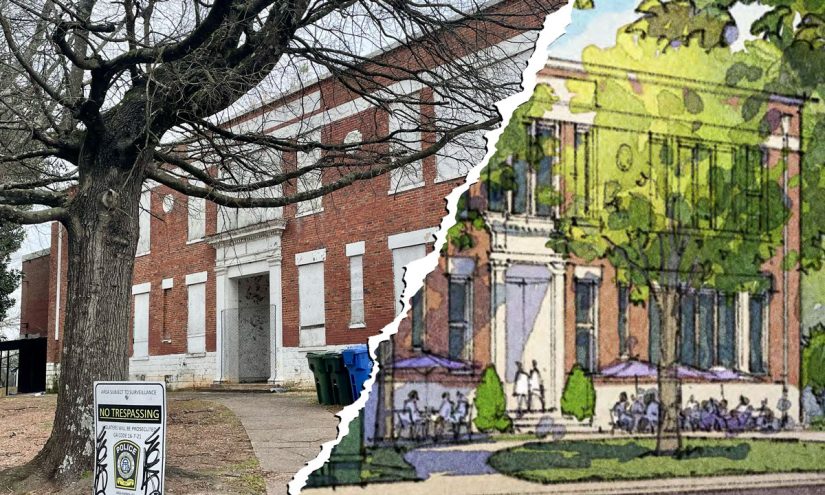
Now the old school is one of several in Atlanta slated to become apartments. It’s a transformation that is increasingly taking place across the country as city leaders and developers look to give new life to vacant buildings once bustling with students and teachers.
Rendering of Lakewood Elementary housing (Atlanta Urban Development and Atlanta Public Schools)
In 2024, nearly 2,000 apartments were built in former schools across the U.S., a record high and four times the number a year earlier, according to an analysis from RentCafe, a property search website. School-to-apartment conversions are now the fastest growing segment of a niche industry devoted to makeovers of historic spaces.
As student enrollment continues to shrink nationwide and more districts, including Atlanta, make the painful decision to close schools, the Lakewood project offers a glimpse of what’s to come: Seventy-four school conversion projects are already underway across the country, RentCafe’s data shows. With enrollment loss in traditional schools expected to continue, districts will be left with even more surplus properties.
Renovating existing structures “offers a way to help those buildings continue on as community assets,” said Patrice Frey, president and CEO of RePurpose Capital, a subsidiary of the National Trust for Historic Preservation.
For the first time since the Great Depression, renovation projects, including historic preservation, surpassed new construction in 2022, according to the American Institute of Architects. Supply chain gridlock and “the rapid escalation of materials costs” likely contributed to the shift, Frey said.
Exclusive Data: Thousands of Schools at Risk of Closing Due to Enrollment Loss
The pandemic also played a part as parents chose charter schools or uprooted to other districts and states to find in-person learning. The rapid expansion of private school choice has also contributed to enrollment declines, school consolidations and closures.
Data from the Brookings Institution showed that between the 2018-19 and 2021-22 school years, 12% of elementary schools and 9% of middle schools lost at least one-fifth of their students. Many districts delayed closures in response to parents and generations of former students who pleaded with leaders to keep the neighborhood institutions open. Some districts, like Seattle, are still putting it off.
But maintaining underenrolled schools, especially those with just a couple hundred students, can be a financial drain. The Houston, Memphis-Shelby and Cedar Rapids districts are among those that have recently announced or discussed closures. That means they’ll eventually have to decide what to do with the buildings.
Minneapolis School Board Signals Potential School Closures
An earlier Atlanta project, completed in 1999, offers a preview of what’s in store for Lakewood and many other former schools. Bass High School was redeveloped into Bass Lofts, a three-story structure that sits in a bohemian neighborhood known for vintage clothing stores, dive bars and record shops. Mallory Brooks, a photographer, moved into one of the units 10 years ago after relocating from Florida.
Mallory Brooks and her husband Mike Schatz live in a loft apartment in a former Atlanta high school that closed in 1987. (Courtesy of Mallory Brooks)
“It was the first place I looked at, and I was definitely smitten,” she said. Stepping through the main entrance, “you are transported immediately to being in a school.”
Old lockers, welded shut, line the ground floor hallways, and a large Depression-era mural of women dancing sits above the stage in the auditorium. While rows of seats remain intact, some tenants also use the space to store their bikes. Brooks appreciates how sunlight pours through the 10-foot-high windows — “I’ve been able to basically create a greenhouse in my apartment,” she said. But regulating the temperature is difficult, and she looks forward to HVAC upgrades.
Bass Lofts 2026 (Judith Fuller)
‘Legacy residents’
Lakewood Elementary is one of eight sites that the Atlanta Public Schools is now repurposing through an agreement with the Atlanta Urban Development Corp., a nonprofit arm of the city’s housing authority that renovates historic properties into mixed-income residences. The plan, part of Mayor Andre Dickens’ pledge to increase affordable housing, includes giving teachers the first choice of apartments. That was important to Cynthia Briscoe Brown, a former Atlanta Board of Education member whose last vote in December was to close or merge 16 schools.
Cynthia Briscoe Brown, a former member of the Atlanta Board of Education, has advocated for turning abandoned schools into affordable housing. (Cynthia Briscoe Brown, Facebook)
“Seventy percent of APS employees do not live within the city limits of Atlanta,” she said. “One of the board’s priorities in developing these properties is to make it possible for our employees to not have to drive so far before their work day.”
A lawyer with experience in real estate, she took an interest in the dilapidated properties when she was first elected in 2013. But she also has personal ties to the site where Peeples Street Elementary, one of the eight former schools, once stood. Her father, Woodson Briscoe, attended the school, which sat just down the street from the boarding house, run by an aunt, where the family lived.
“This was the Depression. They were a young couple with a family, and they couldn’t afford their own house,” she said. Today, as real estate costs in the neighborhood climb, with some homes priced well over $500,000, families are facing the same problem. “The West End is gentrifying to a point where a lot of legacy residents are having trouble staying.”
‘A pall over neighborhoods’
Peeples Street closed in 1982. The structure has been gone for 30 years, torn down after a fire left little worth saving.
But some shuttered schools can sit vacant for decades, attracting crime and casting “a pall over neighborhoods,” Alyn Turner, a sociologist with Research for Action, a Philadelphia-based nonprofit, told a group of Atlanta leaders in February.
In a hotel east of downtown, they gathered in a dining room to discuss ways to lessen the negative impacts of the upcoming closures on both students and the neighborhoods where they live.
“People can experience a (school) closure as yet another signal of neighborhood decline.”
Alyn Turner, Research for Action sociologist
Turner cited a Pew study showing that between 2005 and 2013, 12 urban districts, including Atlanta, Chicago and Pittsburgh, sold, leased or repurposed 267 school properties, but still had more than 300 on the market.
School closures “tend to concentrate in communities that have already experienced displacement and disinvestment,” she said. “People can experience a closure as yet another signal of neighborhood decline.”
In Gary, Indiana, reporters examined a rising number of 911 calls near abandoned schools — an almost 600% increase between 2022 and 2024. They found fires, hundreds of requests for extra police patrols and 26 reports of “shots fired.” In 2015, a Chicago teenager was found dead in Emerson High School, a former Gary high school. Four years later, three teenagers fatally shot a woman and dumped her body in an emptied-out elementary school.
Emerson School, Gary Indiana.
Like any abandoned building, a boarded-up old school can “provide cover” for criminals, according to researchers at Arizona State University. Run-down, vacant structures can even escalate criminal behavior, they write, sending a message that no one owns or cares about the property.
K-12 Enrollment Fails to Emerge from Pandemic, Federal Data Shows
Maintaining former school buildings until they’re sold or repurposed can make the neighborhood feel safer, Turner told the Atlanta group. But like Briscoe Brown, some participants said they worry about the opposite effect — gentrification that leaves some lower-income families behind.
“How can you help the people who are still there?” asked Femi Johnson, a senior director at Achieve Atlanta, a nonprofit that focuses on college access. “Can it be a food bank? Can it be a community health center?”
In her hometown of Philadelphia, she saw the former Edward Bok Vocational School, part of a wave of closures in 2013, transformed into an event space with a rooftop bar, a destination she felt didn’t serve the community’s needs.
Bok Technical High School 1937
Bok Technical High School basketball team 1943
Rooftop bar in former school, 2023 (Instagram: @bok_bar)
Developers are drawn to former schools because of their historic architectural features, like wide hallways and stairwells. The former Monsignor Coyle High School in Taunton, Massachusetts, now Coyle School Residences, boasts “soaring ceilings” and original windows.
Tax credits for historic preservation can offset some of the costs of modernization, but come with restrictions on what developers can change and which “character-defining features,” like a gymnasium, must go untouched, said Pittsburgh developer Rick Belloli.
In 2022, his company, Q Development, acquired Mt. Alvernia, a former Sisters of St. Francis convent and all-girls school north of Pittsburgh. He described the massive, 333-room main building, the Motherhouse, as “a gloriously spectacular historic building” with cast iron stairways and arched ceilings. But he’s still navigating the approval process, and some developers, he said, avoid former schools because of those hurdles.
Mt. Alvernia (Q Development)
Mt. Alvernia (Q Development)
Mt. Alvernia (Q Development)
‘Choice properties’
Like Coyle and Mt. Alvernia, many of the school-to-apartment conversions are concentrated in the northeast and midwest. Columbus, Ohio, ranked first on RentCafe’s list of cities with the most school conversion projects.
Next on the list is Cleveland, where the former Martin Luther King Jr. High School, in the predominantly Black Hough neighborhood, was among those affected by more recent enrollment loss. In 2020, the district closed the school, which had dropped to less than 350 students, and a Maryland-based developer acquired the 11-acre site for $880,000.
@tooomuchtp
Exploring one of Cleveland’s abandoned high school’s #cleveland #ohio #abandoned
♬ al1en_jump – Nxxkz
Last fall, knowing the building might be demolished, former students gathered to reflect and grab what mementos they could. Some cut strings off the basketball hoops, said Ronald Crosby, who attended in the late 1980s. Others took old library cards and team jerseys.
Former students from Martin Luther King Jr. High School in Cleveland gathered last fall to share memories of the school before it’s turned into mixed-use development. (Erika Ervin)
Ronald’s sister Johnetta Crosby has fond memories of the school. “We had teachers that took their time to make sure you learned,” she said. “If you didn’t have anything to wear, they made sure you did. If you couldn’t afford to eat lunch, they fed you anyway.”
D’Angelo Dixon, who graduated from Cleveland’s Martin Luther King Jr. High School, grabbed a ceiling tile he painted during his senior year. (Courtesy of D’Angelo Dixon)
D’Angelo Dixon, who graduated in 2018, felt more conflicted. “Black stuff” leaked from the ceiling, he remembered, and academically, he felt behind friends who attended other schools.
“Once I went to college, I felt like I didn’t know anything,” he said. But he credited the school’s career-tech program with inspiring him to work in health care. He’s now a nursing assistant. At the alumni gathering last year, he headed for the art room to grab a ceiling tile he painted with his nickname, Delo — part of a senior class assignment.
Some alumni hoped the developer, Kareem Abdus-Salaam, would save the building but that’s not part of his vision for the new residential community, a mix of apartments, townhomes and retail space.
“I really want to just level the whole site and bring it up, almost like a phoenix rising from the ashes,” he said. He expects to break ground this spring. “There are so many abandoned schools in this country that are sitting on choice properties.”
MLK Development (Structures Unlimited LLC)
He does, however, intend to make use of the large stones that still border one corner of the property by crushing them into gravel for a quarter-mile walking trail that will wind through the development. Along that pathway, he plans to erect signposts with historical photos of the school so former students “can have some feeling of yesteryear.”
How a Notorious Maximum-Security Prison Was Transformed Into a Thriving Preschool
In Atlanta, the partnership between the school district and the city gives officials a say in what the developers preserve. They’ll integrate the original Lakewood Elementary building into the overall design.
With a strip of commercial properties on the corner, including a popular restaurant and coffee shop, Hawkins-Wynn, who still lives a few blocks away, hopes the redevelopment will spur even more investment in the neighborhood.
On a recent afternoon, the transition was obvious, but so were the obstacles in its path. As she walked the perimeter of the property, a construction crew put up plywood on a new home across the street. A few lots down, trash and discarded mattresses piled up on the curb.
“This is why we need redevelopment,” she said, pointing to the debris. “It’s still shady around here, but it’s changing like you won’t believe.”
Did you use this article in your work?
We’d love to hear how The 74’s reporting is helping educators, researchers, and policymakers. Tell us how
