

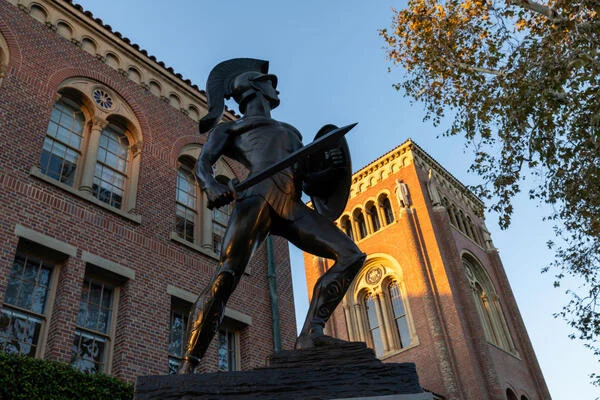
The University of Southern California nixed plans to host a gubernatorial debate after backlash over the exclusion of candidates of color.
Allen J. Schaben/Los Angeles Times via Getty Image
The University of Southern California canceled a gubernatorial debate on campus less than 24 hours before the event after receiving criticism for excluding candidates of color, the Los Angeles Times reported.
The move came after Democratic lawmakers sent a letter on Monday demanding the debate, which was supposed to take place Tuesday, be open to “all leading candidates.”
The university used a methodology by political science professor Christian Grose based on candidates’ polling and fundraising performance to determine who should participate. As a result, San José mayor Matt Mahan, a white candidate who only recently entered the race, was included while former U.S. Health and Human Services secretary Xavier Becerra, state Superintendent of Public Instruction Tony Thurmond, former Los Angeles mayor Antonio Villaraigosa and former state controller Betty Yee were not.
“The university’s selection process—built on a formula never before used for a debate of this scale, has delivered a result that is biased,” read the letter from lawmakers, including leaders of the legislative Asian and Pacific Islander, Black, Latino, Native American, LGBTQ, Jewish and women’s caucuses. “If USC does not do the right thing, we call on California voters to boycott this debate.”
A statement from USC to the Times said the controversy has been a “distraction from the issues that matter to voters.”
USC and the debate’s co-sponsor, KABC, “have not been able to reach an agreement on expanding the number of candidates at tomorrow’s debate,” the statement from USC said. “As a result, USC has made the difficult decision to cancel tomorrow’s debate and will look for other opportunities to educate voters on the candidates and issues.”
Scholars from USC and elsewhere have defended Grose and his methodology. A group of about 50 professors and researchers from USC, Harvard, Stanford and other universities released a letter on Monday urging the university to “publicly and unequivocally affirm Professor Grose’s integrity as a valued scholar.” The letter described Grose’s formula as having “grounding in peer-reviewed social science research.”
“All of us expect and welcome critical engagement from inside and outside the academy,” the letter read. “What Professor Grose has faced, however, is not substantive or methodological debate” but “attacks and insinuations” including “completely baseless allegations of election-rigging, inconsistency, bias, and data manipulation.”
