

Get stories like this delivered straight to your inbox. Sign up for The 74 Newsletter
When Bruce Springsteen released “Streets of Minneapolis” earlier this year, he did what protest musicians have long done in moments of democratic strain: he turned public grief into public memory.
Written in response to the fatal shootings of Alex Pretti and Renee Good during federal immigration operations, the song offered more than commentary. It interpreted a national crisis, asking listeners to confront what state power looks like when it arrives in neighborhoods, on sidewalks and in the lives of ordinary families.
That is precisely why this moment belongs not only on playlists and opinion pages, but in civic education.
Since then, the political terrain has shifted, but not in ways that make the issue less urgent for schools. President Donald Trump ousted Homeland Security Secretary Kristi Noem after months of political fallout surrounding the administration’s immigration crackdown.
Around the same time, reporting showed that the administration had scaled back the most visible ICE tactics in Minneapolis, reduced the federal presence there from roughly 3,000 agents to about 650, and shifted toward more targeted operations after the public backlash. Arrests declined in February, but ICE remains active, and the economic and civic damage in Minneapolis continues.
The retreat matters. It suggests that public protest, documentation by witnesses, investigative reporting and political pressure forced a tactical recalibration. But it also underscores a deeper lesson for educators: Students are living through a period in which official narratives, video evidence, journalism, protest and art are colliding in real time.
Schools cannot pretend these are merely political controversies happening somewhere else. They are contemporary case studies in how democracy works, how it fails and how citizens push back.
The arrest earlier this month of Estefany Maria Rodriguez Florez, a Nashville-based reporter for a Spanish-language news outlet, makes that lesson even harder to ignore. Rodriguez Florez had been covering immigration arrests in Tennessee. Then ICE detained her, despite her pending asylum case, valid work permit and marriage to a U.S. citizen.
Moments like this one shed light on why protest music is produced in response to government actions to silence individuals, raising essential civic questions for students to consider: Who gets to document state power? What happens when the people telling a community’s story become vulnerable themselves? And how should a democracy respond when journalism, immigration status, and political retaliation appear to converge?
Springsteen’s song is not a lone artistic response. Recent reporting in Rolling Stone traces a broader wave of anti-ICE protest music released in the wake of the Minneapolis operations. Billy Bragg wrote “City of Heroes.” NOFX released “Minnesota Nazis.” My Morning Jacket put out a benefit project, Peacelands, in solidarity with communities affected by ICE brutality. Bon Iver shared a live track to raise money for immigrant legal defense. Low Cut Connie and Dropkick Murphys have added their own contributions to this growing soundtrack of dissent.
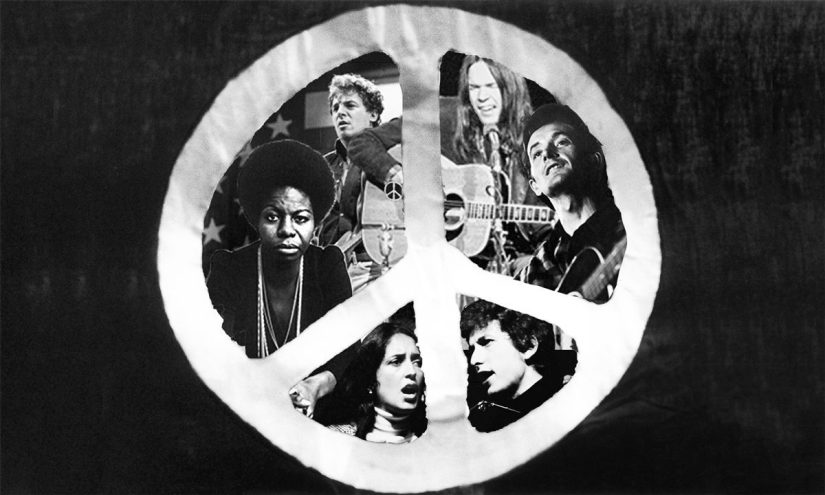
Another Rolling Stone piece places Springsteen’s song in a longer tradition of “instant protest songs,” linking it to works such as Woody Guthrie’s “Deportee,” written in response to a 1948 plane crash that killed 28 Mexican migrant farmworkers being deported; Nina Simone’s “Mississippi Goddam” and Bob Dylan’s “Only a Pawn in Their Game,” written after the 1963 assassination of civil rights leader Medgar Evers; and Crosby, Stills, Nash & Young’s “Ohio,” about the Ohio National Guard’s killing of four Kent State University students protesting the Vietnam War.
This history is what makes this such a consequential educational moment. Protest songs are not simply cultural accessories to political events. They are historical artifacts, rhetorical arguments and emotional archives. They help listeners name what has happened, assign meaning to it and imagine what moral response is required. In classrooms, they can help students examine competing claims about law, order, belonging and dissent without reducing complex issues to partisan slogans.
Analyzing protest music asks students to interpret voice, perspective, evidence, omission and historical context. These are not ideological activities designed to indoctrinate youth. They are learning opportunities to build critical thinking and civic literacy skills.
Steven Van Zandt on Rock, History & Our ‘Antiquated’ Approach to School
The question is not whether teachers should tell students what to think about Bruce Springsteen, ICE, Kristi Noem or the Trump administration. The question is whether students should have the chance to grapple with how democracies narrate force, how communities contest official accounts, and how music, journalism, and protest shape public understanding.
In elementary school, that might mean introducing age-appropriate examples of peaceful protest and the role of songs in movements for fairness. In middle school, it could mean comparing lyrics with speeches or media accounts and asking what each includes, emphasizes, or leaves out. In high school, it could mean examining how protest music enters political life as argument, memory, and civic witness.
The broader lesson is that protest is not alien to American history; it is one of the ways people have always argued about freedom. From abolitionist songs to civil-rights anthems to Springsteen’s Minneapolis lament, music has carried democratic conflict across generations.
It has helped individuals feel the stakes of policies they might otherwise encounter only as abstractions. It has translated public tragedy into public argument. And that argument, however uncomfortable, is not something schools should avoid. It is something students should be prepared to enter with the skills of engaging in productive and divergent thinking on complex civic issues.
At a moment when federal officials are trying to soften the optics of immigration enforcement without abandoning its underlying machinery, and when a journalist covering immigration can herself be detained, schools should resist the temptation to retreat into silence. Young people need more opportunities, not fewer, to interpret the music, reporting, speeches and images shaping public life around them.
A democracy worthy of the next generation depends on an informed citizenry capable of productive disagreement. Protest songs do not threaten that project. They give students one of the essential ways to practice it.
Did you use this article in your work?
We’d love to hear how The 74’s reporting is helping educators, researchers, and policymakers. Tell us how
