

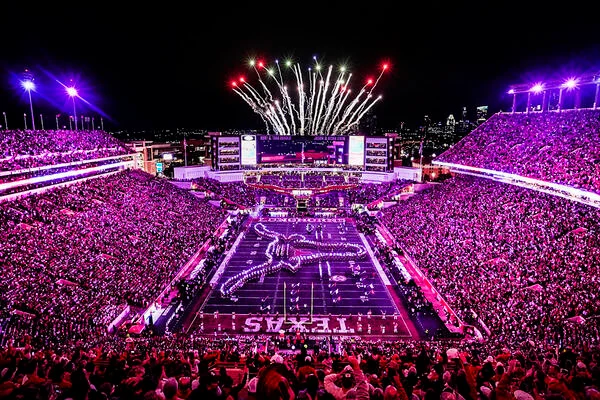
At a time when institutions are funneling millions of dollars into coaching salaries and name, image and likeness deals, calls to reform their runaway spending on athletics—football in particular—have come from as high up as the White House. Amid the spending spree, one man is doing his best to shine a light on what’s happening behind the scenes at athletic departments across the country, from the underappreciated expenses to which politicians are watching football games with university presidents and chancellors.
David Covucci is editor in chief and founder of the newsletter FOIAball, and he has spent much of the last year sending out thousands of public records requests to colleges and universities. He’s gotten his hands on receipts, emails and other records, uncovering how colleges are using a Department of Homeland Security information-sharing platform for surveillance and a draft episode outline for the since-canceled Hulu show on UNC football coach Bill Belichick.
Thanks to the records requests, he can tell you that 38 universities spent $2.8 million on fireworks at home games, and that the University of Mississippi spent the most at $212,480. Renting an American flag big enough to cover an entire football field for one game will set you back $6,900. And in 2024, 42 college football programs spent $736,020 on balloons.
David Covucci
Covucci started FOIAball this past fall after he was laid off from the Daily Dot, an online tech and politics publication. In addition to editing, he ran a public records internship and taught college students how to use national and state freedom of information laws to do investigative reporting. He’s now using his skills to learn more about the inner workings of athletic departments, focusing primarily on college football but with the aim of expanding to other programs. Though the sums can be small, he argues people still want to know where colleges are putting their money.
Inside Higher Ed recently called up Covucci to talk about his work and what he’s learned so far about college athletics and higher ed. The interview has been edited and condensed for clarity.
Q: Why did you want to focus on just college football for your new venture?
A: I think college football is stupid and ridiculous and absurd, and I mean that in the most complimentary sense of the words. I enjoy everything about that. And I actually have always been more of a fan of the off-field stuff. I like watching the game, but I love following the drama around it. It’s the largest business in America that is subject to public records laws. There’s sponsorships, big salaries and big donors and all kinds of things that you would never get to see happening behind the scenes in a big company—like a Fortune 500 company—that you can get because of the way these football teams have grown massively and are still slapped to the side of public institutions. So I try to think of it more as a way to shine a light on the world at large, versus just covering college football.
As you can tell from my stories, I’ve done stuff on surveillance tools and tax fraud; it’s not about what recruit is being courted.
I do think this is a great way to show how big business works and let people sort of see how the other half lives. All these coaches are very lavishly compensated. They’re flying private everywhere; they’re living a good life. It’s not often you can get Mark Zuckerberg’s calendar or his emails or something like that. I love that there is this level of openness and transparency in this massive industry.
Q: How do you decide what records to request?
A: The thing that is really useful is the things you’re seeing out in the world—they’re not lying to you. If you see players traveling to a game on a bus, that bus costs money. I know that if there’s money being spent, there are records.
Q: You’ve been doing this for a while. What areas of spending stand out to you?
A: It’s hard—when an industry like college sports generates $300 million in revenue, does $1,000 matter? I don’t know. I just like to throw it out there and let people kind of decide on their own. But it can be sometimes hard to be like, remember, $1,000 or $100,000 is a lot of money. That’s not just some sort of willy-nilly expense, because these programs are so big and spend so much on all sorts of things … Whether it is balloons or fireworks, or private jets, people want to know what these programs are spending.
Q: In the last year, we’ve seen efforts from universities and state lawmakers to shield some information from the public, particularly related to compensation for athletes. The Louisiana Illuminator and other news outlets recently sued Louisiana State University to receive records related to how the university is using public funds to pay athletes. Are you having a hard time getting records?
A: I don’t think I have a great answer to that, because I came into this at a time when these laws were being passed in state legislatures. These records are already sort of pre-emptively withheld. I haven’t run into schools not wanting to work with me. I don’t think a lot of things that are protected under FERPA should be protected. I think that is wildly overused by schools to withhold records.
I do think—and I try to stress this in any interview—that the people who are fulfilling these records requests are just great civil servants who want to do a good job; they know what the law is and they’re happy to provide you stuff that doesn’t make their university look flattering. They’re just trying to do their jobs, but they are sort of beset by forces around them, [such as] people sending absurd requests bogging them down. I try to be sympathetic to them and understand that they have pressures from university. They’re not trying to delay and stall all the time.
Q: What has spending months going through the public records taught you, if anything, about the state of higher ed and college athletics?
A: This is a very weird system where these businesses that make hundreds of millions of dollars are strapped to the side of schools. I mean, they’ve always existed, but college football is now an insanely big business. It’s very jarring how much the people around college sports have forgotten the college part. You guys are making so much money that you were never making before. These people lost all perspective, and that’s kind of absurd to me, when you’re the ones who are shaping and teaching and conveying values to young people.
Q: Why do you hope people take away from your reporting?
A: I’m really trying to get deep into the money around it and the intrigue. I think the story that really highlights this is giving coaches country club memberships for free. These few people are getting these crazy, lavish perks where Clemson has a travel freeze for its faculty and staff. I understand they generate value for the school, but it goes to show that, like, these coaches have decided that they are more important than the actual teachers and staffers in the school. They would never say that, but it’s very clear that they’re getting private jet hours. They’re getting free company cars. I think it just sort of goes to show how little care and interest the ruling class has in the people who do the hard and important work, like teachers.
There’s always more stuff out there. Whether it’s Bill Belichick getting a TV show, or coaches getting free perks, or all this money spent on fireworks and balloons, it really strips away the kayfabe and the facade and shows what universities really value right now, and that is college athletics more so than college education.
