

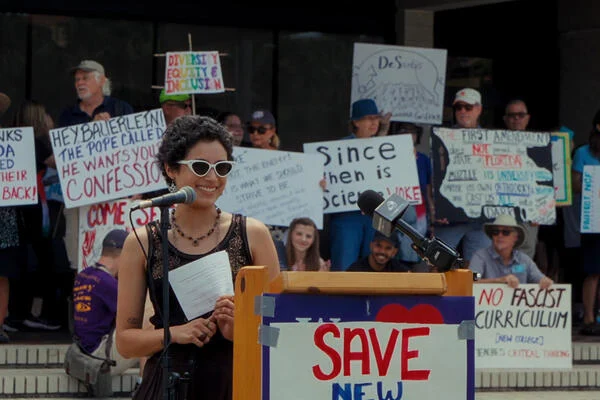
When Governor Ron DeSantis appointed a swath of new trustees in 2023 to reimagine New College of Florida as a conservative institution, it sent shock waves through the small community known for its quirky campus life and free-spirited students.
Subsequent moves by the new board drew national headlines: Trustees quickly fired the president and installed former Republican lawmaker Richard Corcoran. New College subsequently shuttered its gender studies program, dismantled the Gender and Diversity Center and threw out hundreds of books—many on LGBTQ+ themes. Students and professors alike decamped amid the changes, which DeSantis and the new administration argued were necessary to reclaim the small college from the clutches of so-called woke ideology.
As the changes played out, students and a film crew captured tense moments in almost 300 hours of raw footage showing the clash between the New College community and a board and president armed with a mission to transform the institution into a conservative college with a different cultural identity. The resulting documentary, First They Came for My College, debuted at True/False Film Fest last month. It will premiere in Florida on Saturday and continue on the festival circuit. The filmmakers hope to bring it to hundreds of campuses in the fall.
Though top NCF administrators have not seen the documentary, they have blasted it as sensationalized. A New College spokesperson did not provide a comment ahead of publication.
Inside Higher Ed spoke with director Patrick Bresnan and producer Harry William Hanbury, a New College alum, about the documentary, which they shot and produced over three years.
The following conversation has been edited for length and clarity.
Q: When did you start working on this film? What was the moment of inception, so to speak?
Hanbury: When the takeover happened, I and a lot of other alums started paying attention to who the trustees were that Ron DeSantis had appointed on the very significant date of Jan. 6, 2023. We were very worried about them, and there was an immense alumni organizing effort that quickly raised over $200,000 in a little more than a month, created lots of working groups and knitted together this amazing web of solidarity from nothing.
Q: Tell me about shooting the film. You both worked on it, but students also contributed. What was their role?
Bresnan: For me, what was very important with this film was for the students to have agency. I desperately wanted to make a film that college-age students would watch that was in their language. I was a 47-year-old with a 3-year-old at home at the time, and I knew I needed their perspective really badly to make a film that could break through that wall and reach younger students. So what we decided to do as a team very early on was to invest our money in the students instead of in big crews with sound people and expensive cameras. We identified key students at the heart of the story; we bought them iPhones and had weekly meetings with them. It was kind of like an underground film school that we created with the students to document what was happening.
Q: How did you select the students who were featured in and filmed the documentary?
Bresnan: Harry knew the students who were active in some of the resistance groups, so he reached out. And then, being on the ground, we started with the newspaper, because I felt that was really the place to start telling the story. And the professor for [the student newspaper], The Catalyst, Maria Vesperi … saw the value of what we were doing right away. Her students were breaking national news stories. The first characters we started to film with were the student senate president, Libby Harrity, who’s at the front of the protest, and the reporters. Then the next thing I was looking for were the safe spaces where students could talk about this, and that was in the Gender and Diversity Center and also in the student food forest and garden.
Hanbury: I’d say we probably talked to at least 150 students. It was a long process, but I feel like we ended up with this group of students who are each a different facet of the New College experience. They gave a full picture of what it was like to live through this hostile takeover.
Q: The students are presented as sympathetic figures while certain trustees appear to smirk and mock students at times as they are confronted at board meetings. There is a heroes-and-villains dynamic. The film is critical of trustees, the administration and DeSantis; do you feel they were portrayed fairly in terms of the arguments they were making?
Bresnan: I’m 10,000 percent behind the fact that I believe we were fair. At a certain point, we were recording these Board of Trustees meetings with two and three cameras, myself and another alum, and what you see in the film is what happened. So I went to the president of the college, and I said, “Richard, I don’t want to make a one-sided film. Your administration looks terrible from what I’ve been recording to this point. I’m not an interview filmmaker. I like to make films that unfold in real time.” And I told Richard, “I will get a co-director who is an interview specialist, and we will interview you and any Board of Trustee member, we will film with athletes and I will do everything to tell your side of the story.” And he said, “Sure.”
We hired this wonderful crew … and when they were in the air, Corcoran’s chief of staff wrote to us that they had a big issue with our release form, and he cannot do our interviews. It’s the same thing that all of our participants signed, and a grown man is afraid to sign a release form. We spent $100,000 trying to interview Richard Corcoran and tell his side of the story. Do I feel for a second that anything in my film does not explore their world? We explored what we were given access to, and we filmed with incredibly heroic people who are losing their jobs, who are being tormented, who are being expelled, driven out of state and having to sell their homes. I feel zero sympathy for these people.
Hanbury: Their whole MO is to work the ref, to say, “We’re not being treated fairly” and that “leftist indoctrinators are attacking us.” They use the language of liberalism and free speech to criticize their critics, when they are the ones attacking free speech and freedom of thought on campuses.
Q: Do you believe their argument has any merit? This notion that culture at New College had tilted so far off the rails that it required a hard reset and all these changes to personnel and traditions?
Hanbury: None; [the takeover] was pure opportunism. One really interesting fact is that until very shortly before the takeover, Republican politicians in Florida sang the praises of New College. They knew New College was, roughly 10 years before the takeover, the top producer per capita of [science and engineering] Ph.D.s of any public college in the nation. And there was a survey done by the state of Florida in 2022 on viewpoint diversity, and it found that [NCF] students overwhelmingly agreed that they were encouraged to consider a wide variety of viewpoints. Only 10 respondents disagreed. Nearly none of the respondents knew their professors’ political viewpoints. It was an environment, in my experience when I was there and going back talking to students, where people just love to talk, to argue, to debate the world. And I came to New College as the most conservative kid from my Catholic all-boys military school, and I experienced not a second of ostracism or disdain or exclusion because of my beliefs.
I don’t doubt that some 18-year-olds can be overly censorious. But the vision [of the Florida GOP] is that governors should be able to appoint politicians, as DeSantis has in Florida, to run colleges and appoint their cronies to be on the Board of Trustees and then have political operatives determine who gets tenure and what they can teach. You see a dramatic constriction of the freedom of thought.
Q: Was there anything that surprised you in making the film? Any scenes that grabbed you?
Bresnan: I shot two scenes where I started to see this as fascism. I was very hesitant to call it fascism, and then I filmed a scene where I was in the library with a student who was researching what happened to the [missing] books, and we were walking through the library, documenting empty shelves. The university had said these books were gotten rid of because of a leak in the roof and a weeding out that typically happens among older books. What I filmed and documented was that 80 percent of the areas where books had been removed were not near any water damage, and that [in] areas where there was water damage, the books were there.
I also felt it was very important to document safe spaces, so I had been filming the Gender and Diversity Center throughout the two and a half years I was there. It was a wonderful space. People watched movies, talked about their cats [and] collected zines. There was a real effort to document queer history at New College. It was a space for anybody.
One day—the students were not on campus—I was there filming a Board of Trustees meeting and I walked into that space and contractors had been tasked with throwing everything in that space away. Anybody who cares about 19- to 22-year-old kids knows that you do not go into their room and throw all of their things away while they’re out. This space was a collection of the history of the college. None of the students who were in charge of that space were consulted or notified that their libraries, their items, their zines, their clothes were going to be thrown in dumpsters.
New College student Lindsey Bliss Jennings surveys damage to the campus in the aftermath of Hurricane Helene.
First They Came for My College
Q: A lot happened over the timeline you filmed, and New College is still undergoing changes. How did you know when you had reached the end?
Bresnan: I had worked on a previous film about senior year of high school, so I’d always been married to this idea that the film could end on an emotional high at graduation. We had filmed several graduations, and [in 2024] their graduation speaker [Joe Ricketts] had made Islamophobic comments. He was a billionaire who had offered to start an online great books program with New College, so we had four cameras and we filmed that graduation. And at this graduation, the students had been told by Richard Corcoran that if anybody protested for Palestine, they would be expelled without a hearing. During the graduation speech of this billionaire … the students started chanting, “Free Palestine.” In addition to that, [student trustee] Grace Keenan gave a profound speech and said, “We’ve been lectured about our lack of virtue, but I’ve found it’s the adults who are difficult to work with.”
Corcoran brought this billionaire to speak because he thought he was giving millions of dollars to the school. And after that graduation, [Ricketts] completely untangled himself from New College and gave no money. It was this incredibly poetic ending where Corcoran, who had humiliated so many educators, so many students, had the biggest humiliation of his life. You can’t have a better ending to a film than that, where the students regain agency.
Q: Has New College leadership seen the documentary? And if so, what did they say?
Bresnan: They’ve not seen the film because we’re not going to give it to them. They can come to a film festival and buy a ticket and see it. We had one of the best PR moments of our film, when during our world premiere at True/False Film Fest, Richard Corcoran sent out an email denouncing the film to the entire email list of New College with a poster of the film, saying a “sensational film has come out about the New College of Florida.” At the end of this email, it said, “please donate [to NCF].” People saw that email and went and donated to our film that day.
Hanbury: The fact that they haven’t seen the film, but that hasn’t stopped them from claiming that it’s sensationalized, is absurd. Because the film is very close to the lived experience of the people we followed. I think Patrick and the film team did a lot of hard work to distill 300 hours of footage down to its essence and a very honest portrayal of what the school has been like.
Q: What do you hope the takeaway from the film is for viewers?
Hanbury: I feel like this film can help people around the country metabolize the trauma that’s befalling higher education at a much faster rate than we were able to. It took some time to realize what was happening to our beloved institution.
I hope people can experience this hostile takeover through our eyes and students’ eyes and join forces with everyone around them who cares about this issue. One of the paradoxical, unexpected silver linings of this terrible experience is that everyone I know on this project has developed bonds of solidarity across generations, with people in the New College community who are outraged. And we’ve all gotten to work, and I think—to a degree that has not been appreciated in the national media—the New College resistance did a hell of a lot to hold the line against this crack team of far-right education reformers and prevent even worse things that could have happened. A professor in Texas told me that our film was a master class in organizing, and that was one of the best things I’ve heard. So I hope it inspires organizing.
