

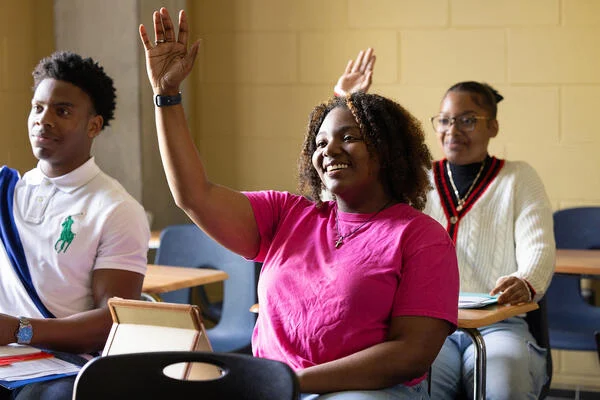
As states look for ways to strengthen college and career pathways, dual enrollment—allowing high school students to earn college credit—has emerged as a key strategy.
Yet researchers at the Community College Research Center argue these programs don’t always deliver on that promise. In many cases, dual enrollment functions as a “program of privilege” for students already on a college track, according to researchers at the center.
Students may also end up taking what CCRC researchers call “random acts of dual enrollment,” or courses that aren’t connected to a clear academic or career pathway, and they often lack access to the advising needed to guide next steps.
At the National Alliance of Concurrent Enrollment Partnerships’ annual policy seminar this week in Washington, D.C., John Fink, senior research associate and program lead at CCRC, gave a presentation outlining how state funding structures shape outcomes, from how much support colleges receive to how those dollars are distributed.
He also highlighted CCRC’s Dual Enrollment Equity Pathways (DEEP) model, which focuses on designing programs that intentionally support underserved students by partnering with middle and high schools. The approach emphasizes outreach to underserved schools, alignment with college and career pathways, comprehensive advising, and high-quality instruction.
Fink answered five questions for Inside Higher Ed about how states and colleges can rethink dual enrollment to better align with students’ goals.
This interview has been edited for length and clarity.
1. Dual enrollment is often framed as expanding opportunity, but you’ve noted it can function as a “program of privilege.” In today’s landscape, who is most likely to benefit from these programs—and who tends to miss out?
There’s been a lot of research over the past couple of decades on the benefits of taking a dual-enrollment course. More recently, researchers have taken up who can benefit—like which particular subgroups of students. Some of the research I shared was summarizing work that my colleagues at CCRC and others have done, looking specifically at the benefits to Black, Latino and low-income high school students.
Dual enrollment, when implemented well, can be this real college-access strategy. And, of course, the challenge is that many of these same groups who are underrepresented in higher education are also underrepresented in dual-enrollment programs. There are policy barriers—for example, in a lot of states, students and families are paying to participate in dual enrollment, so that can be a big barrier.
In states that have really expanded dual enrollment, unless there are strategic levers to equalize access, there can also be increases in gaps in access. What I think is encouraging is that there’s a lot of variation in some districts. CCRC found about one in five school districts didn’t have a gap in access for Black or Latino students. Why is that the case? Is it explained by their practices or something else? So that’s really motivated our field research on going to places that have closed gaps and also have successful outcomes for dual-enrollment students.
The answer is there are gaps, there are these programs of privilege. But there are clear examples of what it looks like when it’s done well.
2. You’ve described how some students end up in what you call “random acts of dual enrollment.” What are the consequences of that lack of structure for how students move into and through college?
The consequences are a real missed opportunity of the dual-enrollment course being transformative for students, in that it shows them that they can do college and that it connects to what they’re interested in. When people use the phrase “random acts,” it’s just when there’s not a real connection to purpose or intentionality for students. It’s just a missed opportunity, because having a more purposeful experience can be a much stronger motivator for students and a connection to what they see is relevant and why they would even want to continue in college after high school.
There’s been a lot of effort to push students into college after high school, and that is true—you do see stronger returns to college. But as more students, and just folks in general, are questioning the value of college, I think playing to the pull factors—like what’s going to pull students into college, not just push them in—the pull is more connected to students’ interests and relevance. So when it feels random or disconnected from students’ interests or other things that they’re doing in high school, it’s a missed opportunity to fully utilize the potential of dual enrollment.
3. The DEEP model emphasizes advising, pathway alignment and academic supports. In your research, how do those elements shape students’ ability to actually build momentum toward a credential?
The DEEP framework has four areas of practice, which are evidence-based best practices around dual enrollment, such as expanded outreach to underserved schools and students, aligning the dual-enrollment courses to college pathways, and providing advising and support for dual-enrollment students to explore and plan that.
This is really about building students’ academic confidence and connection to what they might want to do after high school. That sort of high-quality instruction is that key component of the framework. It’s a research-based framework, and we developed it because it’s based on what we know works well and guides pathways in dual enrollment. The goal is to help practitioners and policymakers think through what they are prioritizing in their programs.
4. Looking across states, where are you seeing dual enrollment working especially well?
Texas is a great example. They have created really good incentives for a more purposeful approach to dual enrollment. The first thing it did was create the FAST Scholarship, which is free dual credit for low-income students. By making it free across the board for low-income high school students, that has created the incentive of increasing participation among those who could really benefit from a jump start on college in high school for free.
The second thing it did, through the performance funding, is it changed the funding model so that colleges are getting some of their performance funding based on the number of dual-credit students who hit 15 credits. That’s a strong incentive, because it’s really helped colleges be motivated to have students gain not just access to dual credit, but substantial college momentum through dual-credit courses. You could argue that creates an incentive for colleges to try to get more, especially low-income students, to its free-credit mark, to kind of spread around the benefit of dual enrollment to more students.
5. You’ve described that some institutions view the work of dual enrollment as an “office of one.” Looking ahead, what are the biggest opportunities—and risks—for states as they rethink how to fund and scale dual enrollment?
I think the sentiment you hear from folks—especially because the field is growing so much, with so many more dual-enrollment students every year—is that there are real growing pains. Just in the last year, dual enrollment grew 13 percent, and it’s close to three million students now every year. I think the folks on the front line doing this work are feeling that, trying to serve more high schools and more students with the same staff.
This phrase “we’re an office of one” or a “department of one” captures the disconnect between the size and significance of the dual-enrollment population and the specific staff dedicated to serving that population. Some colleges are catching up faster than others—reallocating resources, growing the dual-enrollment staff or being more strategic. It’s really about adding more resources to the staff specifically focused on dual enrollment, and also working with other college support staff—in admissions, marketing, academic departments overseeing this work, the registrar’s office, institutional research—working with those core college functions to say, how are we serving dual-enrollment students, which now make up a third of our population?
So people are trying to think this through. It means taking a look at organizational structures, staffing and functions, and that can be challenging. But when you see colleges do this well, it requires leadership from the institution—including boards—to understand this work and support it.
Get more content like this directly to your inbox. Subscribe here.
