

Get stories like this delivered straight to your inbox. Sign up for The 74 Newsletter
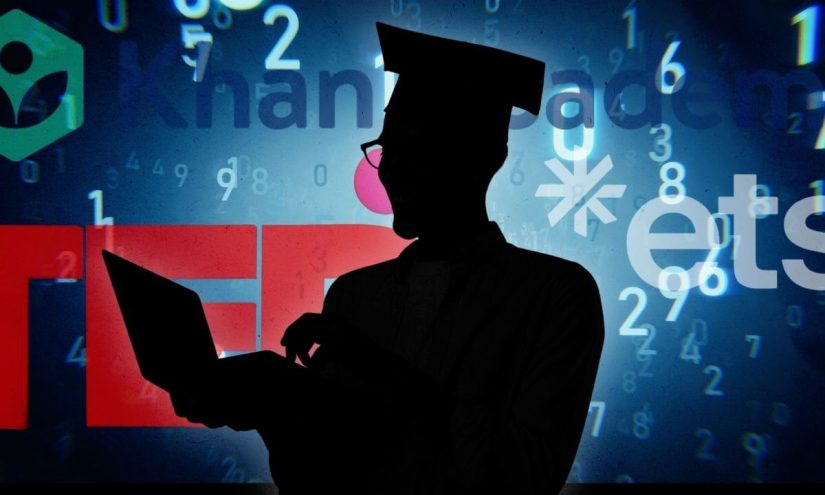
Three well-known but very different names in nonprofit education say they’re coming together Tuesday to launch an improbable enterprise: a new, AI-focused college, designed for a world in which artificial intelligence is reshaping what employers want. It promises a bachelor’s degree in applied AI, delivered almost entirely online in as little as two years — for less than the price of a used Toyota Corolla.
Applications are expected to open in 2027 for the Khan TED Institute, a joint project of Khan Academy, TED — the purveyors of the popular TED Talks — and the Educational Testing Service.
“I think there’s always been, frankly, some need for a program like this,” said Khan Academy founder Sal Khan. Many people, he said, can’t afford a college degree or can’t take the time out of their work lives to attend four years of classes. “It could be that they have pursued a degree, but it’s not giving the signal that would give them the opportunities that they would want.”
Another founder, Amit Sevak, who leads ETS, acknowledged that they are still working out many of the details, but that the new institution could someday enroll “tens of thousands” of students, rivaling flagship state universities. Sevak said he’s “100%” anticipating that its instructors will be humans, most likely a large network of adjuncts.
“We still believe in the value of a human teacher,” he said. “We think that there’s so much socialization and collaboration that takes place [in the classroom]. There’s also the classic need for classroom management and some pedagogical oversight over the assessments.”
Here are five things you need to know about the new enterprise:
1. It’ll offer a bachelor’s degree in applied AI in various fields such as business, marketing, human resources, healthcare and more.
The college will offer a full undergraduate bachelor’s degree organized around three pillars: core academic knowledge — math, statistics, economics, computer science, science, history and writing — applied AI skills and “durable” human skills such as communication, leadership, collaboration, peer tutoring and public speaking.
Early employer partners include Microsoft, Google and Replit, an AI app development site.
At These Universities, Using AI Isn’t Shunned — It’s a Graduation Requirement
2. It’s expected to be competency-based, cost less than $10,000 and take as little as half the time of a traditional bachelor’s degree.
The college’s founding partners say its total cost will likely be under $10,000, a fraction of the average cost of a four-year degree.
Amit Sevak
Rather than requiring four years of seat time, Sevak said, the institute is built around a competency-based model, offering students the opportunity to advance when they demonstrate mastery. That means students could potentially complete the degree in two to three years, he said, depending on how quickly they demonstrate required competencies.
That opens it up to many different kinds of students, he said, including motivated high schoolers who want to earn undergraduate credits quickly before graduation, working adults seeking advancement in their jobs and students already enrolled in traditional colleges who want to stack an AI credential on top of their existing undergraduate credits.
Khan said the new college “is something I’ve thought about doing in some way, shape or form, for many years, and the changes within the job market, because of AI, only accelerated that.”
He said the idea came out of conversations with TED chairman Chris Anderson about a year and a half ago. “We started saying, ‘It feels like there’s something powerful between Khan Academy and TED. We’re both learning organizations. Khan Academy is known for academic learning from K-through-14. TED is known as [embodying] lifelong learning. And it’s about human connection. And it feels like we both have fairly unique brands in the not-for-profit space and the education space.’”
Khan later spoke at an ETS trustees dinner and got to know Sevak.
“They’ve been looking at the same things,” he said, “and they’ve also come up with a framework on durable skills and thinking about ways to assess them. And we realized, ‘Look, the world needs this. And if the three of us come together, this will be very credible and hopefully has a high chance of helping a lot of people.’”
3. It’s an “AI-first” institution, weaving artificial intelligence into how courses are designed, taught and assessed.
Sivak said courses will be shaped by AI and teaching will be supported by AI agents, software systems that can tutor students, answer questions and provide feedback. And students will be prepared for work in “AI-native” environments.
Instruction will likely be 100% online at the college’s launch, with an emphasis on asynchronous coursework to accommodate students in different time zones and life circumstances. Over time, Sevak said, they’ll likely explore a hybrid format.
4. Khan Academy will provide the college’s learning platform and pedagogical infrastructure, despite its founder’s tempered enthusiasm about AI and learning.
TED, the conference organization best known for its short, idea-driven talks, will incorporate its content into the curriculum, giving students access to live talks, Q&A sessions and community-based learning with TED speakers.
College Students ‘Cautiously Curious’ About AI, Despite Mixed Messages from Schools, Employers
And ETS, the testing and measurement organization that produces the GRE and TOEFL tests, will contribute its assessment expertise, said Sevak.
Khan Academy, the popular free tutoring website, which has about 190 million registered users and operates its own Khanmigo AI chatbot, will offer its technology to deliver the college’s coursework, organizers said. Khan, who founded it in 2008, will hold the title of “TED Vision Steward” in the new partnership.
Sal Khan
The announcement comes just a few days after Khan told Chalkbeat that the learning revolution he predicted in 2023, upon Khanmigo’s release, hasn’t happened.
In September 2022, Khan and Kristen DiCerbo, the organization’s chief learning officer, were among the first people outside of Open AI to get access to GPT-4, the large language model that at the time powered ChatGPT. Their experiments gave rise to a revolution in Khan’s thinking: In 2023, he delivered a TED Talk in which he predicted “the biggest positive transformation that education has ever seen,” saying we’d soon be able to give “every student on the planet an artificially intelligent but amazing personal tutor.”
In 2024, Khan’s book, Brave New Words, bore the subtitle “How AI Will Revolutionize Education.”
But more than three years after Khanmigo’s launch, Khan admitted, “For a lot of students, it was a non-event. They just didn’t use it much.”
A Cautionary AI Tale: Why IBM’s Dazzling Watson Supercomputer Made a Lousy Tutor
A few students, he said, have used the AI chatbot readily, while others haven’t. AI tutoring, he concluded, doesn’t necessarily motivate students to learn or fill in knowledge gaps they need to learn more. He’s still optimistic about AI in education, but also sees its limits. ”I just view it as part of the solution,” he said. “I don’t view it as the end-all and be-all.”
On Monday, Khan told The 74 that AI is “just going to be part of our arsenal to help make more engaging tools. Maybe we’ll be able to give more rich assessment practice. Instead of having multiple-choice questions, you can start to have ‘explain your thinking’ [questions]. So it starts to open up the aperture.”
5. It’s very much a work in progress.
Speaking four days before the launch, Sevak admitted that nearly everything about the venture “is still evolving,” and that the team is “workshopping the pedagogical design” of the new college.
Rethinking College Admissions and Applications with an Eye on AI
Sevak said the institute is in talks with regional and national organizations that can offer “the highest form of accreditation,” a step that would set it apart from a growing number of online certificates, micro-credentials and boot camps.
“We’re really in the early days, and it’s just going to take some time for us to adapt,” he said.
The college’s curriculum isn’t yet finalized and applications are 12 to 18 months away. Likewise, the specific structure of its hybrid and asynchronous models, its faculty roster and the full range of majors are all still in development.
“Our intention is, over time, to have a whole range of specializations,” said Sevak. But the program’s core is designed to prepare students “to be really AI-centric” for a new reality. “We’re seeing [AI] as ripping through the economy,” creating a lot of uncertainty for young people.
More to the point, said Khan, “Work is changing very fast. AI is changing everything.”
Did you use this article in your work?
We’d love to hear how The 74’s reporting is helping educators, researchers, and policymakers. Tell us how
