

Join our zero2eight Substack community for more discussion about the latest news in early care and education. Sign up now.
Children and staff at Second Street Youth Center in Plainfield, New Jersey, are well-acquainted with lockdown drills in the event of a fire or an active shooter.
More recently, though, the preschool decided to establish protocols for another kind of emergency: the presence of Immigration and Customs Enforcement agents in the area.
Ever since the start of the second Trump administration, when immigration enforcement activity across the country intensified, staff and families have experienced extreme stress and anxiety about the possibility of masked agents apprehending children at their own schools, said Leah Cates, executive director of Second Street Youth Center. (Previously, education settings like Second Street would’ve been protected from immigration raids under the so-called sensitive locations policy, but the administration rescinded that designation in January 2025.)
Cates is glad she put that new lockdown protocol in place, she said, because they’ve had to activate it twice already.
Head Start Providers Fight to Claw Back Protections from ICE Enforcement
One of those times, a teacher heard a young boy at the school yell, “Pistola! Pistola!” — Spanish for “gun” — after he saw, through a window, an ICE agent with his weapon drawn, trying to detain someone on the street right outside the school.
“We had to pull our children off the playground, bring them in and immediately go into lockdown,” Cates said.
Some children go on walks in the community with teachers throughout the day, she added. During lockdowns, the staff use radios to communicate about the presence of ICE and determine whether groups on walks should return to the school or go to a nearby church or the fire department to seek immediate shelter.
Second Street Youth Center, a preschool in Plainfield, New Jersey. (Leah Cates)
Their fears are not unfounded. So far, five of the 210 children enrolled in the state-funded preschool, which serves ages 3 to 5, have experienced a parent or primary caregiver detained by ICE, said Cates, who is keeping track of the impact on her school community. Many other students have relatives who have been detained, deported or otherwise apprehended by the federal agents. More than 80% of the students are from immigrant families, she added, and most are from South and Central American countries.
Second Street offers just one example of the terror echoing through homes and early childhood programs across the country, in red and blue states, in rural and urban communities, and in documented and undocumented families.
Researchers at the Center for Law and Social Policy, a national, anti-poverty nonprofit, have been examining the impact this administration’s immigration agenda is having on young children and their caregivers.
“Care providers are not feeling secure. Parents are struggling to feel safe themselves. Children are internalizing these stressors and these pressures.”
Kaelin Rapport, CLASP
Between June and December 2025, CLASP staff held focus groups with 56 “at-risk” immigrant parents and primary caregivers of 74 children ages 6 and under. They also interviewed nearly 70 individuals who provide services to these families — many of them as early care and education providers, but also some home visitors, health care workers and others. Their findings, which anonymize the participants, are detailed in a pair of reports — one centered on the experiences of young children and their immigrant families, and another focused on early care and education providers in their communities.
The interviews were conducted in seven states: Colorado, Georgia, Illinois, Michigan, New Jersey, Texas and Washington. In those states, immigrant families with young children range from 13% of the population in Michigan to 41% in New Jersey, according to an analysis from the Urban Institute, which combines data from 2022 and 2023. Nationally, about 24% of children ages 5 and under have at least one immigrant parent.
What emerged from the research is a clear picture of communities that are experiencing toxic stress and trauma, said Kaelin Rapport, policy analyst at CLASP and an author of both reports.
“People are really scared, and they’re struggling immensely,” Rapport said. “Care providers are not feeling secure. Parents are struggling to feel safe themselves. Children are internalizing these stressors and these pressures.”
The concern that many immigrant adults feel, Rapport added, is preventing some of them from leaving their homes, whether it’s to go to the grocery store or to work.
“It’s confining the entire family inside this emotional pressure cooker,” Rapport said.
Many parents attempt to shield their young children by avoiding conversations about immigration enforcement, yet their fears and anxieties still permeate the household.
For Children Whose Parents Are Detained or Deported, a Scramble for Safe Harbors
“It was very clear that children are feeling the trickle-down effects of stress,” said Suma Setty, senior policy analyst for immigration and immigrant families at CLASP and an author of the two reports.
During an interview, the director of a child care center near Dallas shared with Setty that, before 2025, children in the program used to be so curious about visitors who came to the center. Now, when they see new faces, they hide behind the teachers’ legs. “That’s been a marked change she has observed,” Setty said.
Cates, who was interviewed for the CLASP reports and shared details about the experiences of her preschool community with The 74, has seen the way information about immigration enforcement reaches children at Second Street — and how they respond.
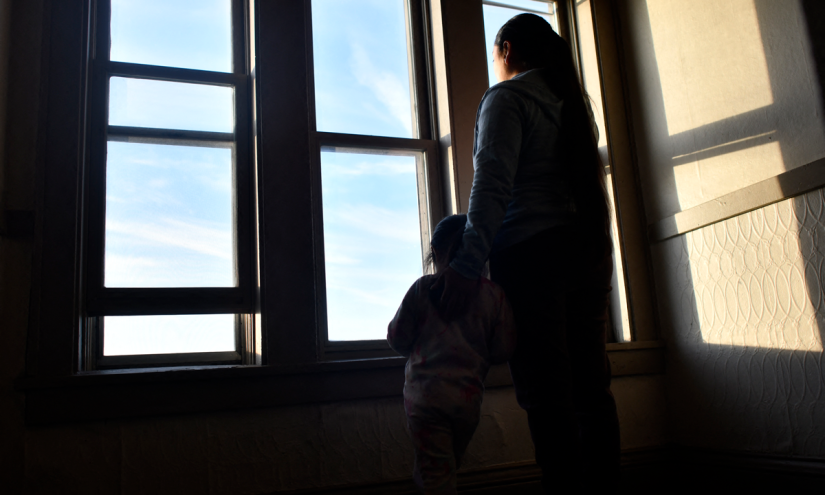
The window the boy was looking out of when he saw an ICE agent trying to detain someone on the street right outside the school (Leah Cates)
It’s a regular practice at the preschool for staff to ask children how they’re feeling each day, she shared. One day, a little girl said she was scared. Her teacher told her she is safe at Second Street. But the girl said, “No, ICE can get me,” then started to cry, Cates recalled.
“The child knows,” she said. “They may not understand everything, but they know someone was taken in their families. They see the upset of parents, the upset of family members.”
Then, she added, they take what they learned and tell their friends. Cates and other staff have overheard children talking about ICE on the playground, she said.
“We think we’re doing a great job of shielding children, but little children have big ears. They put their listening ears on, and they hear everything,” she said. “We’re not doing as good a job as we think. Those 3-, 4- and 5-year-olds are hearing, and being affected by, the trauma.”
In interviews for the CLASP report, Rapport said, several families and early care and education providers described children as “clingy” now. Some children who had been sleeping independently through the night are now insisting on sleeping in bed with their parents. Others, he heard, are less friendly, more emotionally reactive, more frightened of strangers and less adaptable to changes in routine.
As for the caregiving staff he interviewed, Rapport said a word that comes to mind to describe their predicament is “desperation.” They are stressed and traumatized from the past 15 months too. They’re also depressed, burned out and dealing with compassion fatigue.
“People who work in child care and early education do it because they love children and want children to succeed in life. They want children to have a healthy upbringing,” Rapport said. “They pour so much of themselves into that work. They’re pouring from that well, and sometimes that well runs dry … for themselves and their families.”
Most early care and education providers are underpaid, working in under-resourced programs, and in some cases are immigrants themselves or have immigrant family members to think of, the researchers said. Yet, as they write in the report focused on providers, “ECE service providers are being asked to do more than the work that they trained for; they are asked to be immigration law experts, administrative law experts, second parents, and even work for free.”
That certainly rings true at Second Street Youth Center.
In addition to the new lockdown protocols, the preschool has made changes to other procedures.
The program has implemented “very stringent rules” around access into the building. “If we don’t recognize who you are, we aren’t letting you into the first doorway,” Cates said. The maintenance staff, as part of their duties, now regularly walk a two-block radius around the building to scan for ICE activity. Families know to text school staff about any ICE activity they’ve seen or heard about in the area, and staff then distribute the message to all families so they can make alternative pick-up arrangements for their children.
On top of that, Second Street has held events to educate parents about their rights. The school partnered with an immigration attorney who volunteered to help families make a plan for their children in the event something happens to them.
The work is taking a toll on staff, she said, noting that staff are increasingly asking for a day off here and there because “it’s just all too much.”
“But my staff … understand the No. 1 concern is the health, safety and well-being of children,” Cates emphasized. “Before we do anything else, our job is to keep children safe.”
Did you use this article in your work?
We’d love to hear how The 74’s reporting is helping educators, researchers, and policymakers. Tell us how
