

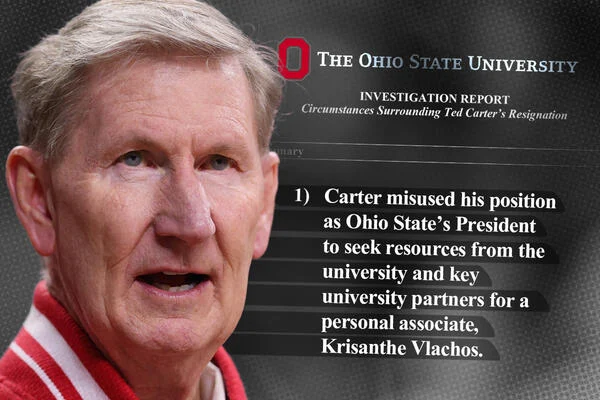
An investigative report released by Ohio State University Tuesday found that former president Ted Carter inappropriately used his position for two years to benefit a “close personal associate.”
Carter resigned in March after admitting to an inappropriate relationship with a woman later identified as Krisanthe Vlachos, who wanted to use public resources to benefit her personal business. While the nature of that relationship was not clear when Carter stepped down, the new report sheds light on how he sought to steer university resources to Vlachos. And while he was not found to have broken any laws, the report determined that Carter misused his position, “betrayed Ohio State’s shared values” and violated university policies. While the university found that staff mostly acted appropriately, the report acknowledges that some senior officials ignored clear warning signs raised by other employees.
The report indicates that Carter asked Ohio State officials to consider Vlachos for employment, repeatedly sought to use university resources to advance her idea for an app to connect veterans to benefits, requested staff and technical support for her podcast, and took at least five business trips out of state associated with Vlachos. Carter also floated the idea of tapping university donors to fund the app, according to the report.
The former president persisted despite staff pushback and questions about efficacy.
“For almost two years, Carter asked numerous individuals inside the university to provide inappropriate assistance to Vlachos, a close personal associate. His efforts were wide-ranging and extensive. Carter sought resources and assistance for Vlachos despite there being no clear nexus to a viable service or product that she could deliver that would serve Ohio State’s interests,” university officials concluded in the 47-page report. “On the contrary, Vlachos’ Callout Podcast appeared to narrowly focus on connecting veterans with utility industry jobs that did not require a college degree, and her related App idea was undeveloped.”
(Carter did not respond to a text message from Inside Higher Ed seeking comment.)
Carter is believed to have met Vlachos at an event for veterans held in Washington, D.C., in March 2023, when he was still president of the University of Nebraska system, before he joined OSU in January 2024. He began leveraging Ohio State resources for Vlachos shortly thereafter.
In February 2024, Carter initially asked an Ohio State staffer to help draft a letter of recommendation for Vlachos’s son, who was applying for a program in the Navy. That is the first documented case of Carter seeking university resources on behalf of Vlachos in any way, but by July 2024 he sent her résumé to human resources and asked that she be considered for a job. Although Vlachos applied to five jobs with Ohio State, she was never formally interviewed.
From there, Carter’s requests appeared to become more frequent and audacious.
In fall and winter 2024, Carter pushed staff to help produce a podcast hosted by Vlachos on veterans’ issues, which he also appeared on as a guest. He also urged a university official to hire her as a consultant, which did not happen, and asked staff to find space on campus for a play that she was involved with. Staff members later told investigators she blamed Ohio State for weak ticket sales for the play and that she seemed to be using it to promote her podcast.
Carter also tapped university staff members and outside relationships in a failed effort to help build and launch Vlachos’s app. The report indicates that Carter connected Vlachos to multiple staff members to discuss the idea. However, Ohio State staffers quickly dismissed the idea, noting that Vlachos appeared to have little technical knowledge and the app was not of interest to the university. But when staffers shut the idea down, Carter called Chris Kabourek, senior vice president for administration and planning and senior adviser to the president, to help lobby for it. Carter also referenced an unrestricted gift of $100,000 from a donor that could be used. Kabourek then drafted a proposal that included $20,000 in Ohio State funding for the app. However, that proposal was not acted on.
The report indicates that Vlachos believed Carter was pitching the idea to Ohio State megadonor Les Wexner. But an attorney for Wexner told university investigators that his client never had conversations with Carter or anyone else regarding Vlachos or her app idea.
As the app idea stalled in university quarters, Carter and Vlachos sought outside funding.
Carter used his personal connections as president to introduce Vlachos to outside groups such as JobsOhio (which later sponsored her podcast), the Ohio Department of Veterans Services, the Ohio National Guard and Student Veterans of America. (Carter, who served on the SVA Board of Directors, also nominated Vlachos for a board seat, but she was not selected.)
Like Ohio State, outside groups balked at the app idea.
After the Ohio Department of Veterans Services declined to fund the app following what the report describes as a “poor and awkward presentation” by Vlachos in late 2025, Carter called ODVS director General John Harris to encourage him to support the proposal. Given Carter’s push for the app, Harris said “he was starting to wonder” about the nature of their relationship.
While Carter and Vlachos sparked suspicions in some outside observers, the university report noted that the president largely concealed “the pervasiveness of his efforts” by spreading those requests through at least 14 different employees, using personal email and taking personal meetings. Although the full extent of Carter’s efforts to steer resources to Vlachos were not known until the investigation, some staff members did raise questions while it was ongoing. Several employees raised concerns in conversation with other university personnel about Carter’s interactions with Vlachos, according to the report, but “lacked factual evidence of an inappropriate relationship and, therefore, felt speaking out would not be received well.”
Two staff members allegedly took their concerns to Kabourek. In return he told them to raise their concerns with Carter directly. The report suggests a “refusal or unwillingness” by Kabourek “to respond appropriately to such concerns” and states that directing junior employees to confront the university president was “a dereliction of duty” by Kabourek.
Kabourek, who followed Carter from Nebraska and resigned April 13, was excoriated in the report. Investigators found he “went far beyond any other employee in supporting Carter’s efforts to assist Vlachos, both inside and outside the university; he failed to stop or report those efforts himself; and he failed to appropriately address concerns raised to him by other employees.”
(Kabourek has since been hired as senior vice president and chief financial officer at West Virginia University. He did not respond to a request for comment sent through WVU. The university declined to comment on concerns raised in Ohio State’s investigative report.)
Aside from Carter and Kabourek, the report credited employees for making the right decisions, though they did note some staff members could have acted more seriously in response to the concerns raised. Ohio State highlighted the actions of employees in a statement included with the report, noting that despite Carter’s alleged impropriety, OSU personnel largely prevented misuse of resources.
“We are grateful for the careful and comprehensive work that went into finalizing this report,” John W. Zeiger, chair of the board, said in a statement. “Its findings regarding our former president are deeply disappointing, but it is gratifying the university’s systems and processes— and the people charged with implementing them—prevented misuse of Ohio State’s resources.”
