

Touro University, an institution composed of a system of nonprofit undergraduate, graduate and professional schools across seven states and four countries, has launched the Touro University Antisemitism Institute in response to rising incidences of antisemitism in academia. As the largest university in the U.S. under Jewish auspices, Touro created the institute to confront and combat antisemitism on college campuses and beyond through avenues such as research dissemination, professor trainings and yearly conferences.
It’s intended to be a hub where faculty, students, researchers, community members and others can be equipped to understand, counter and prevent antisemitism at the intersection of academic research, legal response, policy and street-level education.
“There’s been a lot of discussion – lately and by very prominent figures – about the efficacy of this work, and many are suggesting that dollars should be shifted away from antisemitism-related advocacy and programming,” says institute director Malka Fleischmann. “But, in essence, that would be the surrendering of our youth’s values and character education to a shallow and ever-fluctuating news cycle. So, we’re keeping our ears to the ground, finding ways to augment the work of our peer organizations, and intervening in the lives and minds of young people in the classrooms and on the platforms where they’re becoming this world’s next custodians. As such, they’ll be tasked with sustaining the civility, compassionate curiosity and love of diversity that are critical to the health of the university campus, the marketplace of ideas and to society at large.”
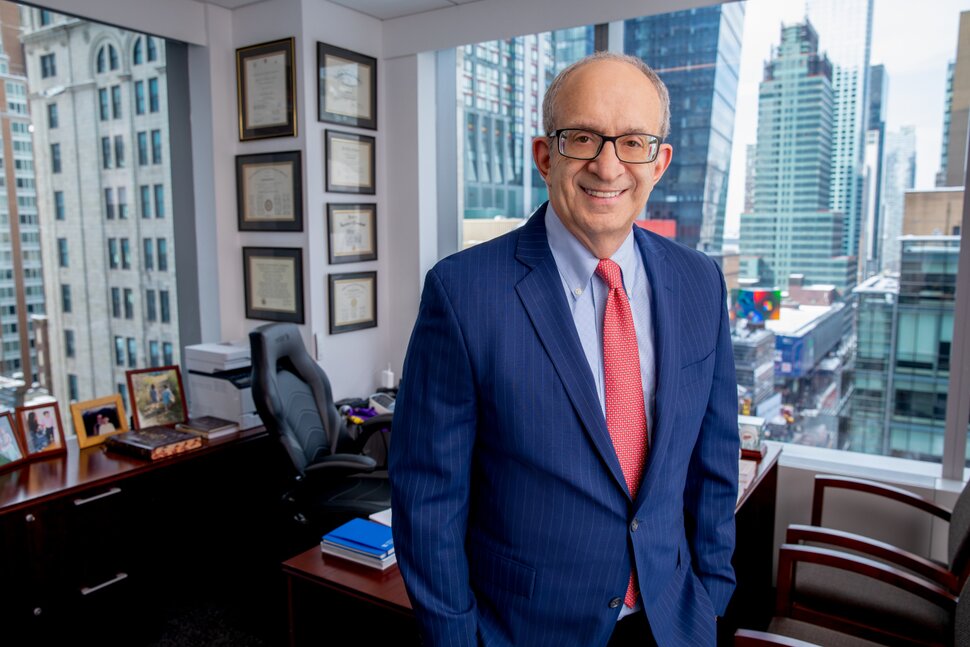
U.S. news recently discussed the institute with Dr. Alan Kadish, president of Touro and its medical school, New York Medical College. The interview has been edited for length and clarity.
Q: The institute is a result of Touro seeing a need to more directly address antisemitism in classrooms, particularly after open displays of hate against Jewish students spiked – notably on some U.S. college campuses – during the conflict that began in fall 2023 when Hamas committed a deadly attack on Israel near Gaza. What does antisemitism in academia look like and why is it important to address it?
Antisemitism in academia takes many forms, and that’s part of what makes it so insidious. It shows up in classroom discussions where Jewish students feel they cannot speak freely, in campus events where Jewish identity is openly mocked or vilified, on social media posts and campaigns targeting Jewish students and faculty, and in institutional responses – or nonresponses – that send a clear message about whose safety matters. While experiences differ among students and campuses, one of the most concerning aspects of the rise in antisemitism is the social ostracism that many students feel. Since Oct. 7, 2023, we have seen antisemitism on college campuses surge and become more visible, more aggressive and more normalized than at any point in recent memory. A recent survey by the Anti-Defamation League, Hillel International and College Pulse indicated that 83% of Jewish college students reported having experienced or witnessed antisemitism at their university after Oct. 7. That is not a fringe problem or one-off event. That is a systemic failure. Why does it matter? Because the college years are the most formative in a young person’s life. What students see, hear and experience during those years shapes how they view the world and their place in it. If we allow antisemitism to take root in academia, we are not just failing Jewish students. We are failing the entire educational mission on which universities are built.
Q: What is the multipronged approach Touro will take with the institute at the forefront?
We believe that lasting change requires working on multiple fronts simultaneously, because antisemitism is not a single problem with a single solution. Through the Touro University Antisemitism Institute, we are committed to educating and partnering with professors at universities nationwide to teach rigorous courses on antisemitism and Jewish peoplehood within their own disciplines. We are investigating the causes and impact of antisemitism so that the conversation is grounded in evidence. We are studying how existing laws can be used to combat hate and evaluating where new legislation may be needed. We are examining the role social media plays in the spread of antisemitism because that is increasingly where the battle is being fought. In addition, we are training the next generation of Jewish civil rights attorneys to handle real cases in the field, and convening leaders across academia, policy, law, media and business to develop new strategies together. No single initiative can solve this. A multipronged problem needs to be addressed everywhere it is found.
Q: How widespread has antisemitism facing Jewish college students become?
The numbers are stark. Directly following Oct. 7, there was a surge in antisemitic incidents on campuses across the U.S. Jewish college students reported feeling unsafe and 83% said they witnessed or experienced antisemitism on campus. That amounts to nearly four out of five Jewish students. And I believe that figure, as troubling as it is, may undercount the problem, because it only captures what students recognize and are willing to report. Antisemitism, in many instances, goes unacknowledged, unreported or dismissed as something else entirely. In fact, 92.5% of students who responded to the ADL survey did not report antisemitic incidents they witnessed or experienced on campus to campus authorities. What we saw on campuses in the months following Oct. 7 – the encampments, the rhetoric, the targeting of Jewish students and faculty – was not a sudden eruption. It was the external expression of something that had been brewing and building for years. The difference was that it became impossible to ignore. When pro-Palestinian student protesters entered a Cooper Union (for the Advancement of Science and Art) building targeting Jewish students who were studying in the library, banging on windows opposite them and a locked door to the library while chanting “globalize the intifada,” this was impossible to ignore. When a series of posts on a student website threatened violence against Jewish students at Cornell University, urging people to kill Jews on campus and saying that they needed to be “eliminated,” this was impossible to ignore. When a swastika was found in a residence hall at Bucknell University, this was impossible to ignore. Jewish students’ feeling unwelcome and unsafe on campus must be addressed.
Q: What are you seeing in terms of both the position and direction of mutual respect and tolerance on U.S. college and university campuses in general, and among academia in particular?
I am concerned. What I have observed over the past several years is a troubling erosion of the norms that make genuine intellectual discourse possible: the shared commitment to hearing difficult ideas, engaging with them seriously, and treating the people who hold them with basic dignity. On too many campuses, that commitment has weakened. Identity has become a proxy for credibility. Discomfort has become a reason to silence rather than engage. And Jewish students have disproportionately borne the cost of that shift. That said, I am not without hope. There are faculty members, administrators and students at universities across the country who are pushing back, who understand that a campus that is unsafe for Jewish students is ultimately unsafe for everyone. The question is whether institutions will support those voices or continue to equivocate. That is the challenge our institute is designed to help address.
Q: The institute’s first initiative will be this summer with The Touro University Teaching Fellowship to Combat Campus Antisemitism. Touro law professor Mark Goldfeder, who will lead the fellowship program in association with the National Jewish Advocacy Center, says it “is about reclaiming the campus as a serious place for scholarship, fairness and safety through the most powerful tool available to universities – the classroom.” Can you talk more about the teaching fellowship?
If the university is going to be saved, it will be saved in the classroom. For too long, too many campuses have drifted away from their core mission. Instead of teaching students how to think, they have rewarded faculty and administrators who tell them what to think. The result has been an environment in which ideology crowds out inquiry, activism displaces scholarship and Jewish students are too often left to navigate hostility that would be instantly recognized as intolerable if directed at almost any other minority group. The problem on many campuses is not simply that bad ideas exist. Universities are supposed to be places where bad ideas are exposed and challenged. The deeper problem is that too many bad actors captured the terms of discussion itself. This fellowship is about helping faculty from all disciplines reclaim the classroom for scholarship, fairness and serious intellectual engagement. The goal is not to shut down debate, but to restore it. The teaching fellowship will provide structured support to help faculty build courses that work in the real world. Participants will gain practical teaching tools to develop serious content around the history of U.S. and global antisemitism, legal frameworks governing discrimination and civil rights protections, as well as advocacy tools to understand and counter bias, hate crimes and systemic discrimination.
Q: The institute is also intended to be sort of an umbrella for Touro’s existing work in the antisemitism space. What are the various projects and programs that will come under one roof, so to speak?
One of the things I’m most proud of is that we are not starting from scratch. Touro has been doing this work for years, and the institute is bringing it all together under one roof for the first time. That includes the Touro Institute on Human Rights and the Holocaust, which has been promoting tolerance and human rights through advocacy and education for many years. It includes the Antisemitism Law Clinic at Touro Law Center – the nation’s first law school clinic dedicated specifically to combating antisemitism, that we launched in the wake of Oct. 7. It includes the Jewish Law Institute at our Jacob D. Fuchsberg Law Center, which serves as a national clearinghouse for research at the intersection of Jewish law, American law and legal ethics. And it includes a History of Antisemitism course that is open not just to Touro students but to the broader community. The institute gives all of this work a common home, a shared identity, and the ability to coordinate and amplify across programs in ways that weren’t possible before.
Q: Touro has an international presence. How do you see the institute helping to make a difference abroad, not just in the U.S.?
Antisemitism is not an American problem but a global one. Touro has campuses and partnerships in Israel, Russia and Germany and our reach into those communities gives us both a responsibility and an opportunity to extend this work beyond our borders. At our Touro Berlin campus in particular, faculty across disciplines work together on education and research projects to combat antisemitism and preserve historical truth. The research we disseminate, the legal frameworks we develop and the educational models we build are designed to be exportable. Our fall conference, led by professor Ido Aharoni, the former Israeli consul general, will deliberately bring together international voices, because the strategies that work in one country don’t always translate directly, and we need to learn from each other. Antisemitism looks different in different contexts, but its roots and its consequences are universal. Our goal is to build something at Touro that contributes meaningfully to the global conversation – not just the American one.
