

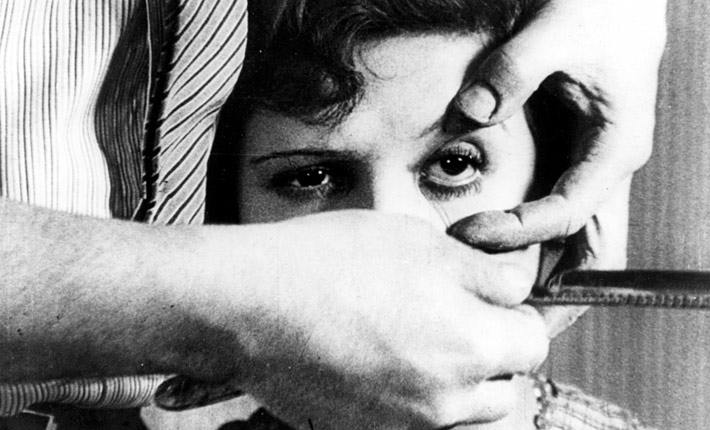
Under most circumstances, there’s nothing particularly shocking about cutting into an eye removed from a dead animal. Gratuitous, maybe, and surely disgusting for some, but certainly not psychologically damaging. I remember a man turning up one day to my first-grade classroom and showing us how to dissect a real sheep’s eye, which most of us found a fascinating break from our usual spelling and math exercises. But in education as in art, context is everything, and it is the context established by Salvador Dalí and Luis Buñuel that has allowed their own act of eye-slicing to retain its visceral impact. It occurs, of course, in their short film Un Chien Andalou, from 1929, the subject of the new Nerdwriter video above.
The shot of Buñuel’s hand taking a razor to the disembodied eye of what he later said was a calf comes early in the picture. What gives it its power are the images that precede it: Buñuel sharpening a razor and gazing up at the moon, and the actress Simone Mareuil having her own eye opened up and the razor brought near. In extreme close-up, the calf’s eye obviously isn’t Mareuil’s, but no matter.
Cinema is so often about carrying the audience along with sheer momentum, and in any case, Un Chien Andalou is a work of surrealism. To the extent that any combination of shots makes sense, it fails on that movement’s terms. Dalí and Buñuel succeeded, possibly to a unique degree, in making a film in which nothing adds up. “The rule was to refuse any image that could have a rational meaning, or any memory or culture,” says Buñuel in a late interview clip included in the video.
Nerdwriter creator Evan Puschak lists a few of the images that made the cut: “A crowd surrounding a man poking a severed hand with a stick; a man dragging two Jesuit priests, one played by Dalí himself, as well as two pianos laden with two decomposing, oozing donkeys; a woman’s armpit hair suddenly appearing over a man’s vanished mouth.” The goal of assembling such grotesqueries into one disordered viewing experience? “Buñuel felt that mainstream cinema, so concerned with re-creating the conventions of the nineteenth-century novel, was trapping itself in the same insidious morality and limiting its creative potential. He and Dalí sought to liberate the medium and the audience, and that liberation was not designed to be pleasant.” Nearly a century on, Un Chien Andalou remains memorably troubling, but most of cinema still stubbornly refuses to be freed.
Related content:
The Short Surrealist Film That Revolutionized Cinema: Luis Buñuel & Salvador Dalí’s Un Chien Andalou (1929)
