

Get stories like this delivered straight to your inbox. Sign up for The 74 Newsletter
Americans who engage with “new right,” fringe media outlets — like Breitbart and Newsmax — are more than twice as likely to be skeptical of the measles, mumps and rubella vaccine than those who never turn to those sites, according to new John Hopkins University research.
The 17% of surveyed respondents who believe the harms of the vaccine outweigh the benefits were also significantly more likely to seek out health information from non-authoritative sources. These include social media influencers, alternative health practitioners or alternative health newsletters, such as the one produced by Children’s Health Defense, an anti-vaccine advocacy group founded by now-health Secretary Robert F. Kennedy Jr.
In contrast, for the vast majority who see vaccines as a positive, these sites are essentially shunned.
“My main takeaway isn’t so much where the hesitant people are online, but where the non- hesitant people are not online,” said Lauren Gardner, senior author of the paper and a Johns Hopkins professor in the Department of Civil and Systems Engineering. “What we saw is that everyone is really online, but people that are more likely to be supportive of vaccines are very selectively not using some of those new right, fringy media outlets.”
The survey was done in August 2025 during the worst year for measles outbreaks in the U.S. in decades, with 2,288 confirmed cases and three deaths, two of them unvaccinated children. During this period of time, the survey showed that those who were vaccine hesitant were consuming far more information and engaging with far more media than those who supported immunization, she said.
Lauren Gardner is the director of Johns Hopkins University’s Center for Systems Science and Engineering and senior author of the research. (Johns Hopkins University)
“More information is better until the information sources become really unreliable, and potentially harmful,” Gardner said. “In which case, more information is not better. It’s confusing, it’s misleading, (it’s) misguiding.”
The researchers surveyed nearly 3,000 U.S.-based adults via an online panel survey. They noted that while previous work has tended to zero in on the singular moment in which adults choose to vaccinate themselves or their children, they decided to focus on the larger world of vaccine hesitancy, including the shifting attitudes and beliefs people hold. Participants were deemed vaccine hesitant if they indicated a belief that the harms of vaccines outweigh the benefits.
The authors of the study — research scientist Amelia Jamison, Ph.D. candidate Samee Saiye and Gardner — set out to better understand the relationship between individuals’ media consumption and their views around the MMR vaccine.
Of those reported sickened in the 2025 outbreaks, some 93% were unvaccinated or their status was unknown and 70% of them were kids. Just four months into 2026, nearly 1,800 cases have been reported across 36 states.
These outbreaks followed precipitous declines in childhood vaccination rates, which have been falling since the COVID pandemic. Last June, Gardner and Saiyed published research showing that rates had dropped in 78% of the more than 2,000 counties they studied across 33 states, and that the average immunization rate had fallen to 91% — further below the 95% threshold needed for herd immunity.
New Research: Childhood Vaccination Rates Drop Across 1,600 U.S. Counties
Vaccine-hesitant adults in this latest study were more likely to identify with the Republican party (39%) or as independent voters (33%) and were much more likely to identify with the “Make America Healthy Again” movement (43%) than non-hesitant adults (26%). Consumption of legacy conservative media — such as Fox News or the New York Post — was not associated with vaccine hesitancy.
These skeptical adults also tended to skew younger and were more likely to be parents, racial minorities, lower income and less educated, but many of these demographics held less sway when researchers also considered types of media consumption.
“Historically, demographics have been thought to be more of an explainer of attitudes,” said Gardner, “but in our work, we see that if you include those and then you also include media habits, the demographics really get overpowered and they no longer explain those vaccine attitudes. The better explanation is media habits.”
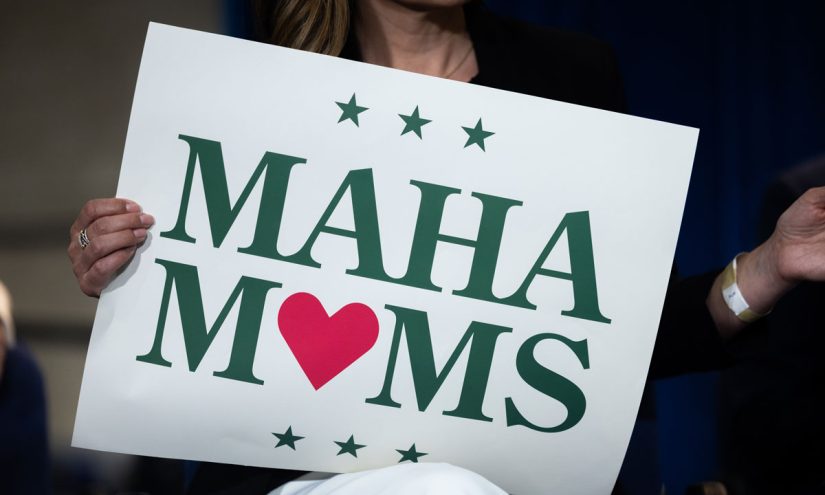
Researchers noted surprise at the sheer number of total respondents who reported being affiliated with MAHA: nearly 900, or 30%. The movement has proliferated in recent years and members have successfully used social media and other non-traditional outlets to shape narratives around health and amplify Kennedy’s political profile.
Demonstrators opposed to the Trump administration’s health policies and Secretary Robert F. Kennedy Jr.’s “Make America Healthy Again” movement hold signs during a May 2025 protest outside the National Institutes of Health in Bethesda, Maryland. (Kayla Bartkowski/Getty Images)
Gardner emphasized the strong caveat that this study was not causal, meaning it doesn’t demonstrate that vaccine hesitancy is a direct result of media consumption — just that there is a strong association. The team’s future research will explore if such a causal link exists and examine how these attitudes influence parents as they decide whether or not to vaccinate their young children — especially in light of shifting state policies around school-based compulsory vaccination.
All Eyes on Florida As State Gets One Step Closer to Nixing Vaccine Mandates
The researchers found that consuming media from Breitbart, which they deemed a “new right” group, had a particularly marked association with vaccine hesitancy. Some of the theories promoted in such outlets have also been heard from top officials in the federal government, including Kennedy, who initially downplayed the measles spread in 2025 and has been inconsistent in his support of the MMR vaccine since.
Throughout his tenure as secretary, Kennedy has sown disruption, leading the charge to overturn a recommendation that all newborns receive the hepatitis B vaccine; change policies surrounding the combination MMR and varicella (chickenpox) vaccine; roll back recommendations around 2025’s COVID- 19 booster; and overhaul the U.S. childhood vaccine schedule, significantly reducing the number of shots routinely recommended for all kids.
A preliminary injunction in March temporarily halted some of these changes, though the federal government filed an appeal on April 29, leaving the future of these policies uncertain.
A Seasoned Pediatrician on What the Latest Vaccine Victory Means for Kids
When pressed to take a stance on the vaccine at an April 22 Senate hearing, Kennedy responded, “We promote the measles vaccine,” adding that he has “always” said the injection is effective in 97% of people.
This April, in a departure from previous top-level appointments, President Donald Trump nominated Erica Schwartz, a pro-vaccine, board-certified preventive medicine doctor, to head the Centers for Disease Control and Prevention, which falls under Kennedy’s Department of Health and Human Services. While some see this as a signal of shifting federal priorities, Kennedy said he wouldn’t commit to supporting Schwartz’s potential future vaccine policies at an April 21 U.S. House of Representatives hearing.
Under Kennedy’s leadership, the Trump administration also released the controversial “Make America Healthy Again” report in May 2025, which involved no pediatricians, misinterpreted studies, cited ones that don’t exist and is suspected of being generated in part by artificial intelligence.
CDC Advisory Committee Votes to Overturn Decades-Old Hep B Vax Recommendations
Jamison, the research scientist who co-authored the Johns Hopkins study, said their work is particularly important given the current political climate in which public health has increasingly become front-page news.
“It used to be that if you were a parent you would seek out specific information when it became relevant for you,” Jamison said. “But now, when public health is so politically polarized post-COVID, and it’s so omnipresent across different news channels — being framed differently depending on which outlet — to me, that really spoke to the fact that people’s casual news consumption is probably contributing to their beliefs about vaccines, (and) not always in a super conscious way.”
Did you use this article in your work?
We’d love to hear how The 74’s reporting is helping educators, researchers, and policymakers. Tell us how
