

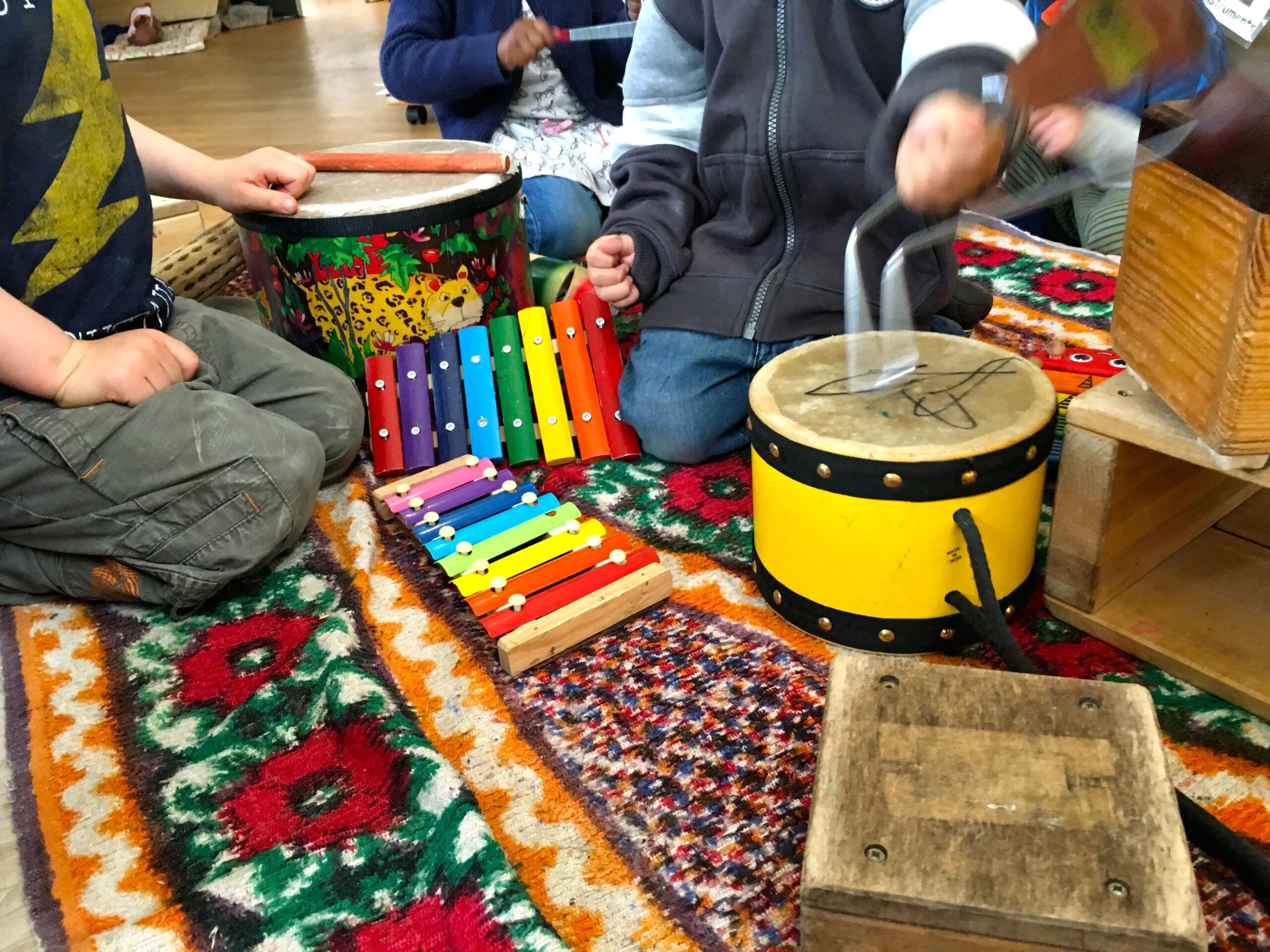
Parents and educators intuitively know the many benefits of singing and music for young children. It’s why children learn the alphabet through song, PBS’ Daniel Tiger sings to teach emotional regulation, and lullabies are used to lull babies to sleep.
But there is also a growing body of research backing a link between music and brain development — specifically, reading skills. Studies have found that singing helps children learn vocabulary and identify sounds in words, known as phonological awareness. Listening to music also reduces anxiety and supports bonding between caregivers and children, research shows. Playing instruments has been found to strengthen fine motor control and executive function.
Experts say making more time for music in early childhood classrooms could be a way to improve child outcomes, especially at a time when reading scores have stalled post-pandemic.
“Increasingly in early childhood education, if you look at the requirements, we’re urging literacy and mathematical competence,” said Dennie Palmer Wolf, a principal researcher at the research and consultancy group WolfBrown, and author of a recent report with Carnegie Hall’s Weill Music Institute on how music affects child development. “Visual arts, dance, music get pushed to the side.”
When it comes to access to music, opportunities are uneven and limited for many children. In the earliest years, exposure to the arts is largely contingent on the capacity and resources of parents or caregivers. And although almost anyone can sing or chant, many caregivers lack confidence in their musical abilities, Palmer Wolf said. Children’s music classes can be costly, and access to free options, like those at public libraries, varies greatly by community.
In some states, nonprofits are trying to close the gap by bringing music programs into places already frequented by families and young children. In Minnesota, the MacPhail Center for Music, a music school that serves thousands of students a year in the Twin Cities, has partnered with local health clinics to offer free parent-child music classes.
In Houston, the Prelude Music Foundation offers free music classes in local early childhood programs, with an emphasis on underserved communities. And in New York City, the Weill Music Institute has launched music initiatives in child care programs, public hospitals and correctional facilities to encourage parents to sing and make music with their children.
Another state-funded project in Minnesota provided $600,000 for an intervention called Tune Into Reading. From 2016-2021, children in 25 of the state’s elementary schools used karaoke-like software that encouraged more singing.
“Singing is natural, it precedes talking,” said Ann C. Kay, co-founder and education coordinator of the project. By encouraging more singing, Kay said, teachers can “develop young brains for reading.” The program, run by a nonprofit called the Rock ‘n’ Read Project, was used for 14 hours over a span of 12 to 16 weeks. A report to the legislature after the program concluded said that children who participated made notable literacy gains.
The program has shifted to bringing more music to early childhood classrooms by educating educators and parents on the literacy-related effects of music and singing. This year, the Rock ‘n’ Read Project is partnering with four Head Start pre-K classrooms in Minneapolis to train teachers and encourage daily singing and basic music skills, like beats, rhythm and pitch. By introducing music early, Kay says the program hopes to build early literacy skills and ultimately close reading achievement gaps.
“Auditory processing is the key to language and literacy,” Kay said. “This is how it starts.”
This story about early literacy was produced by The Hechinger Report, a nonprofit, independent news organization focused on inequality and innovation in education. Sign up for the Hechinger newsletter.
This <a target=”_blank” href=”https://hechingerreport.org/want-to-boost-early-literacy-skills-try-singing/”>article</a> first appeared on <a target=”_blank” href=”https://hechingerreport.org”>The Hechinger Report</a> and is republished here under a <a target=”_blank” href=”https://creativecommons.org/licenses/by-nc-nd/4.0/”>Creative Commons Attribution-NonCommercial-NoDerivatives 4.0 International License</a>.<img src=”https://i0.wp.com/hechingerreport.org/wp-content/uploads/2018/06/cropped-favicon.jpg?fit=150%2C150&ssl=1″ style=”width:1em;height:1em;margin-left:10px;”>
<img id=”republication-tracker-tool-source” src=”https://hechingerreport.org/?republication-pixel=true&post=116410&ga4=G-03KPHXDF3H” style=”width:1px;height:1px;”><script> PARSELY = { autotrack: false, onload: function() { PARSELY.beacon.trackPageView({ url: “https://hechingerreport.org/want-to-boost-early-literacy-skills-try-singing/”, urlref: window.location.href }); } } </script> <script id=”parsely-cfg” src=”//cdn.parsely.com/keys/hechingerreport.org/p.js”></script>
