

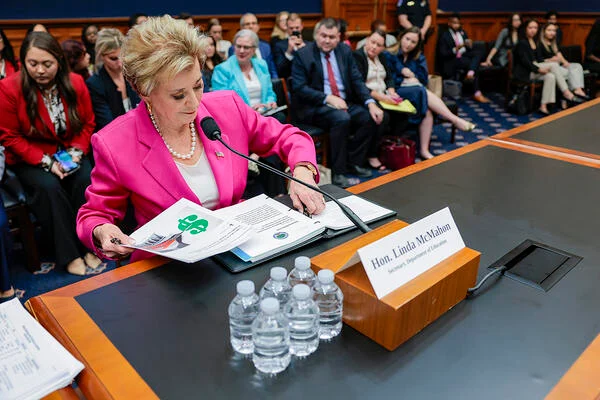
Education Secretary Linda McMahon fielded barbed questions from Democratic lawmakers at a House Committee on Education and Workforce hearing Thursday.
Democrats sparred with her over the department’s plans to dissolve itself, impending loan caps for graduate and professional degrees, and backed-up Office for Civil Rights complaints, among other policies. In contrast, many Republicans defended the department, praising its efforts to downsize, detect financial aid fraud, direct Pell dollars to short-term programs and bar trans athletes from women’s sports—though some also raised concerns about loan limits and threats to college access programs.
Tim Walberg, chairman of the committee, applauded McMahon’s record, including interagency agreements that shifted some of ED’s responsibilities to other agencies.
“Under your leadership, the Trump administration is delivering on reforms that will make education less expensive, improve outcomes for students and families, protect civil rights, and empower states and local communities with greater freedom to make the education decisions that are right for them,” he said in his opening statement.
Ranking Member Bobby Scott, a Democrat from Virginia, struck a different tone.
“Let me be clear: The Trump administration has not ‘returned education to the states,’” Scott told McMahon in his opening remarks. “Rather, he has empowered you to effectively dismantle one of our country’s strongest civil rights institutions.”
The hearing was part of McMahon’s rounds on Capitol Hill to defend the Trump administration’s fiscal year 2027 budget.
McMahon told lawmakers that Trump came into office with “a clear mandate: to sunset a 46-year, $3 trillion failed federal education bureaucracy in Washington, D.C.,” and that’s what the department has strived to do.
She also listed rising FAFSA completion rates and settlements with universities among ED’s recent accomplishments.
“After our nation watched violent riots erupt on college campuses, men invade women’s sports and harassment against Jewish students while universities turned a blind eye, we secured seven historic agreements with universities to recommit to merit, fairness and civil rights protections for more than 120,000 students across their campuses,” McMahon said in her opening remarks.
Debate Over Dismantling ED
Democrats repeatedly questioned McMahon about her moves to downsize her department, arguing that such efforts require congressional approval and programs historically designated to ED shouldn’t be overseen by other departments.
Scott argued that the Department of Labor “lacks the expertise” to properly administer adult education programs.
“Adult education programs in the Department of Education offer students lifelong skills, such as literacy, and support them in completing their GED,” Scott said. “At Labor, the focus of the adult education program has shifted to ‘finding the next job,’ which just does not meet the needs of students in these programs, especially in a world where the demand for upskilling requires both soft and hard skills.”
Representative Suzanne Bonamici, a Democrat from Oregon, asserted that most Americans oppose dismantling the department and dubbed interagency agreements “bureaucracy expansion agreements.”
“Several if not all of these bureaucracy expansion agreements are illegal or unconstitutional,” she said.
Democratic lawmakers also chided McMahon for staffing cuts at the department, particularly the Department of Government Efficiency’s early slashes to the Office for Civil Rights, citing long backlogs of unresolved cases.
McMahon and California Rep. Mark Takano had a tense back-and-forth over how many cases had been addressed under the Trump administration, whether OCR is currently stretched too thin and whether the administration’s fiscal year 2027 budget allows for hiring more OCR attorneys.
The proposed budget provides a “floor” for OCR’s budget—lower than last year’s, McMahon acknowledged. But “we hope then to work with Congress to raise that so that we will hire more lawyers,” she said. “We’re moving expeditiously to resolve as many of these cases as we can.”
Over all, Republicans, and McMahon herself, argued that the Education Department downsizing curbs government bloat and allows states and local governments to exercise more authority over education decisions.
“We don’t have the votes to abolish the Department of Education, I know that,” Walberg acknowledged in his closing remarks. “I’d like to see it abolished. I don’t think it’s proved itself to function well. Madame Secretary, I appreciate the fact that you’re finding creative ways, I believe totally legal ways, to run your department and to do it in a way that ultimately uses what we have laid out in front of us now but … with creativity, austerity, with transparency.”
Loan Cap Pushback
New loan limits for postbaccalaureate degrees—passed in the One Big Beautiful Bill Act and finalized last month—received widespread pushback, including from some Republicans.
The finalized rule allows a higher borrowing threshold for 11 “professional” programs, $50,000 per year or $200,000 total. Federal loans for all other programs, deemed “graduate” degrees—including in fields like nursing and social work—have a lower loan cap: $20,500 per year, or $100,000 total. The move has sparked debates over why specific fields took a harder hit, reflected in heated exchanges at the hearing.
Connecticut Rep. Joe Courtney lambasted McMahon over the omission of nurses from the “professional” category.
“Aside from being one of the most insulting, tone-deaf messages to five million nurses imaginable across the country, it will in fact raise education costs for critically needed nurses,” he said.
McMahon argued throughout the hearing that the goal of loan limits is to pressure universities to drive down costs for graduate programs, noting that the University of California, Irvine, and Purdue University have done so for business programs.
But lawmakers repeatedly pressed her to prove the policy shift would bring costs down more broadly, rather than pushing students to private lenders or forcing them to disenroll and contribute to workforce shortages.
“What evidence, if any, do you have that, as stated, this is going to lower the cost of acquiring those professional degrees?” Rep. Donald Norcross, a Democrat from New Jersey, asked. He praised UCI and Purdue for lowering tuition, but asked, “How many colleges do we have in the United States, thousands?”
Some Republicans also raised questions about which fields didn’t make the cut as professional degrees.
Rep. Lisa McClain, a Michigan Republican, said she’s gotten “a lot of feedback and concern” about loan caps, particularly for medical professions like nurse anesthetists.
“I’m wondering if there’s any way or you had any thoughts on, can we … expand these caps or lift these caps” for nursing graduate programs, “because it’s good return on investment and we sure do need them,” McClain said.
Florida Rep. Randy Fine, also a Republican, put it more bluntly: “Does it make sense for us to take a field where we have real shortages and create a situation where we may not be able to create the ones that we need when we already don’t have enough?”
Concerns About TRIO
The Trump administration’s plans to cut TRIO programs also raised some concerns from both sides of the aisle. ED recently put out two calls for proposals for TRIO programs that prioritize workforce development pathways, though the programs’ statutory requirements define them as supporting access to higher ed for first-generation learners. Trump’s fiscal 2027 budget also proposes eliminating TRIO, as did his 2026 proposal.
McMahon claimed TRIO programs have “not met their own goals,” arguing that “what we really want to do is make sure money is being spent effectively.”
“The people who are affected by programs like TRIO are literally the people who need the most help, who need the most investment,” Connecticut Democrat Jahana Hayes pushed back.
Rep. Glenn Thompson, a Pennsylvania Republican, also told McMahon that as a first-generation student, he’s “a big fan of TRIO” and invited her to visit programs in his state.
Though less of a focus, the Trump administration’s legal battles with universities over campus antisemitism and other issues also got some airtime.
New York Republican Elise Stefanik, known for her fiery takedowns of higher ed presidents in earlier hearings on campus antisemitism, asked for an update on the administration’s ongoing negotiations with Harvard University as the department investigates the institution over claims related to antisemitism and race-based preferences in admissions.
McMahon said she’d like to see Harvard emulate Yale, which recently released a report that acknowledged its role in the public’s declining trust in higher ed.
“I would just encourage more and more of our universities to be looking again at what they were set up and designed to do,” McMahon said. “They have so much to offer, but we really have strayed.”
