

Join our zero2eight Substack community for more discussion about the latest news in early care and education. Sign up now.
The United States’ primary childcare assistance program has long been underfunded, leaving millions of eligible families unserved. But recently, the situation has become acute.
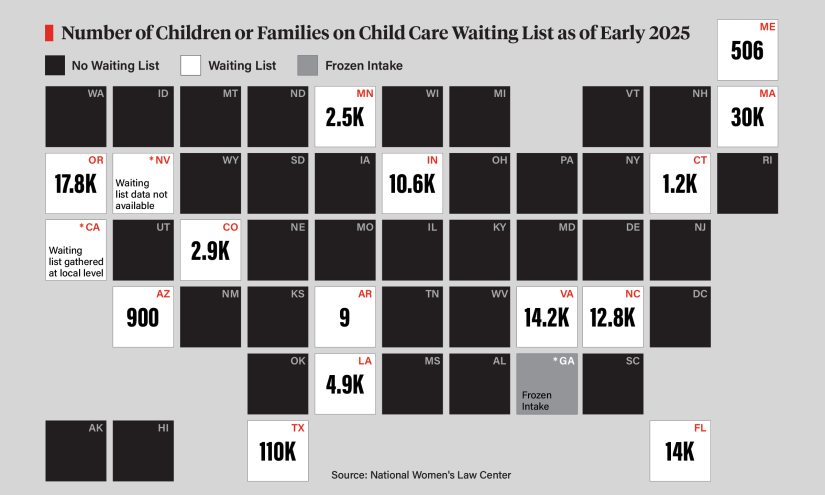
In 2025, one-third of states had a waitlist or a freeze on applications for childcare assistance for most families, through the Child Care and Development Block Grant, according to new data published in a report from the National Women’s Law Center.
The number of states with a waitlist or freeze had increased from the prior year — from 13 in 2024 to 17 in 2025. But perhaps more concerning, said Karen Schulman, the center’s senior director of state childcare policy, is the total number of children on those waitlists.
Between February 2024 and February 2025, the number of children on state childcare waitlists nearly doubled, to 225,000, according to the NWLC, which collected data from state childcare administrators across the 50 states and Washington, D.C.
Those waitlists only grew as the months wore on. By the second half of 2025, more than 400,000 children were on waitlists in those states, marking a 78% increase from February. In the months since the data was collected, at least five more states, plus Washington, D.C., have implemented waitlists, and two more began freezing intake, according to NWLC.
“A range of factors are pulling at states,” Schulman said, “so you have more families needing help but a strain on resources that provide that help.”
Some states are struggling to adjust to the end of pandemic-era funding, the last of which expired in September 2024, and many states are trying to balance tight budgets while also planning ahead for federal funding cuts to Medicaid and SNAP, she explained. Meanwhile, rising costs have changed many families’ financial circumstances, and more may be seeking out assistance.
Plus, Schulman said, some states have increased the reimbursement rates paid to providers in an attempt to get more of them to participate in the subsidy program; that has redirected some of the dedicated funds for the program.
It’s not a surprise that the CCDBG program, which is the main source of federal support for families struggling to afford childcare, is failing to reach everyone who qualifies for it. As of this year, it is estimated to be serving only about one in six of all eligible children, due to inadequate funding.
While the 400,000 children on waitlists make up a small slice of the total population of eligible children, that number is significant because it represents the families who have expressed a need for the benefit and are being denied it or told it will be delayed, Schulman explained. She also noted that the number of families seeking help is very likely underestimated because of complexities with data tracking. California maintains waitlists at the local level, rather than at the state level; Colorado has waitlists in some counties and frozen intake in others; and Georgia, although it doesn’t use the term “frozen intake,” effectively has a freeze in place since it only serves families meeting priority criteria.
Whether it’s a waitlist or a freeze, “There are tremendous impacts for a family who is waiting for assistance,” Schulman said.
While families are waiting for a childcare subsidy, they may have to stretch their budgets to pay for care out of pocket. That could mean putting off other bills, such as rent and utilities, or struggling to afford food.
“They’re just meeting their basic needs if they have to pay for childcare themselves,” Schulman said. “They might have to patch together unstable arrangements that could fall apart at the last minute and put their job in jeopardy. They may not be able to go to work at all, which could put them in even greater financial straits.”
All of these outcomes, she said, could have impacts on the family’s future financial, emotional and physical health.
Meanwhile, early care and education programs in low-income areas, where many families rely on subsidies to afford childcare, may face another set of repercussions. They could end up cutting already-low staff wages, Schulman said, or go out of business, putting their enrolled families in a bind.
“There’s just a ripple effect throughout the whole community, affecting the economy of the community, the workforce of the community, whole neighborhoods,” Schulman said.
Kim Kofron, executive director of early childhood education at Children at Risk, a Texas-based statewide advocacy organization, said that one of the challenges is that families who join a waitlist may incorrectly believe that they’ll soon circulate off it.
Anecdotally, Kofron said, she hears that waitlists in Texas are about two years long. (The state had more than 110,000 children on its waitlist as of February 2025, according to the NWLC.)
“Do they patch together some type of childcare with neighbors and friends? Do they go to a subpar childcare program because that’s what they can afford? Or do they turn down the job because … it’s cheaper to not work and not pay for childcare?” Kofron said, outlining the options for waitlisted families.
She added: “There’s a lot of questions right now from providers of, ‘Is it worth it? Is it worth taking subsidies when I can’t get more kids off the waitlist?’”
States Are Increasingly Using Child Care Waitlists, Leaving Parents in Limbo
These outcomes are not theoretical for RB Fast, founder of Westwood Academy, an early care and education program in Denver.
She remembers receiving an email in fall 2024 notifying her that one of the counties she serves was freezing intake. (In Colorado, waiting lists and freezes are decided at the county level.)
“I really thought it would be a couple of months,” she said. “I was not ready for it to be semi-permanent and extended the way it has been.”
Soon, she learned that two more counties would also be implementing a freeze.
Back then, Fast’s program, which is licensed for 30 slots, was fully enrolled. She estimates that about two-thirds of those families paid with subsidies. Today, her program is underenrolled, with 22 children, and only three of those families pay with subsidies — two got in before the freeze began and the third is a child living with a foster family who was granted a temporary subsidy.
For the remaining families, some manage OK, but others scramble each month, sending panicked emails asking if they can pay late or use a friend’s credit card for this month’s tuition. “You can tell they’re juggling to try to get tuition paid,” Fast said.
She has also seen firsthand the way some families pull together substandard childcare arrangements in the absence of public assistance. Fast knows of a family that had to start leaving their toddler with the great-grandmother while the parents go to work.
“I’m sure she loves that child very much … but at 80, are you in place to give an optimal environment to a 2-year-old?” said Fast, noting the level of attention and activity a toddler requires. “It’s not about an inconvenience for one family or a handful of families,” she said of the waitlists. “It affects employers, extended families [and] children.”
Fast is in the process of opening her second location, in a nearby suburb of Denver. That program will not be accepting childcare subsidies, she said. Nor will any future program she opens.
“It doesn’t feel worth it to me,” she said.
Did you use this article in your work?
We’d love to hear how The 74’s reporting is helping educators, researchers, and policymakers. Tell us how
