

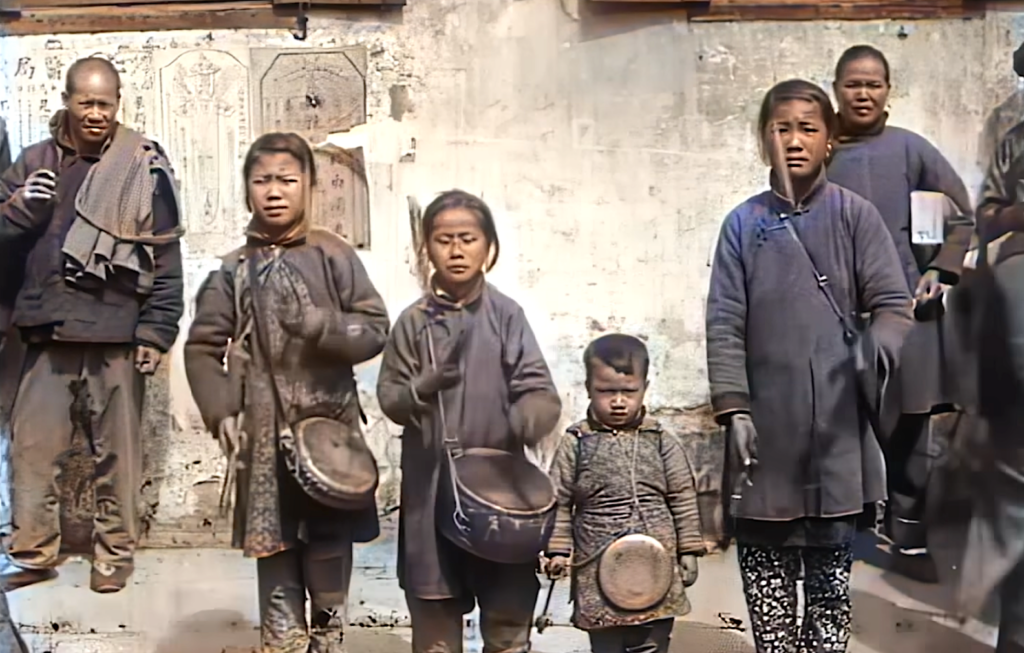
Even for Americans, keeping up with the geopolitical entanglements of the United States has never been an easy task. More than a century ago, just a few months after their country got involved in what’s now known as World War I, they got word that the military of a distant nation had joined their side: China, whose image would have been both opaque and forbiddingly vast. A dozen years before they’d even heard the name Pearl S. Buck, what impressions of that country they had would have come from scattered sources like post-Opium Wars missionary publications, newspaper coverage of complicated events like the Boxer Rebellion and the fall of the Qing dynasty, and silent-film genre stereotypes. (Perhaps the rare reader got ahold of John Thomson’s Through China with a Camera.) Most could live a lifetime without a glimpse of “the real China.”
By the end of 1917, however, “there were at least 10 documentaries available to satisfy curiosity about America’s new ally in the Far East,” according to the National Film Preservation Foundation. Most were shorts that played alongside features, but A Trip Through China was different. At least five years in the making, “the documentary was the brainchild of Benjamin Brodsky, a widely traveled Russian-born businessman who claimed to speak 11 languages. According to a 1912 Moving Picture World profile, the young entrepreneur had moved to China from San Francisco after the 1906 Earthquake and set up shop as a film exhibitor. Soon, as the American representative of Variety Film Exchange, he had a hand in distribution and by 1909 branched into film production in Shanghai and Hong Kong. While juggling business interests, he filmed his travels,” all of which took place not just before China’s economic rise, but before even the Communist Revolution.
Brodsky brought 20,000 feet of negatives with him back to San Francisco, eventually cutting it down to ten reels, which would have run around one hour and 50 minutes. Of this feature-length travelogue film only certain sections survive, but you can see them enhanced and colorized with artificial intelligence in the video at the top of the post. (Some of an un-enhanced black-and-white print appears just above.) Bear in mind that colors you see are not, of course, the colors Brodsky would have seen; there’s also some discussion about whether the AI rendered certain complexions unrealistically dark for the regions in which he shot these scenes. For China is quite a diverse place, not just in regional landscapes, climates, and cultures, but also in the faces of its people: something many Westerners wouldn’t have guessed in the nineteen-tens — and for that matter, something a fair few of them don’t realize even today.
Related Content:
Behold the Photographs of John Thomson, the First Western Photographer to Travel Widely Through China (1870s)
A Trip Around the World in 1900: See Restored Footage Showing Life in New York, London, India, Japan, China & Beyond
Footage of Cities Around the World in the 1890s: London, Tokyo, New York, Venice, Moscow & More
Watch Life on the Streets of Tokyo in Footage Recorded in 1913: Caught Between the Traditional and the Modern
A Trip Through New York City in 1911: Vintage Video of NYC Gets Colorized & Revived with Artificial Intelligence
The Photo That Triggered China’s Disastrous Cultural Revolution (1966)
Based in Seoul, Colin Marshall writes and broadcasts on cities, language, and culture. He’s the author of the newsletter Books on Cities as well as the books 한국 요약 금지 (No Summarizing Korea) and Korean Newtro. Follow him on the social network formerly known as Twitter at @colinmarshall.
