

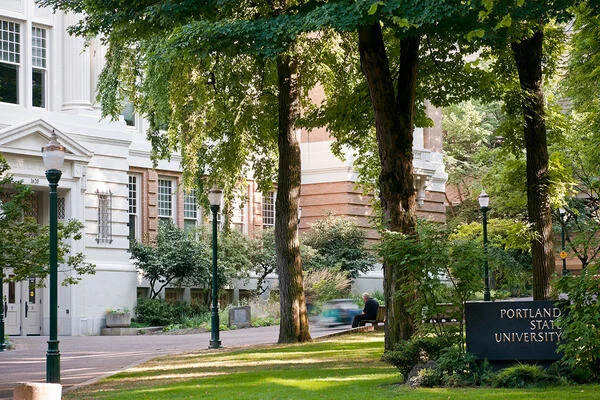
Enrollment at Portland State University has declined by more than 20 percent since the start of the COVID-19 pandemic. Its president is now pushing to lay off faculty and eliminate two departments, despite objections and no-confidence votes from employees.
President Ann Cudd says she hasn’t made any final decisions yet. She has scaled back designs for cuts she announced in March and says the plan won’t be set until after the latest campus comment period ends June 13.
But her current provisional plan includes axing 52 members of the union representing the university’s full-time faculty and nonfaculty academic professional workers. Leaders of that union, PSU–American Association of University Professors, say a dozen tenured faculty are among those on the chopping block.
The two departments that would be eliminated—alongside reductions in seven other departments and schools—are conflict resolution and university studies, Portland State’s centralized general education department. Almost half of the proposed layoffs are in that single area.
The university estimates it must cut costs by $35 million over the next two fiscal years to close a budget deficit, Cudd told reporters earlier this month. “Enrollment is the driver of this,” she said. “Over 14 years, we’ve shrunk by a third.”
According to the plan she released, “We are maintaining an infrastructure built for 30,000 students while currently serving 20,000.” Other options “have been exhausted” and “incrementalism” has failed, it says. With the university spending more than $12 million in education and general reserve funds this fiscal year—and with those reserves “facing total depletion” within the next two years—the plan says, “The time for temporary fixes has passed. We cannot maintain these spending levels if we are to remain a solvent and thriving university.”
“I wish that I didn’t have to make these kinds of decisions,” Cudd told reporters. “But we are in this situation where our institution needs to resize itself in order to be able to be here for the future.”
Portland State is far from the only Oregon public university facing financial struggles. In January, the state Higher Education Coordinating Commission warned in a report that “on the current path universities will be forced to continue to make substantial cuts annually or, in aggregate, fund balances will be completely exhausted within an estimated three to five years.” The state’s financial support for higher ed is among the lowest in the nation.
Southern Oregon University has declared financial exigency amid a projected budget deficit of $12.5 million and growing; Deloitte consultants have proposed ending four academic programs there and consolidating nine others. And the flagship University of Oregon, citing a projected $25 million to $30 million deficit in education and general funds, announced in September that it cut “117 filled positions across the university, roughly half of which occurred earlier this year”—though it was able to avoid cutting degree programs and laying off tenure-track faculty. This month, its president announced a hiring freeze due to a projection of “significantly lower incoming out-of-state first-year enrollment.”
The HECC is also considering whether to recommend that the Legislature end the state’s decade-old Oregon Promise Grant, which covers community college tuition and some other costs for many recent high school graduates. Commission officials say the program has fallen short of its goals; enrollment only increased two percentage points in the first academic year of the program before growth stopped.
Multiple Oregon lawmakers failed to respond to Inside Higher Ed’s requests for information on the continued statewide funding issues. The PSU-AAUP union has repeatedly criticized Cudd for not seeking more state funding. It has also provided Cudd a “counteranalysis” of the university’s financial condition, arguing for a pause in layoffs and further analysis.
“This scenario has broken our hearts, coming as it is from an administration that doesn’t seem to want to fight for PSU,” union president Bill Knight said.
Cudd told reporters she opposes the idea “that we should raid the [state] Education Stability Fund at this point,” and she doesn’t think asking the Legislature and governor for money to fill an operational deficit “would be well received.”
The union is also calling for more transparency on Cudd’s plans for the institution. Her written plan leaves unanswered questions about what the university’s future will look like after the cuts, it says.
Lacking Details
The plan describes only $16 million worth of savings, less than half of the budget deficit Cudd estimated needs to be filled. Asked about any further layoffs, Cudd told Inside Higher Ed in an email Friday, “No further decisions have been made” and a “more complete financial sustainability plan will be provided to the Board of Trustees as it considers our FY 2027 budget in June.”
Knight said his union represents a little more than 1,100 employees, so 52 layoffs would represent about a 5 percent loss. But he said he worries further cuts “would likely make up a significant portion of the bargaining unit.”
“I don’t think that this is the end of the labor impacts at PSU by any means,” Knight said. He has said Portland State is in an austerity-fueled “doom loop” that the cuts will exacerbate. “At what point can we stop cutting?” he said.
Cudd’s written plan also doesn’t provide enrollment figures or other data on the demand for majors, minors, certificates or classes in the departments being cut or eliminated, and Cudd didn’t provide Inside Higher Ed that information. “While financial results are important, we also considered other criteria, such as student success, mission fit and the department’s organizational effectiveness” when determining the cuts, she said.
Six of the planned layoffs are in the world languages and literatures department, but Cudd said, “We have not yet finalized which language programs will be affected.” Knight said at least four minors will be eliminated.
Of the two-thirds of the PSU-AAUP bargaining unit who participated in a recent no-confidence vote in Cudd over the proposed cuts, 85 percent voted no confidence, Knight said. Nearly 90 percent of those who took part in the adjunct faculty union’s vote also voted no confidence.
Cudd said in her email to Inside Higher Ed, “The university is navigating a very challenging period, necessitating layoffs to preserve our institutional survival. The unions are opposing this with all tools at their disposal and calling for no confidence votes is one of those. My role is to chart the best course through these difficult waters, but I also understand the role of unions and will continue to try to work with them.”
The Faculty Senate is meeting Wednesday about the plan, said Matt Chorpenning, the Senate’s outgoing presiding officer. He noted that no motions have been filed in the Senate to express confidence or no confidence in Cudd.
The Senate has, however, passed a resolution calling for university studies employees to be transferred to new jobs if the university eliminates the department. “Successful implementation of any new general education model at PSU depends on preserving and effectively deploying existing institutional expertise in first‐year learning, writing‐intensive and interdisciplinary instruction, community‐engaged learning, and dual‐enrollment programming, much of which is currently concentrated among university studies faculty and staff,” the resolution says.
Chorpenning said the Senate recently endorsed a general education model that would replace university studies, but now the administration has made that curriculum discussion “complicated and harder” by separately recommending laying off all university studies employees. “There’s this myth that this general ed proposal comes from the administration, and it doesn’t,” Chorpenning said.
Sonja Taylor, the incoming Senate presiding officer, is a university studies administrative/faculty member who’s set to be laid off. She said she was in university studies in the 1990s as an undergraduate, and while she found it “amazing and transformative,” not all students like it.
“There’s been numerous attempts to get rid of university studies,” Taylor said. It’s “been under attack since its conception,” largely driven by arguments over university resources, she said, adding that several College of Liberal Arts and Sciences department chairs told administrators last academic year the university should get rid of it.
And, while she doesn’t quite see Cudd’s path for the university, she said she would love to. She called the president “extremely tenacious.”
“Clearly everyone’s struggling,” Taylor said. “All the districts are struggling, all the state colleges are struggling, the community colleges. I mean, we’re all in it.”
Óscar Fernández, a non-tenure-track associate professor of teaching, also in the university studies department, has been at Portland State since 2003 and strongly defends the department.
“President Cudd has been floating around since she got here three years ago that university studies is a fossil,” Fernández said. (Cudd wrote in an October 2025 post on the university website that “The last time Portland State took a comprehensive look at general education [GenEd] and made significant changes, Bill Clinton was starting his first year in office, the original Jurassic Park movie was playing in theaters and PSU was under the leadership of its first woman president. In other words we are due for an overhaul.”)
Fernández said university studies has been modernized over the years, including by adding career-focused electronic portfolios for students to its other features, such as faculty teaching in area high schools, paid peer mentors and senior capstone projects. In the capstones, students work with faculty who have long-standing connections to Portland civic organizations to solve local issues, he said.
“Sadly, an outsider president like Dr. Cudd does not understand this long history,” he said.
Fernández, who’s from Costa Rica, said he also created a course called Immigration, Migration and Belonging and co-created the DREAMer Resource Center to support undocumented students. Now, he may lose his job.
He said he wants the president axed instead.
“I am hoping that our own Board of Trustees will look at what’s happening on campus and make decisions to dismiss President Cudd,” he said.
