

Join our zero2eight Substack community for more discussion about the latest news in early care and education. Sign up now.
I’ve always believed that where you live shouldn’t inform the quality of education you receive. For me, a high-quality education is not a privilege. It’s a right, and it starts in pre-K. In 2014, Missouri became one of the 44 states to fund preschool programs. The state legislature approved a bill that allowed schools to receive state reimbursement for pre-K enrollment, covering a share of costs for their students who qualify for free or reduced-price lunch.
Since then, schools across the state have wanted to offer pre-K, but many lack the facility space to add classrooms or the expertise to hire and manage pre-K teachers. At the same time, child care centers in their communities often lacked the training and resources needed to get students ready for kindergarten.
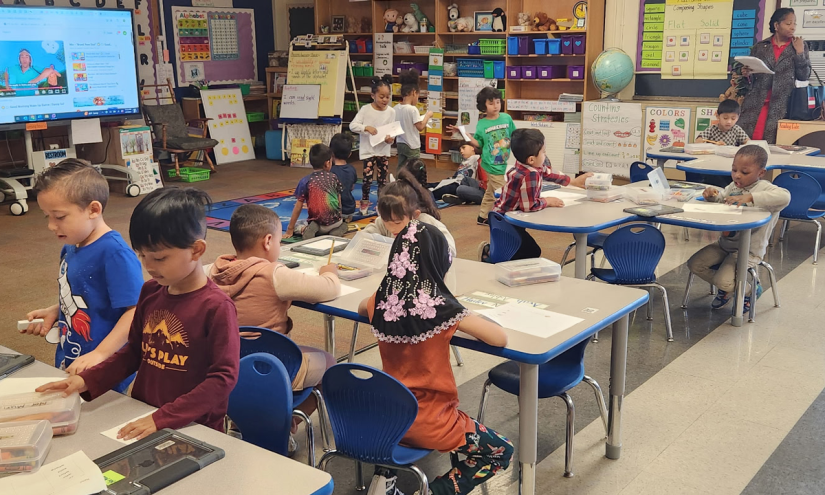
So in Kansas City, the education nonprofit SchoolSmart KC created the KC Pre-K Cooperative in 2019 to connect traditional public schools and charters with early childhood centers. This systems-level, research-based approach has expanded local access to high-quality early learning, currently collaborating with 28 partners serving approximately 700 students a year.
In addition to adding pre-K seats, our goal has been to improve kindergarten readiness as measured by a tool known as the Pre-Kindergarten Observation Form, which was developed by a regional council serving Missouri and Kansas. Readiness is not about mastering every skill before school begins. It’s about being prepared to learn, connect and thrive in a classroom setting. The observation form or PKOF identifies five areas of development that help determine if a child is ready for kindergarten: language and literacy development, cognitive development, social and emotional development; physical development and health and approaches to learning, also known as self-regulation.
SchoolSmart KC leads the pre-K co-op, uniting schools and early childhood providers to expand access to high-quality pre-K education and align funding across the system. We support partners by offering them resources they wouldn’t otherwise have. This includes professional development and instructional coaching, grants to help “mom-and-pop” centers raise standards, and technical support to help centers become accredited with the state.
We then connect these early childhood care providers with schools. Together, they coordinate enrollment and instruction through ongoing, combined professional development with pre-K and kindergarten teachers. The goal is preparing students for kindergarten and ensuring a smooth transition into our local school system.
Preschool Enrollment, Spending Hit Record Highs, but Access and Quality Gaps Persist
An example of the co-op’s success is Kids in Christ Academy, founded and directed by Christina Puckett. The child care center serves children from 6 weeks old to age 5, and has distinguished itself by providing expanded hours to support working families and offering specialized care for children on the autism spectrum. Puckett’s dedication to early childhood education and her collaborative approach have helped the academy serve a diverse community and grow, recently opening a location that offers a larger space and more seats. SchoolSmart KC helped her gain accreditation for her site, as well as funding for the process. The staff received training.
The co-op has had an impact across the city. At the beginning of last school year, 23% of Kansas City’s pre-K students were kindergarten-ready. By the end of the year, that number had skyrocketed to 74%. Our goal is to achieve 90% kindergartner readiness citywide by 2027.
To achieve that goal, we recently launched a pilot to gauge the impact of providing early intervention services to pre-K students who need additional resources such as speech or occupational therapy. So far, we’ve seen a noticeable difference in students’ behavior, as well as their cognitive and academic abilities.
All of these students receive hearing, vision and developmental screenings. If any flags arise, their pre-K provider can institute a response to intervention before the student reaches kindergarten. We look forward to learning more from the data to strengthen our support for students with learning challenges.
The co-op has created shared success in a city where families seek more affordable pre-K options, child care providers have both capacity and expertise, and schools want students ready for kindergarten. SchoolSmart KC was an early champion of this collaborative model to expand pre-K access, and our approach can serve as a blueprint for other communities. It begins by connecting schools and early childhood providers, then aligning their strengths to deliver high-quality pre-K through joint enrollment and coordinated instruction.
Did you use this article in your work?
We’d love to hear how The 74’s reporting is helping educators, researchers, and policymakers. Tell us how
