

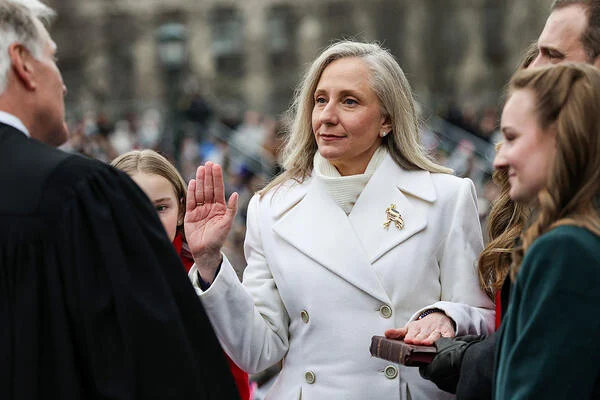
Freshly sworn into office, Virginia governor Abigail Spanberger appointed 27 new members to three university boards Saturday, effectively reshaping governance at the University of Virginia, George Mason University and Virginia Military Institute.
Spanberger’s wave of appointments comes after state Democrats blocked numerous picks advanced by former Republican governor Glenn Youngkin, who stocked university boards with GOP megadonors and various conservative figures, including former lawmakers and officials.
The unprecedented blockade has now handed Youngkin’s Democratic successor an opportunity to reshape governing boards at a much faster pace than she would have been able to otherwise. Under Virginia law, governors appoint a certain number of members each year. By the end of their term, each governor will have filled out a board with their own picks. But if her picks are confirmed, Spanberger will have already appointed a majority of the UVA and GMU boards.
At least 13 of the 27 picks donated to Spanberger’s gubernatorial campaign.
For months, the question surrounding Spanberger’s prospective board picks has been whether she will aim for a nonpartisan reset or continue the Youngkin tradition of appointing donors and former politicians and government officials, albeit with a leftward tilt. But for Spanberger, it may be too soon to tell; her early appointments are heavy on business executives. Her picks also include three former politicians, most notably former Democratic governor Ralph Northam, who was appointed to board of the Virginia Military Institute, which he attended for undergraduate studies.
Other politicos include former Republican representative Tom Davis and former Democratic representative Jim Moran, both of whom were appointed to the GMU Board of Visitors. Davis previously served on GMU’s governing board and was rector from 2014 through early 2020.
Nominees must still be approved by the General Assembly, which has a Democratic majority.
University of Virginia
Spanberger named 10 nominees to UVA’s governing board, filling multiple vacancies.
Her appointments come after the resignation of three members last week: former rector Rachel Sheridan, former vice rector Porter Wilkinson and Paul Manning, a prominent Republican donor. Sheridan led UVA through a tumultuous last year, which included a contentious presidential resignation and search as well as a deal with the Department of Justice to close civil rights investigations. (All three resigned at Spanberger’s request.)
Under Sheridan, the board defied calls from Spanberger, other state officials and faculty members to pause the presidential search until the newly elected governor took office. Instead, UVA plowed ahead, hiring business dean Scott Beardsley, despite various process concerns.
Nominees include two former members of the UVA Board of Visitors (Carlos Brown and Victoria Harker), a major Spanberger contributor (Mike Bisceglia), and a deep-pocketed Republican donor (Peter Grant).
Spanberger appointed the following to UVA’s governing board: Mike Bisceglia, Carlos Brown, Robert Bryon, Peter Grant, Owen Griffin, Victoria Harker, Elizabeth Hayes, Rudene Mercer Haynes, Evans Poston and Mohsin Syed.
George Mason University
Spanberger’s 12 nominations to GMU’s Board of Visitors will both reshape the composition of the board and also restore its functionality.
GMU’s board has not had a quorum since state Democrats rejected multiple picks in recent months. Two members also resigned Saturday: Charles Stimson, the board rector who had worked for the Heritage Foundation, a right-wing think tank, and Robert Pence, a former Trump administration official and Republican megadonor.
Similar to UVA, GMU board nominations lean heavy on the business side and include two members of the George Mason University Foundation’s Board of Trustees (Sumeet Shrivastava and Delbert Parks).
Spanberger appointed the following to GMU’s governing board: Anne Altman, Bruce Caswell, Shawn N. Chambliss-Purvis, Tom Davis, Paul Misener, Trevor Montano, Jim Moran, Delbert Parks, George Schindler, Sumeet Shrivastava, Sean Spence and Jennifer Taylor.
Virginia Military Institute
Spanberger’s appointment of Northam, a VMU alum, elevates one of the military college’s foremost critics in recent years to a position to direct change.
As governor, Northam demanded reforms after a Washington Post investigation found a culture of racism and sexism had flourished at VMI. He also launched a probe into VMI’s culture, and retired general J. H. Binford Peay III, the long-serving superintendent, soon stepped down, though he was later honored.
Last year, the governing board rejected an extension for Peay’s successor, Major General Cedric Wins. A VMI graduate and the first Black leader in the college’s history, Wins faced criticism from conservative alumni for diversity, equity and inclusion initiatives implemented in his tenure.
Northam is the most notable of the VMI nominees, several of whom are alumni. Two of the nominees, Lester Johnson and Allen Damon Williams, served previous appointments on the VMI Board of Visitors.
Spanberger appointed the following to VMI’s governing board: Michael Dick, Don Hall, Lester Johnson, Ralph Northam and Allen Damon Williams.
