

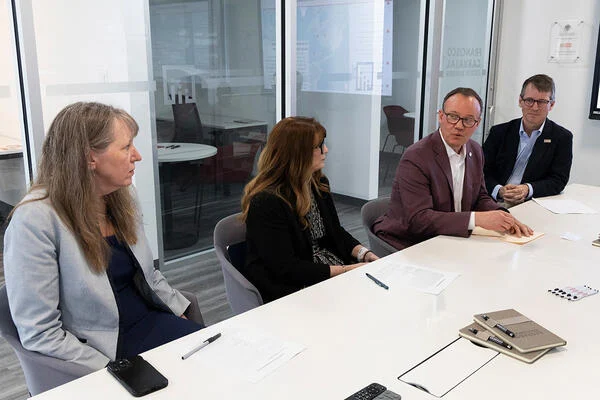
Four Catholic Hispanic-serving institutions are banding together to form a new resource-sharing partnership, with dreams of expanding bilingual coursework, travel opportunities and academic programs for underserved students across their campuses.
The institutions—University of the Incarnate Word in Texas, University of Mount Saint Vincent in New York, Dominican University in Chicago and Universidad del Sagrado Corazón in San Juan, Puerto Rico—are geographically far apart. But ideologically, they’re neighbors: All are century-old universities founded by nuns in bustling metropolitan areas, and all enroll at least a quarter Hispanic students and disproportionately serve low-income and first-generation students.
When the individual campus presidents realized how similar their institutions were, they started brainstorming ways they could draw on one another’s respective strengths, and a coalition was born. The group, which calls itself CHARISM, or the Catholic Higher Education Alliance of Rising Institutions in Service and Mission, officially launched last month.
The presidents’ asked themselves, “How do Catholic institutions that have these affinities work together? What are the kinds of things that we could do?” said Thomas Evans, president of University of the Incarnate Word. “A long list” of possibilities materialized.
The group is dreaming big—co-taught virtual classes, joint degree programs, new pathways to each other’s graduate programs, faculty and student exchanges, and shared efforts to offer more bilingual programming. The hope is, if one campus doesn’t have a particular resource, program or opportunity for students, another can provide it or the four can develop it together.
“When so many other institutions are pulling back from their missions, our success, individually and collectively, is that we’re leaning into that in this moment,” said Susan Burns, president of University of Mount Saint Vincent. “Part of the appeal of the alliance is that we’re institutions that are on the move, institutions that are not afraid of innovation and institutions that are willing to think creatively … and really asking the question of, how can we continue to serve well those who deserve?”
Though the idea was first considered roughly a year ago, the Catholic HSI partnership comes at a time when minority-serving institutions are struggling against new headwinds.
In September, the U.S. Department of Education axed competitive grants to many minority-serving institutions. A legal report by the Department of Justice also deemed federal funds designated for MSIs unconstitutional last month.
CHARISM’s institutions have all lost federal grant money, the presidents said, but they’re not deterred.
Glena Temple, president of Dominican, said the campuses all share a commitment “to serving our communities and the cultures from which our students come.”
“We’re not HSIs because of the federal designation,” she said. “We’re HSIs because of the students we have the privilege of serving … We’re committed to serving our communities, and that means centering our students.”
New Opportunities
Temple emphasized that the partnership allows her students to benefit from programs she could “only dream of” offering at a university the size of Dominican, which serves roughly 4,000 students. She also believes that because the campuses share a mission but are not close together, they’re not competing for students and can only gain by helping each other.
Now Dominican will have “access to the expertise, the talent that exists at these three other campuses to broaden the opportunities for our students in the way they deserve,” she said.
For example, the presidents want to help each other grow their campuses’ bilingual academic offerings so students have an array of dual-language courses and programs to choose from.
University of the Incarnate Word has been building up its bilingual programming, with two campuses in Mexico and coursework that teaches pharmacy students to counsel patients in both Spanish and English. Meanwhile, both Dominican University and University of Mount Saint Vincent are eager to grow bilingual offerings. And Universidad del Sagrado Corazón, which primarily teaches in Spanish, is working to develop a bilingual curriculum. Campus leaders believe they can help each other achieve those goals through virtual course-sharing and by drawing on the combined expertise of their faculty members.
“Dominican, and I think all of us, have a desire to have truly bilingual courses and programs for our students,” Temple said, “and that would be very hard for Dominican to do on our own without the talent that comes from Sagrado Corazón and Incarnate Word. And our students are calling for that.”
Gilberto J. Marxuach Torrós, president of Universidad del Sagrado Corazón, said if the group succeeds in creating a “fully bilingual higher education system” together, that could be a model for the rest of higher ed.
“It doesn’t exist,” he said. “It doesn’t exist anywhere in the world, so what we are embarking on is potentially transformative for higher ed. We are not talking about doing classes in English and classes in Spanish. How do we manage both languages simultaneously? … It’s an ambitious goal. It’s going to take time. But the fact that all institutions are committed to this goal is fundamental.”
The presidents also hope to send students to each other’s campuses, offering low-income students often hard-to-access travel and immersion opportunities. The presidents envision running programs on Incarnate Word’s campuses in Mexico or at Universidad del Sagrado Corazón and offering Puerto Rican students study opportunities on the U.S. mainland campuses.
“The beautiful synergy of this project is that you have four institutions deeply rooted” in their communities, but that are also “committed to making the world available to them,” said Torrós. For “a kid from any small town in Puerto Rico, the possibility of going to New York, or going to San Antonio, going to Chicago, really changes their lives.”
Already, new collaborative projects are underway.
Incarnate Word is working on a program where faculty from the Texas campus would provide hybrid, bilingual training in occupational therapy at Dominican. Nursing students across the campuses are already interacting virtually this spring semester, with hopes of creating a shared Spanish immersion study abroad trip for them in the future.
The campuses are also working on opportunities for students in UIW’s pre–physician’s assistant program to visit PA graduate programs at University of Mount Saint Vincent and Dominican where they could continue their studies. And Mount Saint Vincent, which is launching a new film production associate degree in the fall, is in conversation with film faculty from Universidad del Sagrado Corazón about offering the Puerto Rican university’s film bachelor’s degree on the Bronx campus. The goal would be to create a seamless pathway to a film B.A. for Mount Saint Vincent students and an opportunity to study in New York for Sagrado Corazón students. Meanwhile, Sagrado Corazón is home to Puerto Rico’s main communications school, but it can’t keep up with employer demand for bilingual graduates, so it hopes to extend its programming to the other campuses.
Temple said she hopes other higher education institutions follow CHARISM’s lead.
“I personally hope this can serve as a model for other schools, because I do think to keep higher education affordable and create the opportunities that our students deserve, we have to think about doing the work differently going forward,” she said.
