

Get stories like this delivered straight to your inbox. Sign up for The 74 Newsletter
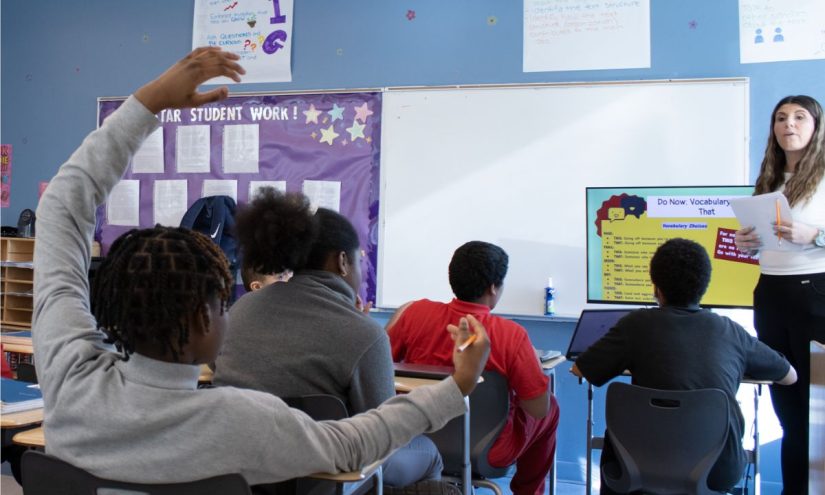
Jomeilin Reyes, a seventh-grader English learner, had spent most of the fall putting his head down during writing time. Co-teachers Ashlee Robateau and Marjorie Levinson knew he struggled with comprehension and avoided assignments that felt overwhelming. But one afternoon, they brought in an AI-powered teaching assistant that walked their students through the writing task of the day. Guided by a series of prompts on their laptops, students worked through their assignment in manageable chunks. The assistant asked Jomeilin to restate the question, pull evidence from the text and explain how that evidence supported his answer — one step at a time.
Something shifted. That day, Jomeilin worked almost entirely on his own, asked one question of the assistant about where to find a quote and submitted his response. When a 3 out of 4 appeared on his screen, Jomeilin let out a small yelp, broke into a grin and asked, “Can I call my mom?”
The introduction of the platform came after teachers and school leaders spent months discussing ways to incorporate artificial intelligence to improve reading comprehension and the quality of student writing. What if an AI tool could show teachers exactly what each student was struggling with in real time, so they could give targeted help, instead of waiting a week to see patterns in graded work? The result was the launch of the teaching assistant in DREAM East Harlem Middle School’s sixth-, seventh and eighth-grade English classes.
Marjorie and Ashlee start their class by explaining to students what they will be reading, what they will learn, the steps to understanding the text and how to approach the assignment, which focuses on one key element of the reading. Students make notes on scrap paper as they read the full text on their school-issued Chromebooks. Then, they do a close read of a smaller excerpt on the AI assistant’s platform and answer questions regarding what they read. These questions build in complexity as students work their way up to writing a full response.
Students respond to the AI assistant’s suggestions, note which advice they will adopt and why, and submit those annotations with their revision. Ashlee and Marjorie then discuss the annotations with the students and coach them through any further revisions that are needed.
The AI platform mirrors what the teachers would do one-on-one with students. It surfaces issues that Ashlee and Marjorie are already watching out for and enables them to address them with students in real time. The platform pulls together all student responses at once, showing the teachers where the whole group is struggling and highlighting strong examples from students who got it right. Teachers can see what those students did to succeed and share that approach with classmates who are stuck.
Across the school network, AI assessment and data tools have saved each teacher about 50 hours that otherwise would have been spent grading student work and entering data. Instead, they are using that time for small-group instruction, extra lesson planning and instructional practice sessions. Since the platform was introduced in October, students’ performance on benchmark assessments rose by about 5 points in math and 2 points in English — changes the school attributes in part to the extra targeted instruction those hours made possible.
But not everything about this AI adoption has been smooth. Early on, some teachers worried that requiring students to write rationales for why they accepted or rejected the assistant’s feedback felt like busywork. Sometimes, the AI feedback was too general and needed more teacher input. Other educators found the rubric too rigid for open-ended creative tasks.
DREAM’s leadership and curriculum team adjusted after listening to the teachers, building more flexibility into the system and clarifying when to use the AI platform and when to set it aside.
Other schools have asked what it would take to replicate this. Early success at DREAM has stemmed from giving teachers time to learn and master AI tools before students start using them and building in guardrails that train and enforce ethical AI use.
Jomeilin’s success that afternoon wasn’t about his use of AI itself. It was about two teachers who spent weeks thinking through his specific needs, how AI could fill the gaps and how to catch his struggles early. Marjorie had been skeptical of AI at the start of the year. year. She worried that the students who most need to build independence could become too reliant on AI.
What changed her mind was watching students like Jomeilin work through a full writing process, make decisions about feedback and build confidence along the way. Jomeilin has changed his mind about writing, too.
Did you use this article in your work?
We’d love to hear how The 74’s reporting is helping educators, researchers, and policymakers. Tell us how
