

Listen to the article
This audio is auto-generated. Please let us know if you have feedback.
Dive Brief:
- While youth are likely to have a positive impact when they become involved in their communities, there’s a huge gap between the impact they can have and the opportunities available for them, according to a recent CivicPulse survey of nearly 1,400 local government leaders, including school board members.
- Respondents valued K-12 schools highest, at 83%, among eight institutions in terms of their positive impact on civic participation and ability to help young people engage with political polarization. The other institutions included recreational sports leagues, colleges and universities, public libraries, museums and cultural centers, hospitals, police departments, and parks.
- Gaps in the perceived positive impact versus availability of civic programming opportunities were seen in areas like youth volunteering during elections (80% versus 18%), youth representation in local boards (80% versus 33%), youth-run newspapers or news stations (75% versus 25%), and youth-led town halls or candidate forums (73% versus 8%).
Dive Insight:
The findings from the CivicPulse survey — the third in a series — suggest major opportunities for social studies and civics educators, according to leaders in these disciplines.
Tina Ellsworth, president of the National Council for the Social Studies, sees the 83% rating for schools as a place to reduce polarization as “a powerful vote of confidence in social studies teachers and public education.”
Donna Phillips, president and CEO of the Center for Civic Education, also underscored that result, along with the gaps, which “is where organizations like the Center for Civic Education live, to try to provide more opportunities.”
Young people regularly engage in their political differences in schools before they “harden,” and because they can’t escape into the bubbles that adults sometimes can, Ellsworth said. Connecting that to outside civic participation requires investment in high-quality civic education through professional development as well as forging more partnerships, she said.
“The good news is, the trust is already there,” said Ellsworth in reference to the survey. “They’re already demonstrating they believe schools can have the largest impact.”
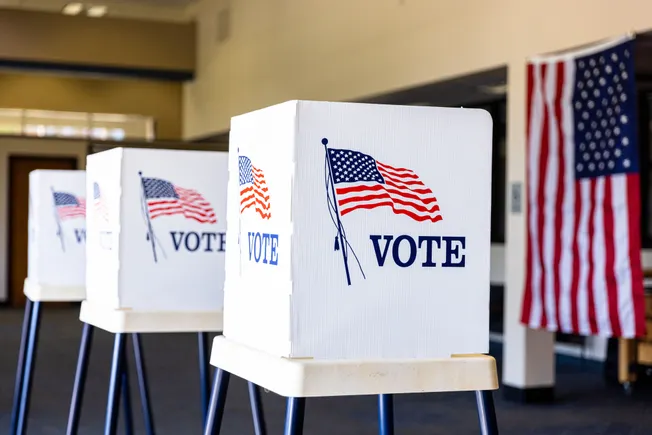
Social studies classrooms are uniquely positioned to connect students to real-world civic action, and sometimes, this can simply involve teachers picking up the phone, Ellsworth said. When conducting a mock election, she once reached out to her local election board, which agreed to provide voting machines and ballots for the students to use, to make it feel more real.
“Don’t be afraid to pick up the phone and say, ‘Hey, I have an idea. How can we work together?’ Especially when we have institutions that are like-minded and have the same mission,” she said.
When students are able to participate in simulations like mock elections, that builds civic dispositions, competencies, discourse and collaboration, Phillips said. But attending local board meetings or volunteering in local elections “aren’t necessarily baked within a course that can happen in K-12 education unless you have a community partner,” she said.
When such programs attain funding, sometimes it’s for “flashy” outcomes that might showcase the work of one exemplary student rather than a more structural shift within the classroom to provide exposure to all students, Phillips said.
“Rather than a singular contest, what is the learning that’s actually taking place?” she said. “Where students are building and flexing these civic virtues and competencies that transfer out of the classroom to conversations and — not dissolve — but mitigate affective polarization.”
Some 89% of respondents in the CivicPulse survey said polarization is negatively impacting the U.S., yet only 30% said the same of their own communities.
Media literacy training is key to addressing that polarization, Phillips said, and this needs to be built throughout the curriculum — not as an add-on — with an emphasis on looking at the same story from different news sources to see if there’s consistency, as well as looking for bias before jumping to conclusions.
“The youth-run newspapers, youth-run town halls and candidate forums — teachers need [leadership] support to be able to create those opportunities for students,” she said.
While teachers don’t typically take partisan stances, they need to be able to navigate the fact that any topic is potentially political in today’s climate — and be encouraged to avoid self-censorship both personally and among students, Phillips said.
“When they have strong programs in schools that allow for dialogue building, they don’t self-censor,” she said. “Because they’re modeling and participating fully in what we want to do in our outside town halls, and community meetings, and Thanksgiving dinner tables.”
The CivicPulse survey was commissioned by the Carnegie Corporation and conducted in September and October 2025.
