

Get stories like this delivered straight to your inbox. Sign up for The 74 Newsletter
The Los Angeles Unified School District is weighing layoffs that could reshape classrooms across the nation’s second-largest school district.
The district’s board at next week’s meeting is expected to decide whether to cut jobs, as it faces a projected $191 million deficit in the 2027-28 school year if it keeps spending at its current pace. The deficits in LAUSD and other districts are driven largely by the loss of Covid relief funds, declining enrollment and rising costs.
Meanwhile, labor unions throughout the state are pushing many districts for pay raises and other changes, such as increased health care contributions in their next contracts.
“When your cuts are driven by declining enrollment, which means declining caseload, you’re not left with a whole lot of choice,” said Michael Fine, the CEO of the Fiscal Crisis and Management Assistance Team, or FCMAT, an agency that works to help educational agencies in sustaining healthy finances.
“Where you need to cut then is the classroom,” he said. “Because you need fewer classrooms, you need fewer teachers, fewer aides, fewer of folks that are at the sites directly serving kids.”
Los Angeles Unified is not alone among California’s school districts facing financial pressures. The Sacramento City Unified School District must close a deficit or face state receivership. Pasadena Unified plans to implement job cuts to address its budget shortfall.
Layoffs, Cuts and Closures Are Coming to LAUSD Schools As District Confronts Budget Shortfalls
“Large and small districts, urban, suburban and rural alike, are experiencing similar constraints,” reads an open letter from superintendents of eight California districts, demanding the state restructure the way it funds schools. “When nearly every school system in California is facing the same challenges, it is clear that the issue is not isolated decision-making, but the sustainability of the funding model itself.”
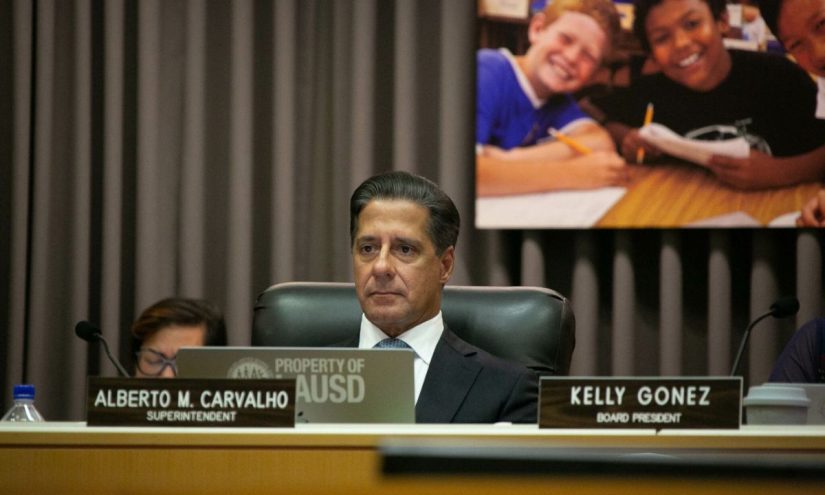
The superintendents who sent the letter, including LAUSD Superintendent Alberto Carvalho, cited ongoing challenges, such as enrollment declines.
LAUSD’s enrollment declined more than 3% to 389,000, down from roughly 402,500 between the 2024-25 and 2025-26 academic years. That outpaced both the state and country, according to a presentation at January’s Committee of the Whole meeting.
About 90% of LAUSD’s budget is spent on personnel. Fine said that with so much of the money being spent on staffing, it would be nearly impossible to balance the budget on the remaining funds.
“Our priority will be to protect students, protect programs, protect schools, and, to the extent possible, protect workforce,” Carvalho said at a Roundtable discussion with reporters in late January. “And within that priority, the protection of workforce begins with school sites. That is the balance that we want to establish, leading to the necessary fiscal solvency that we must continue to observe.”
If LAUSD moves forward with job cuts, laid-off employees would be notified by March 15, per state law.
Weighing in the potential cuts, LAUSD is expecting a $191 million deficit for the 2027-28 academic year, though several factors are at play, including the final governor’s budget. The district also said it plans to move forward with roughly $150 million in reductions to its central office.
The current fiscal challenges come after two years of diminishing reserves to help replenish a multi-billion-dollar deficit. While the district teacher’s union has pointed to $5 billion in reserves as of July, LAUSD is expecting to burn through it in three years.
“The danger in just trimming 5% here, 10% there is it leaves you sometimes with incomplete programs,” Fine said. “It may leave you with the inability to actually turn things into practice.”
The school board was originally expected to vote on the layoffs Tuesday, but postponed its regular meeting to Feb. 17 to allow for better preparation and engagement. The meeting’s reschedulingcomes after LAUSD unions issued a letter asking that the vote be delayed and presented instead at a stand-alone meeting.
Ongoing labor actions
The discussion of layoffs comes as United Teachers Los Angeles, or UTLA, the union representing roughly 35,000 teachers, voted to authorize a strike if a labor agreement isn’t reached. Meanwhile, SEIU Local 99, which represents roughly 30,000 workers, including special education assistants, cafeteria workers and custodians, is in the midst of a strike authorization vote.
Before mediation began with UTLA in January, LAUSD said its bargaining proposals would cost $4 billion over a three-year contract, while SEIU Local 99’s would cost $3 billion through 2027-2028.
LAUSD’s most recent proposal to SEIU Local 99 would increase wages by 13% over the next three years — starting with a 10% increase this year. Before mediation, the district offered UTLA a 4.5% raise and 1% bonus over two years.
UTLA says that isn’t enough. With Los Angeles’ high cost of living, teachers are struggling financially, the union says. A 2024 report showed that money is particularly important for Gen Z Black and Latino teachers in the district; a quarter of whom said they would leave their careers in education in search of a higher-paying job.
“I’m a third-year teacher. I have a master’s degree from UCLA, which is the premier education school in the country, and I’m still living paycheck to paycheck. And I’m still unable to even think about one day owning a home,” said Jon Paul Arciniega, a 29-year-old social studies teacher at Edward R. Roybal Learning Center in the Westlake area.
“I still live at home,” Arciniega said. “And if I want to think about things like getting my own place, starting a family, buying a home, right now, all of that seems untenable.”
Uncertainty ahead
Sandy Meredith, a psychiatric social worker covering 42 district schools, said she hopes a strike won’t be necessary, both because of the financial strain it would place on colleagues like Arciniega and because schools play a critical role in students’ daily safety.
But at the same time, she said they’re struggling to support students — 20% of whom require mental health services — without the district providing the support and wages they see as critical to their success. She expressed frustration with the size of the district’s reserves, particularly when teachers and staff like her pay out of pocket to provide basic resources, such as toilet paper, for students.
“I feel like I’m on an airplane,” she said, “and I’ve been told ‘I’m sorry, but we can’t give you a mask to put on first. But go ahead and take care of the child.’ ”
Strikes are nothing new in Los Angeles Unified. UTLA last went on strike in 2019, leading to a historic agreement with 6% pay raises, smaller class sizes and investments in community schools. Four years later, in 2023, SEIU Local 99 went on strike, which resulted in a 30% wage increase.
But teachers and staff say this year comes with much higher stakes.
Members of UTLA’s leadership say educators and school staff play a bigger role beyond the school walls.
“We’re dealing with families’ anxieties. Are they not being able to come to school because of their housing insecurity? Is there trauma with this addition of the ICE raids? There’s concerns about safety,” said Margaret Wirth, a pupil services and attendance counselor who supports all of LAUSD’s Region South. “Is my child safe? For the child, is my parent safe? There’s a lot of different factors that make everything more heightened.”
Pupil service and attendance counselors like Wirth help reduce chronic absenteeism. She said layoffs will mean her caseloads will increase.
But at the same time, Fine said if a district is going to move forward with layoffs, the earlier, the better.
“The earlier you cut, the better off you are, and you’re also not dangling this black cloud over your staff and the community,” Fine said. “You get the discussion done, you forecast your gap right, and you make a decision on how to close that gap all at once, and everybody knows what the plan is.”
This story was originally published on EdSource.
Did you use this article in your work?
We’d love to hear how The 74’s reporting is helping educators, researchers, and policymakers. Tell us how
