

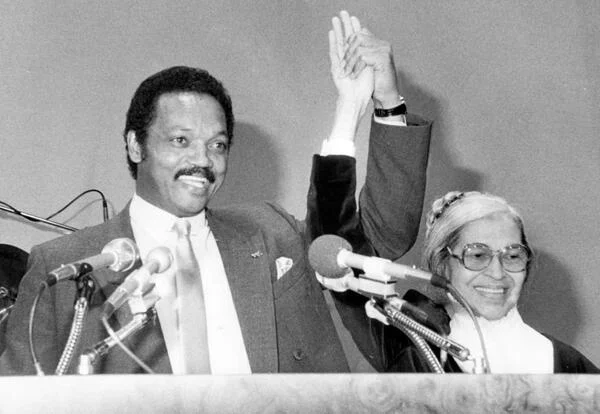
The Rev. Dr. Martin Luther King Jr. was assassinated at the Lorraine Motel in Memphis, Tenn., on April 4, 1968. Jesse Jackson, his 26-year-old protégé, was there. Photos and videos from that era show Black people being hosed down by police officers, attacked by dogs, humiliated, beaten, bloody and facedown on concrete streets. Jesse Jackson was there.
Black people were jailed for trying to integrate “whites-only” establishments, for attempting to vote and for sitting with dignity in the front of city buses. Jesse Jackson was there. In fact, he was repeatedly jailed for civil rights protests throughout the 1960s. The first time was when he was an 18-year-old college freshman; he and seven other Black teens were arrested and jailed for reading books at a whites-only public library in Greenville, S.C., Jackson’s birthplace.
Time and time again throughout adulthood, Jackson was called to scenes all across America where racial injustice had occurred. Too often, Black children, women and men had been murdered. Too many were wrongly convicted of crimes and subjected to cruel circumstances in which they were treated as less than human. Jesse Jackson was there. He saw and experienced this all. And yet, he famously insisted that all Americans, especially Black citizens, “keep hope alive.”
The Honorable Rev. Jesse Louis Jackson Sr. died. He was 84 years old. How can it be that someone who saw so much evil maintained hope and consistently inspired others to do the same? The King murder would have been enough for most people—they would have lost faith in the racial equality and social justice efforts for which their mentor and dear friend lived, fought and ultimately died.
Yesterday, one television network referred to “keep hope alive” as a Jackson “catchphrase.” That was a mischaracterization. It was not merely a slogan that became most widely known during his two campaigns for the U.S. presidency. Instead, it was Jackson’s philosophy. It kept him fighting for and believing in justice, even when so much around him could have easily thrust him and others into apathy and hopelessness.
Constantly calling Jackson to the scene of injustice over decades was sometimes met with critique. “Jesse Jackson doesn’t speak for all Black people” was the shortsighted complaint. Here is the thing: The Rainbow PUSH Coalition founder always spoke for Black people and was one of the most reliable leaders to ever do so. Also praiseworthy is how Jackson consistently answered the calls and showed up. He was there. We need more, not fewer defenders, protectors, ambassadors and freedom fighters like him. Courageous leaders who somehow still believe that our nation is capable of living up to its ideals and promises, in spite of its recurring contradictions and betrayals, are what we desperately need.
There is a lot happening in the U.S. right now: snatching health care from poor, working class and elderly people; suppressing voting rights, which is guaranteed to disproportionately affect Black citizens; terrorizing immigrants and separating families; and unnecessarily killing unarmed Black people and peaceful protesters. That is just some of it. Jackson saw and experienced even more than this over his lifetime. So then, again, how did he manage to keep hope alive?
I asked a version of this question to one of my beloved mentors, the legendary Black psychology professor Joseph L. White, who always reminded others and me to “keep the faith.” I still do because he always did, despite all the injustice to which he bore witness over his 84 years on this earth. It is my daily tribute to Dr. White. Henceforth, it will also become my daily tribute to Rev. Jackson.
CNN NewsNight host Abby Phillip provides insights into Jackson’s philosophy in her 2025 book, A Dream Deferred: Jesse Jackson and the Fight for Black Political Power. Marshall Frady did so as well in his 1996 biography, Jesse: The Life and Pilgrimage of Jesse Jackson. Many other scholars in African American studies, political science and other academic fields have published research that provides windows into Jackson’s faith, optimism and enduring commitment to fulfilling King’s agenda as well as his own vision for America.
These are tough times for our nation, including its higher education institutions. Surviving this particular moment requires us to be more like Jackson: hopeful, courageous, reliable, consistent, brave and enduring. Undoubtedly, there will be numerous tributes to his life, legacy and massive impact on America and its Democratic Party. But if we really want to honor this colossal civil rights icon, we will do exactly as he instructed: Keep hope alive.
Shaun Harper is University Professor and Provost Professor of Education, Business and Public Policy at the University of Southern California, where he holds the Clifford and Betty Allen Chair in Urban Leadership. His most recent book is titled Let’s Talk About DEI: Productive Disagreements About America’s Most Polarizing Topics.
