

COLUMBUS, Ohio — One glossy insert stuck out from the orientation packet handed to hundreds of Ohio State University freshmen last August. It advertised a tempting offer: Students could earn a $4,000 scholarship — close to a third off in-state tuition — if they enrolled in one civics-oriented course and attended three events each semester outside of class.
It seemed straightforward, but missing in the fine print was the controversial nature of the center giving the scholarships, sponsoring the lectures and crafting the new courses. It was the Salmon P. Chase Center for Civics, Culture, and Society, created by Ohio’s Republican-dominated legislature with the explicit goal of enticing students to take courses taught by a newly hired group of conservative philosophers, political scientists and historians.
Housed in one of Ohio State’s sturdy brick buildings, the center has 20 faculty members teaching nine credit-bearing courses this academic year. Most of its lectures and other events have a decidedly right-leaning bent. In 2023, Ohio state legislators allocated $24 million in tax dollars to create the Chase Center and four others like it on Ohio campuses and to influence the details of university operations in a manner that would have been unthinkable just a few years ago.
It’s part of a new conservative playbook: A growing number of Republican legislators are using their power in the name of intellectual diversity to get right-leaning professors in front of all students, including, and maybe especially, the liberal ones. They are stepping in to influence who is hired and what is taught on public campuses, hoping to wrest back control from what they say has been an unchecked left-wing indoctrination of America’s college students.
Eight other states, including North Carolina, Florida and Utah, now have similar centers or schools at their public universities, championed by Republican politicians. These places will receive nearly $50 million in taxpayer money during the 2025-26 school year, according to university spokespeople. And that’s not including the $100 million the University of Texas System Board of Regents has set aside to renovate an existing building to house the School of Civic Leadership at the University of Texas at Austin.
Ohio, with the five centers now open, is a national model for a movement that is being backed by the Trump administration. Four of Ohio’s centers have also received federal grants totaling more than $8 million to train the state’s K-12 teachers in civics education. And Chase was one of several centers chosen to receive additional funding through a noncompetitive grant from the National Endowment for the Humanities — $5 million for more faculty hiring, scholarships and curriculum development.
Related: Interested in innovations in higher education? Subscribe to our free biweekly higher education newsletter.
To critics, these centers are inserting politics into faculty hiring decisions and pulling resources away from other academic departments and needed campus improvements. Proponents say they are simply trying to bring some balance to campuses that tilt heavily left.
Adam Kissel, a deputy assistant education secretary during Trump’s first term, said universities across the country are suffering from “curricular rot” and need legislative intervention. Civic centers, Kissel said in an email to The Hechinger Report, could exemplify “a more serious college education — examining what is best in the American and Western tradition.”
Universities have “squandered that deference they used to deserve by too many people becoming activist,” Kissel, now a visiting fellow at the Heritage Foundation, said at a hearing on the Ohio legislation. “Then it’s right for the legislature to come in and say ‘It’s the public’s money, it’s the public’s accountability. We have something to say about curriculum.’ ”
Even conservatives who reject the idea that students are being indoctrinated contend that they are more often exposed to left-leaning ideas than more moderate ones. In 2023, about half of professors described themselves as liberal, while a quarter said they were conservative and 17 percent identified as moderate.
Researchers counter that young people enter college already disproportionately on the left side of the political spectrum, so that peer pressure is more salient than professors’ ideologies. Many students told Hechinger they haven’t experienced the problem Kissel and other Chase Center supporters say needs to be solved.
“I would challenge anyone to find left-wing indoctrination” at Ohio State, said Danielle Fienberg, a junior and history major who took a Chase course last semester. “Professors want you to challenge them, they want you to disagree.”
Fienberg was attracted to Chase by the scholarship money, she said, and has appreciated the open debate and discussions.
“I can’t watch Fox News, but I can sit in that class and hear ideas discussed civilly,” said Fienberg.
“Much of the reading material is between center and right politically,” she added, “and I really object to how it was formed.”
But in the classroom, she said, “just like my liberal professors, their opinions do not show up in how they grade me.”
Last fall, the Chase Center sponsored two classes. It is offering seven this spring and 14 in the fall. The goal is to hire a total of 50 new faculty, with joint appointments in departments throughout the university, which will “increase the diversity of thought in other units and make existing units healthier,” said the center’s associate director, Christopher Green.
“We want to conserve and consider what’s good about America,” said Green, a constitutional law scholar who was previously a professor at the University of Mississippi School of Law.
Center leaders hope to create an academic community by sponsoring reading groups and offering individual attention from professors that will expose students to ideas that Chase administrators believe they don’t get elsewhere on campus. They are also using scholarships, fancy dinners and funded study abroad opportunities to attract students who might otherwise give the classes a pass. (Next year, to receive the full $4,000 scholarship, recipients will have to declare an academic minor offered by Chase.)
Related: How education changed in one year under Trump
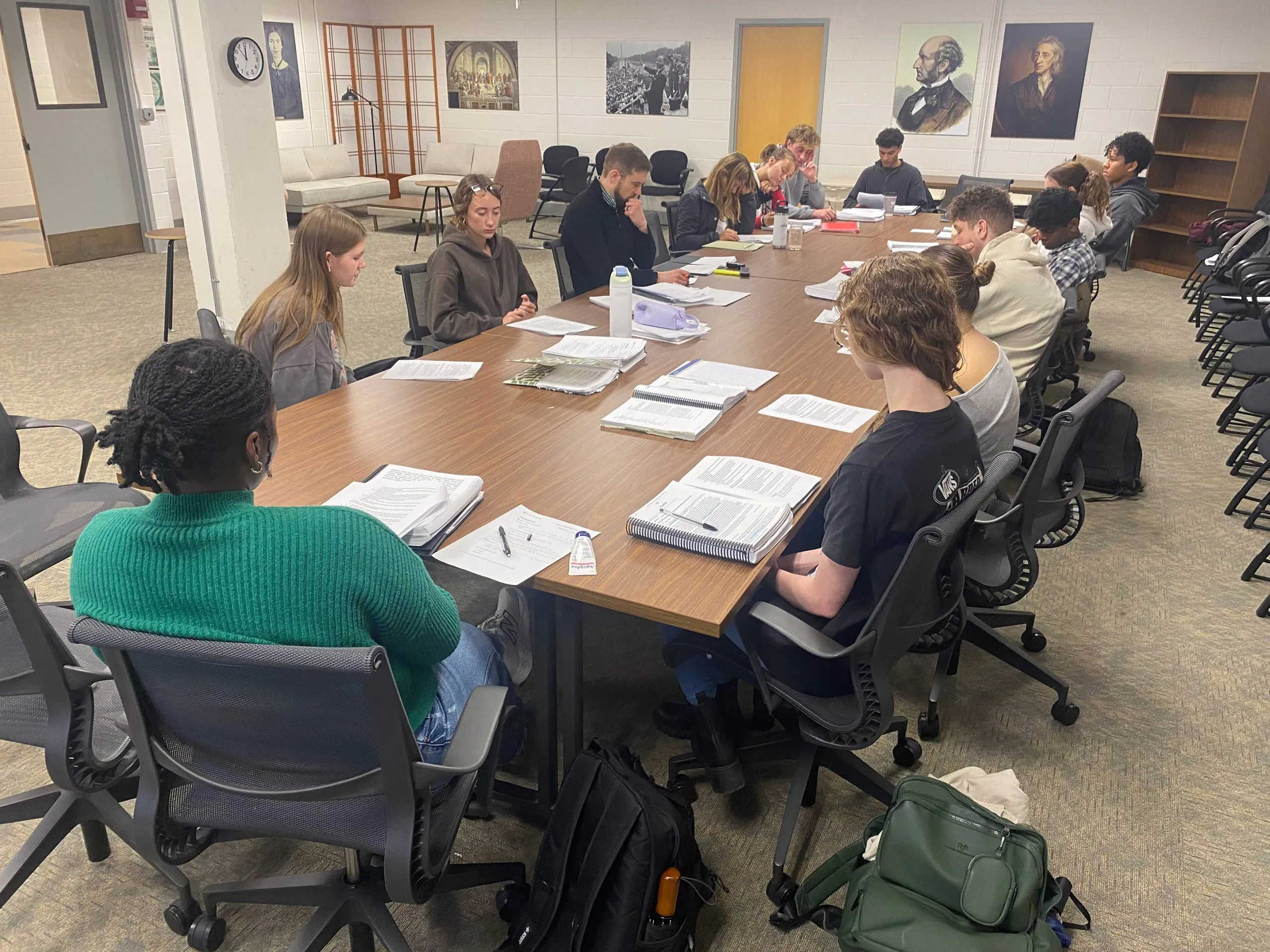
On a cool morning last fall, seven students who had enrolled in one of Chase’s inaugural classes, “The American Civic Tradition: Then and Now,” sat around a long table, debating whether the abolitionist Frederick Douglass believed the Constitution was a pro- or anti-slavery document.
As the debate got heated, lecturer David Little raised the concept of civic friendship, which encourages respect between people with differing opinions. Evelyn Wan, a freshman from Maryland, said she believed New York Congresswoman Alexandria Ocasio-Cortez embodied its ideals. Little appeared mildly amused by this, but he let the students continue their arguments, occasionally connecting them back to the readings — Alexis de Tocqueville’s philosophical arguments and scriptural references in Lincoln’s second inaugural address.
“I do think the Chase Center can be a good way to get outside of the echo chamber if you’re only in one kind of social circle,” said Wan, in an interview after the class. “But it is very Republican and very patriotic. If you come in with a blank slate, you’ll probably come out a Republican.”
Other students agreed.
“Sometimes he baits me into pushing back against him,” Amiri Rice, a junior who is majoring in political science, said of Little, “but I feel like it produces good discussions.”
During the 2018-19 school year, law professor Lee Strang was a visiting fellow at Princeton University’s James Madison Program in American Ideals and Institutions, a privately funded, conservative-leaning unit considered to be the grandfather of the modern civics center movement. When Strang returned to the University of Toledo, he began working to bring similar centers to Ohio. But rather than seek out donors, he found an eager partner in state Senator Jerry Cirino.
Cirino said that when he was in college, and ever since, faculty leaned left. “That is indisputable,” he said. “We wanted to balance that out and make sure students are getting a diverse set of views in things like politics and economics.”
By 2023, Cirino had his sights set on a total overhaul of higher education; he wanted to eliminate mandatory diversity, equity and inclusion training, ban faculty strikes and weaken tenure protections. In a less sweeping, separate piece of legislation, Cirino proposed creating “intellectual diversity centers” to teach civics courses at two schools, Ohio State and the University of Toledo College of Law.
He worked closely with Strang to craft legislation that would allow these centers to have maximum independence from the universities that would house them. Strang said he had noticed a limitation at Princeton’s Madison program: Even though it had its own funding, its position within the political science department stymied its ability to hire freely.
When the Ohio House declined to take up Cirino’s larger bill, he responded by making the civic center legislation more expansive.
“I decided if they’re not going to give me the reforms I’m looking for, I’m going to add three more of these,” he said of the centers. The bill passed as part of the legislative budget and Strang went on to lead Ohio State’s Chase Center.
Cirino’s intellectual diversity center bill now serves as the basis for model legislation put out by the conservative National Association of Scholars that proposes the creation of similar centers, run largely independently from the colleges that house them and from faculty who have “abandoned their commitments to intellectual freedom, the Western heritage, and the American heritage.”
The association has argued that merely requiring specific courses isn’t sufficient. “A law requiring the teaching of American history likely will result in a course devoted to describing American history as a catalogue of sin,” it wrote in introducing its model legislation. “Policymakers must change the administrative structure of higher education to change the substance of what professors teach in college classrooms.”
This spring, Iowa lawmakers passed a bill that appeared to be based on the association’s model legislation, creating the Center of Intellectual Freedom at the University of Iowa.
Related: Trump administration makes good on many Project 2025 education goal
These laws, and others like them, drastically change traditional hiring and firing procedures for faculty. Usually, new hires at a university go through several layers of academic approval, with input from existing faculty, deans and administrators. But in Ohio, for instance, each campus center has a separate academic council, whose members must be approved by the state legislature. State senators consulted with university presidents about nominees and ultimately chose to replace two proposed members on one council. Chase’s council includes several notable conservatives and no prominent liberal scholars.
That council then recommends a director who has far more power than any department head. According to the law, the director “shall have the sole and exclusive authority to manage the recruitment and hiring process and to extend offers for employment for all faculty.”
“This is essentially legislatively directed hiring at a university,” said Ashley Hope Pérez of Ohio State, an associate professor of literature, director of undergraduate studies and a member of the university senate steering committee. “It’s basically setting up political loyalty for tenure.”
A spokesperson for Ohio State President Ted Carter, however, said that the university’s board of trustees approves all faculty hires, including those at Chase.
“President Carter supported creation of the Chase Center, and the university structured the center in accordance with state law to further our mission of educating for citizenship,” said Benjamin Johnson, assistant vice president of media and public relations, in an email.
Other faculty who have been department chairs and on hiring committees said that trustee approval was more of a rubber stamp without individual vetting.
Earlier this month, a Chase assistant professor, Luke Perez, was charged with assaulting an independent journalist who had attempted to ask former Ohio State president Gordon Gee a question. Gee was a guest speaker in Perez’s class. Ohio State placed Perez, who pleaded not guilty, on administrative leave while the university investigates, Johnson said.
In hiring professors, Chase leadership said there was no political litmus test. The goal “is not to establish a conservative faculty,” Cirino said. He hopes the centers will hire professors who will teach students how, rather than what, to think.
“We have been explicit about saying we don’t care where you’re coming from, religiously, politically, ideologically,” said Strang. “What we care about is, are you going to contribute to, in a simple and thoughtful way, the education of Americans from all backgrounds?”
He added that the center’s new hires represent a broad spectrum of academic thought.
“What that has done is it has made the Chase Center much more diverse than almost any academic unit in a large public university.”
But ideologically speaking, the diversity mostly ranges along a conservative spectrum. There are Reagan-supporting neoconservatives who object to the views of MAGA along with professors who support President Trump and others whose politics are shaped by conservative interpretations of Christianity. Strang said he didn’t track the political leanings of his staff, but that he wasn’t surprised if there were more right-leaning professors in the mix since, he said, conservative academics often felt they didn’t have an equal shot in the usual hiring process.
Related: Behind the turmoil of federal attacks on colleges, some states are going after tenure
“The phrase ‘intellectual diversity’ has become really a Trojan horse for the imposition of ideological stances,” said Amy Reid, the program director of PEN America’s Freedom to Learn project, who co-authored a new report that criticizes civics centers like Chase. “When you have bills to ensure that there is viewpoint diversity, what they’re really doing is ensuring that there is a space for conservative ideology.”
Critics also point out that almost all of the new hires are white and most are male. The same is true in other publicly funded civic centers: In all, a Hechinger analysis shows, about 75 percent of their faculty are male and more than 85 percent are white, compared to 52 and 65 percent, respectively, at all public and nonprofit four-year universities.
Pérez and other leaders in the faculty senate also say the center is duplicating courses already being taught in other departments while using the scholarships to draw students away from those courses and to the Chase Center’s classes. For example, Ohio State’s Center of Ethics and Human Values offers a certificate (similar to a minor) called Civil Discourse for Citizenship.
Unlike Chase, most departments at the university are funded partially based on how many students enroll in classes, so losing students to Chase courses means losing revenue.
“There is a diversion of funding from actual educational needs while dumping money into these centers,” said Pérez.
Some faculty also say that the cost of new tenure-track positions with salaries and benefits will rise to tens of millions of dollars over the next several years, and that it’s unclear whether the state legislature will commit to funding in the future.
Ohio State said Chase had a projected five-year budget that includes fundraising, tuition revenue and state support.
Soon, thousands of Ohio college students will be funneled through these centers. It took two years, but in 2025, Cirino finally got his major higher education overhaul through the full Ohio legislature. This time, it has a new provision: All students earning a bachelor’s degree will have to take an American Civic Literacy course.
“When we see statistics about the embracing of socialism by our young people, we sit back and we wonder why,” Cirino said in a podcast with the American Council of Trustees and Alumni. “Well, we have not schooled them on the free market capitalism. We have not schooled them on the historical massive problems that socialism, when it has been experimented with, has resulted in.”
The new course will feature foundational texts from U.S. history as well as lessons about capitalism.
The civic centers will be ready to teach it.
Contact senior investigative reporter Meredith Kolodner at kolodner@hechingerreport.org or on Signal: @merkolodner.04.
Contact investigations editor Sarah Butrymowicz at butrymowicz@hechingerreport.org or on Signal: @sbutry.04.
This story about conservative-leaning civic centers was produced by The Hechinger Report, a nonprofit, independent news organization focused on inequality and innovation in education. Sign up for our higher education newsletter. Listen to ourhigher education podcast.
This <a target=”_blank” href=”https://hechingerreport.org/conservative-leaning-civic-centers-public-colleges/”>article</a> first appeared on <a target=”_blank” href=”https://hechingerreport.org”>The Hechinger Report</a> and is republished here under a <a target=”_blank” href=”https://creativecommons.org/licenses/by-nc-nd/4.0/”>Creative Commons Attribution-NonCommercial-NoDerivatives 4.0 International License</a>.<img src=”https://i0.wp.com/hechingerreport.org/wp-content/uploads/2018/06/cropped-favicon.jpg?fit=150%2C150&ssl=1″ style=”width:1em;height:1em;margin-left:10px;”>
<img id=”republication-tracker-tool-source” src=”https://hechingerreport.org/?republication-pixel=true&post=114965&ga4=G-03KPHXDF3H” style=”width:1px;height:1px;”><script> PARSELY = { autotrack: false, onload: function() { PARSELY.beacon.trackPageView({ url: “https://hechingerreport.org/conservative-leaning-civic-centers-public-colleges/”, urlref: window.location.href }); } } </script> <script id=”parsely-cfg” src=”//cdn.parsely.com/keys/hechingerreport.org/p.js”></script>
