

Listen to the article
This audio is auto-generated. Please let us know if you have feedback.
Dive Brief:
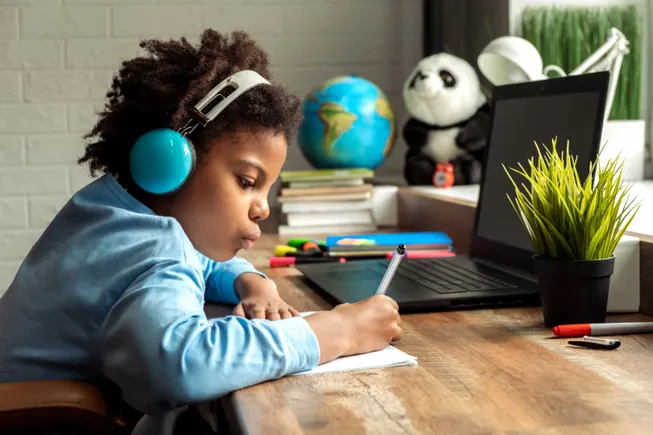
- Struggling readers in Missouri’s Kansas City Public Schools showed statistically significant gains in literacy outcomes when virtual high-impact tutoring was used within a multi-tiered system of support framework, a study from Stanford University’s National Student Support Accelerator found.
- Using 1:1 teacher-led virtual tutoring program in early literacy, the study analyzed data from 1,550 students across 14 elementary schools in grades 1-4. Students who scored “well below” grade level on benchmark assessments at the start of the 2024-25 school year particularly benefited.
- Participating students also saw significantly higher gains in annual typical growth (10.84 percentage points) and annual stretch growth (5.24 percentage points) on the i-Ready reading assessment.
Dive Insight:
The tutoring intervention aims to provide a scalable and sustainable way to boost access to personalized learning for students, the study released in February said.
Stanford researchers conducted the analysis through a randomized controlled study. They split students eligible for the virtual tutoring services into two groups. One half received 1:1 virtual tutoring for 30 minutes at least three times per week over 20 weeks. The other half continued to receive the standard instruction they typically receive but without virtual tutoring.
Students who were the furthest behind and received the virtual tutoring outperformed their peers and gained weeks or months of learning. For example, participating 1st graders had 0.82 months of learning and 4th graders gained about 2 additional months of learning.
Another promising study on virtual tutoring and student outcomes was released in January by the Center for Research and Reform on Education at Johns Hopkins University.
The researcher analyzed the impact of a 1:1 virtual tutoring literacy intervention based in the science of reading for Massachusetts students across 13 public school districts in 2024-25. The study found that the 1,872 participating 1st grade students made significant progress in decoding and early fluency skills — equivalent to over five months of additional instruction.
On average, students received 33 hours of tutoring over 36 weeks.
Additionally, the study found these literacy gains were sustained into the 2nd grade. For students who completed the tutoring program at or above grade level by the end of 1st grade, 85% continued to read at or above grade level by the end of the 2nd grade even though they no longer received the tutoring.
“These findings show that intervening to ensure students are reading on grade level by the end of first grade is highly effective and has promising implications for district planning and policy initiatives focused on improving third-grade reading outcomes,” the Johns Hopkins report said.
These virtual high-dosage tutoring interventions come at a time when students are still trying to recover from learning loss during the COVID-19 pandemic.
NWEA, an assessment and research company, recently released a study that found about a third of schools have recovered in math or reading after the pandemic. But far fewer schools recovered in both subjects — just 1 in 7. Even though schools serving higher-poverty and historically marginalized students were less likely to fully recover, they saw the largest gains.
