

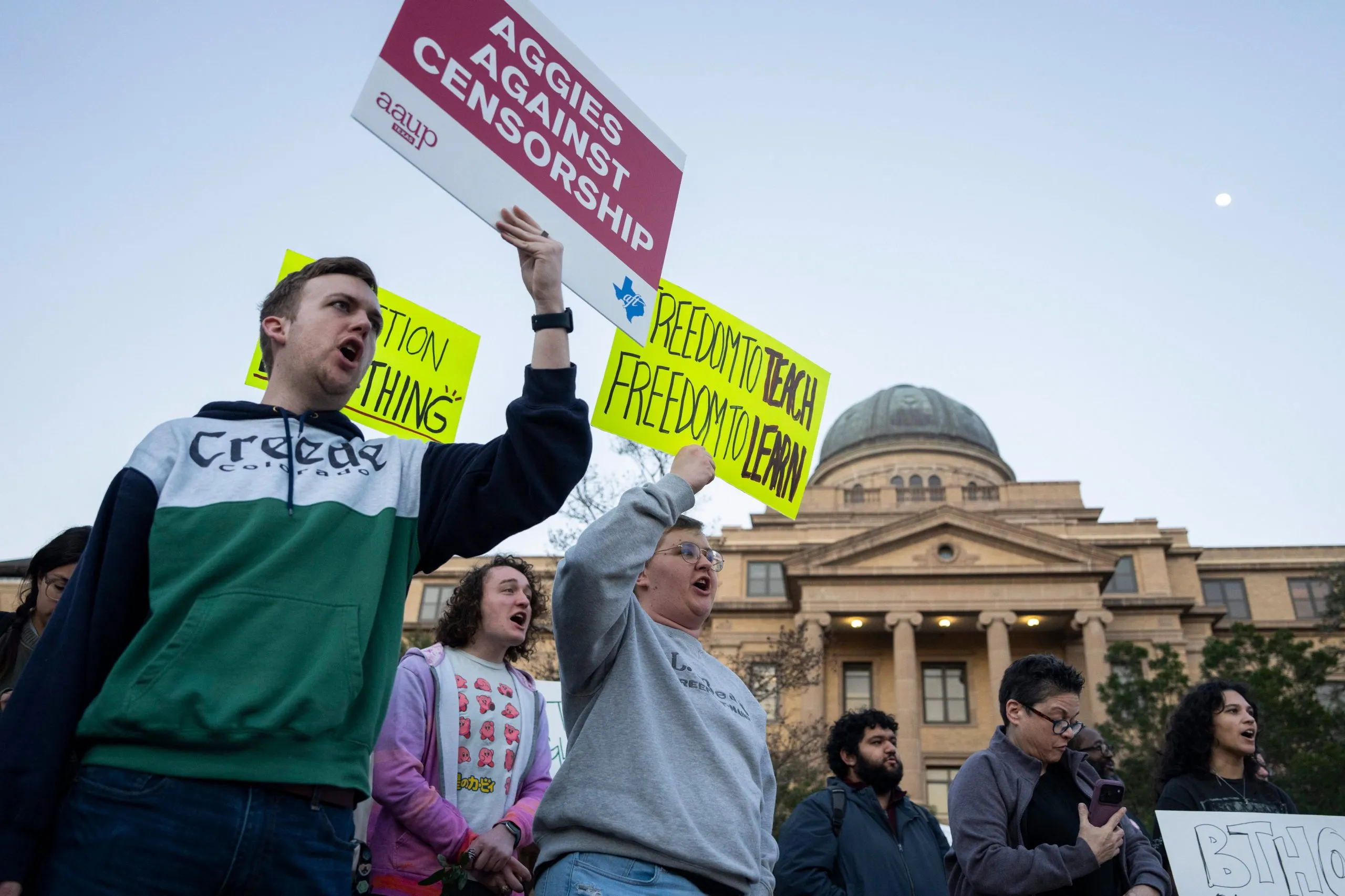
When Texas A&M ended its women’s studies program and overhauled its race and gender classes last month, its actions joined a long line of recent institutional rollbacks of women’s rights and autonomy in Texas and across the nation, from eliminating diversity, equity and inclusion programs to cutting access to legal abortions.
With this closure and overhaul, Texas A&M — one of the largest public schools in the country — reveals that it is not, as the home page of its website announces, “a force for good,” but rather that it is willing to capitulate to save little and hurt a lot.
Shuttering a women’s studies program, overhauling a gender studies program and cancelling courses focused on race and gender are attacks on all feminist movements and women everywhere. They send a message that the study of women and gender is a waste of time and resources. The cancellations also illuminate the troubling reality that rather than supporting the mission of public higher education, state and federal policies are increasingly functioning as instruments of censorship.
Related: Interested in innovations in higher education? Subscribe to our free biweekly higher education newsletter.
Amid this turmoil, we cannot forget that students are unwittingly caught in the middle of this political game. Cancelling classes that students count on for degree progression is damaging; it leaves them scrambling to adjust their schedules and grappling with the revelation that, despite oft-spoken platitudes, their university does not actually care about their particular intellectual pursuits, or at least not enough to stand up to censorious policies.
Such cancellations disrupt all students, even those not interested in women’s and gender studies. Students whose schedules are not upended by this shift are witnesses to the disruption; they may see their friends struggle, they may experience more crowded classes because of the overflow of students from the shift, and they may justifiably fear that their own programs of study are next.
This results in a chilling effect and message to Texans that is clear: Pursue studies of a safe topic in a docile manner.
The decision in favor of the cuts was made by interim president Tommy Williams, who maintained there was no way to support the programs as they were, given the need to comply with “new system policies” that aim to eliminate courses and programs centering on women and historically underrepresented groups. It was an oblique reference to federal changes under President Donald Trump, who uses funding and the threat of federal investigations as a stick to force academic institutions to eliminate DEI policies and subjects.
In what can clearly now be understood to be a preview of this women’s studies closure, Texas A&M cancelled its LGBTQ studies minor and popular culture and performing social activism certificates in 2024, with the university citing low enrollment and State Rep. Brian Harrison calling the courses an “outrageous abuse of tax money.”
Whatever the fallout of these cuts, chances are it will be shouldered not by Williams but by his successor. Williams’ compliance communicates the current power dynamic to any candidate interested in taking the helm: The state legislature is in complete control and any expectation of academic freedom will be strictly rhetorical.
Most frightening is that these cuts reveal how higher education, specifically university personnel at the executive level, can be complicit in perpetuating the patriarchy’s manipulative control.
Shuttering a women’s studies program signals to women everywhere that they will be silenced.
The cuts send a clear message to public institutions everywhere, in red and blue states alike, that “You could be next.”
They also send a message to students that these fields are a waste of time. Ending the formal, university-supported study of women means that fewer stories about women will be told, which will slowly but surely render women less visible and less valued.
What is really happening here? Why shut down a popular course of study? I believe it is because the resilience, influence and power of women is so strong and is perceived as a threat.
Related: How education changed in one year under Trump
Women have proven, over the generations, and most recently in Minnesota, that they will put their bodies on the line to protect not just other women, but whole communities.
Mothers in Minneapolis have gathered to protect their children’s teachers from ICE raids. Women survivors of physical and sexual abuse have recognized the tactics ICE used to kill and to justify the killing of Renee Nicole Good and are swiftly making those connections clear to others. Stella Carlson, formerly known as “the woman in the pink coat,” captured and released the first video of the murder of Alex Pretti by ICE agents. Kayla Schultz, another woman who recorded the murder of Pretti, says it is time to “make some noise” in order to protect our communities.
Despite all that Texas and the nation overall are doing to whitewash history (rolling back human rights and civil liberties, censoring thought and attempting to control bodies they feel threatened by), these Minnesotan women are evidence that it will not work.
Women will not be relegated to obscurity and will not stand down. Women’s and gender studies programs may be silenced, but women never will be.
Allison T. Butler teaches in the Department of Communication at the University of Massachusetts Amherst. She is the author of the forthcoming “The Judgment of Gender: How Pop Culture Centers and Silences Women.”
Contact the opinion editor at opinion@hechingerreport.org.
This story about cuts to women’s studies and gender studies programs was produced by The Hechinger Report, a nonprofit, independent news organization focused on inequality and innovation in education. Sign up for Hechinger’s weekly newsletter.
This <a target=”_blank” href=”https://hechingerreport.org/opinion-shuttering-womens-and-gender-studies-programs-sends-the-wrong-message-to-higher-education/”>article</a> first appeared on <a target=”_blank” href=”https://hechingerreport.org”>The Hechinger Report</a> and is republished here under a <a target=”_blank” href=”https://creativecommons.org/licenses/by-nc-nd/4.0/”>Creative Commons Attribution-NonCommercial-NoDerivatives 4.0 International License</a>.<img src=”https://i0.wp.com/hechingerreport.org/wp-content/uploads/2018/06/cropped-favicon.jpg?fit=150%2C150&ssl=1″ style=”width:1em;height:1em;margin-left:10px;”>
<img id=”republication-tracker-tool-source” src=”https://hechingerreport.org/?republication-pixel=true&post=115140&ga4=G-03KPHXDF3H” style=”width:1px;height:1px;”><script> PARSELY = { autotrack: false, onload: function() { PARSELY.beacon.trackPageView({ url: “https://hechingerreport.org/opinion-shuttering-womens-and-gender-studies-programs-sends-the-wrong-message-to-higher-education/”, urlref: window.location.href }); } } </script> <script id=”parsely-cfg” src=”//cdn.parsely.com/keys/hechingerreport.org/p.js”></script>
