

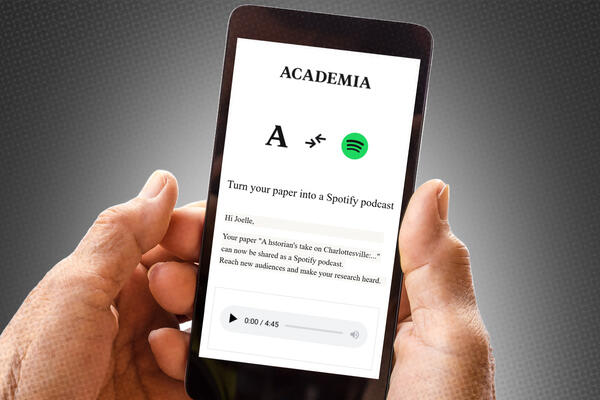
When I first saw the email with the subject line “Turn your paper into a Spotify podcast,” I thought it was a joke. When I realized it wasn’t, I deleted it immediately, as though its very presence in my inbox might be contagious. But like a child peering at a scary scene through her fingers, I couldn’t unsee or ignore it, so I opened my trash folder to reckon with it:
“Hi Joelle,
“Your paper ‘A hstorian’s [sic] take on Charlottesville: …’ can now be shared as a Spotify podcast. Reach new audiences and make your research heard.”
I’d forgotten about Academia.edu, an online repository popular particularly with grad students and emerging scholars. I’d created an account years ago when I moved to Boston and was constantly searching for teaching gigs. When I logged in after receiving this recent email, I found four of my articles on the site, none of which I remember uploading. I certainly didn’t give explicit permission for the company to turn my work into a podcast, but as it turns out, I didn’t need to. Users of Academia.edu or any online platform should read the terms and conditions carefully, particularly when it comes to AI. And users who care about accuracy, attribution and learning should delete their accounts.
Academia.edu has been sketchy for a while. It no doubt purchased the .edu domain because it wanted to pose as an educational nonprofit, rather than the for-profit institution it really is. Since its founding in 2008, Academia.edu has received funding from corporate investors such as Tencent Holdings, Khosla Ventures, Spark Capital and True Ventures in a bid to compete with other online platforms such as ResearchGate.
That competition prompted Academia.edu to team up with Spotify to release podcasts derived from papers in its database. I couldn’t listen to the podcast derived from my own paper without becoming a premium member of Academia.edu, and I won’t give the site money. But I could listen to other similar podcasts for free. Each one starts with CEO Richard Price introducing himself and talking about the cool new research that the episode features. Except it’s not actually Price—it’s an AI-generated voice with natural pauses and intonation.
What’s more disingenuous and problematic is that AI also paraphrases the papers’ findings and arguments to make them more accessible to a bigger audience. The use of AI can introduce idiosyncrasies and errors into the podcasts. Other academics have reported that the podcasts contain AI-contrived non sequiturs, such as the host randomly commenting on drinking a coffee in Prague or falsehoods or arguments that directly contradict those of the author.
Given how many academics would recoil at the use of their work in this way, Academia.edu changed its terms and conditions so we didn’t need to consent. The company made a controversial rights grab in September 2025, when it asserted that the creation of an account gave it the rights to “use your Member Content and your personal information (including, but not limited to, your name, voice, signature, photograph, likeness, city, institutional affiliations, citations, mentions, publications, and areas of interest) in any manner.”
In other words, under those terms, the existence of an Academia.edu account gave the company permission to commit fraud in the name of the scholars it purports to help.
Users pushed back on the new terms and got Academia.edu to drop its claim on name, voice, signature and likeness. Remaining in the terms, however, is the provision that users grant Academia.edu the right to use AI “to generate adaptations and other derivative works of Member Content.” In addition to podcasts, Academia.edu scrapes content to generate “fireside chats” and personalized comics as well.
Many users deleted their accounts. Others, like me, had no idea any of this was happening until now. Academia.edu banks on the ignorance of users, especially inactive ones. There is a setting to turn off AI’s access to your material, but that’s not helpful for users who didn’t know about it or whose work has already been harvested.
It’s bad enough that AI can scrape, transform and misrepresent one’s work, but the availability of the resulting podcast on Spotify further twists the knife. Spotify hosts misinformation machines such as Joe Rogan, and it’s advertised for U.S. Immigration and Customs Enforcement. Anyone who is still on Academia.edu and cares about the integrity of their work or about the consequences of companies using AI to plunder and commodify academia and research should delete their account, now.
Many educators like me worry about the use of AI to destabilize foundations of knowledge and learning. We’re concerned about the erosion of critical thinking, metacognition, reading comprehension and other essential skills. We’re concerned about companies and institutions forcing AI down the throats of faculty, students and anyone who uses the internet. We’re concerned about the “Spotify-cation” of knowledge, as though listening to a series of AI-generated podcasts constitutes learning.
These types of AI commodify and devalue learning, and they do so by design. Scraping the web and turning my paper into a podcast that’s delivered without human fact-checking or invention doesn’t facilitate education. Academics and their scholarship shouldn’t be collateral damage in the world of AI. More importantly, neither should students or anyone attempting to learn.
