

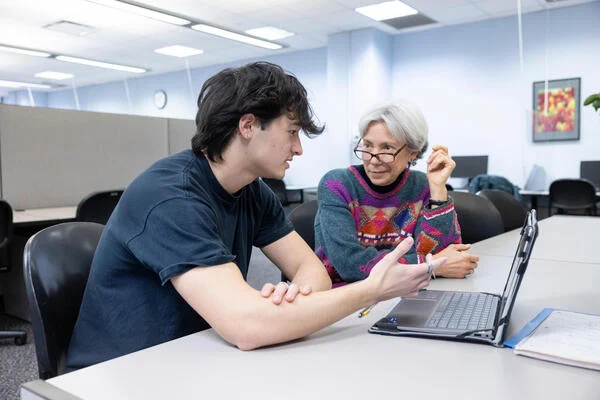
Community colleges are a primary gateway to higher education for first-generation and nontraditional students. But many face barriers to completion, ranging from navigating complex transfer pathways to experiencing basic needs insecurity, often while balancing work and caregiving responsibilities.
To help address those challenges, the One Million Degrees program provides holistic support to students at the City Colleges of Chicago, including student success coaching, financial support, academic advising and career development. Data shows that participants earn degrees at higher rates, secure stable employment and see stronger earnings outcomes than their peers not enrolled in the program.
New long-term results from an ongoing randomized, controlled trial conducted by the University of Chicago Inclusive Economy Lab demonstrate that the model significantly improved degree completion and increased annual earnings by more than $14,000 on average seven years after enrollment for students who applied while still in high school.
Aarti Dhupelia, chief executive officer of One Million Degrees, said the student-centered model helps participants graduate as well as achieve longer-term career outcomes.
“The program not only helps [students] complete these steps along the way, but also builds confidence and networking skills—and, in some cases, connections through volunteer professional coaches—that help them succeed after college,” Dhupelia said.
The study tracks multiple cohorts of community college students who applied to the program beginning in 2016, examining eight-year degree attainment and seven-year labor market outcomes. To participate in the program, students must be Pell eligible or meet the criteria for the City Colleges of Chicago’s Star Scholarship and be pursuing their first college degree, with at least one academic year remaining before graduation.
“One of our scholars said to me, quite simply, ‘[One Million Degrees] puts the “community” in community college,’” Dhupelia said. “That support from her program coordinator, along with the experience of being with other students in this career-connected learning community, has created an environment that makes students more likely to succeed.”
What the data shows: Participants were 16 percent more likely to earn a degree than their peers in the control group. Those who applied while still in high school saw even larger gains: They were 48 percent more likely to earn a degree.
“The impact is amplified if you apply while you’re still in high school,” Dhupelia noted. “There seems to be an effect for students who are on the fence about going to college at all.”
“In any higher education institution, a student—particularly a first-generation college student—walks in feeling nervous about whether they can succeed,” she said. “This added support helps build confidence because there is a supportive community that has their back and ensures they aren’t getting lost in the crowd while in community college.”
Compared with the control group, program participants were 21 percent more likely to graduate with a stable job—defined by the study as a long-term, full-time position that provides consistent income, fixed hours and employee benefits.
Again, the effects were even larger for students who applied while still in high school: They were 83 percent more likely to be working in a stable job and 90 percent more likely to be enrolled in school or working full-time than their peers in the control group.
Dhupelia said participants also frequently connect with professional coaches across industries—from health care to business and education—who facilitate workshops on networking, interviewing, résumés and cover letters. She said these relationships help students “complete college and achieve economic mobility.”
Why it matters: Dhupelia said the program’s long-term results reflect a deliberate effort to preserve its core approach as it has expanded, supported by shared goals with the City Colleges of Chicago.
“We haven’t cut corners in our model in order to scale,” Dhupelia said. “We always want to be as effective and efficient as possible with limited resources. But we also know what works, and we’re not going to dramatically change something without being intentional about what we’re trying to achieve.”
Ultimately, Dhupelia said, colleges and policymakers should take away from the program’s success the importance of personalized support and community building.
“This model demonstrates an opportunity to invest in what works,” Dhupelia said. “It highlights the need to bring all of those pieces together as we support students—particularly students who are low income or the first in their family to go to college—who would benefit from an extra level of support.”
Get more content like this directly to your inbox. Subscribe here.
