

Get stories like this delivered straight to your inbox. Sign up for The 74 Newsletter
The project that teacher Matt Gebhard presented to students earlier this month at the Amp Lab entrepreneurship high school in Ft. Wayne, Indiana, was, in one way, straightforward: Help a company solve a problem.
Steel Dynamics Inc., a local manufacturing company, wanted student help recruiting young women and candidates from different ethnic groups that don’t often seek manufacturing jobs.
“They’re kind of expanding their outreach,” Gebhard told a classroom of juniors and seniors, all deciding between eight business and non-profit project challenges to spend the spring working on. They’re kind of rebuilding recruitment from the ground up…so your job is to create some marketing around that.”
But Gebhard wanted students to consider another level, a more personal one, as they made their choice, telling them to carefully pick the project that fits a passion or teaches them a key skill toward a career goal.
That’s the overall mission of Amp Lab, after all. Still in its infancy, the school launched in 2022 with a very different goal from a typical high school:
Developing an entrepreneurial mindset that applies across multiple careers or businesses, especially companies they might start themselves.
Though many high schools boast of creating good work opportunities for students, few have overcome the schedule and transportation hurdles to place students in internships, even when companies want them. Only about 6% of high school students nationally have the chance to do an internship or apprenticeship, the best available estimates show.
Amp Lab’s model is built around giving every student the opportunity to work with local businesses, going beyond even some of the more ambitious schools in the country. The school also focuses on building mastery of personal skills — including insight, persistence, problem solving, turning problems into opportunities — alongside broad business skills such as financial management, legal analysis, marketing, sales and operations.
“Always think of it this way: How does this matter to you 10 years from now?” Gebhard told students. “Like, what is this going to do for you 10 years from now?”
Amp Lab teacher Matt Gebhard tells students about one of their eight choices of companies or nonprofits to work with this spring. (Patrick O’Donnell)
Amp Lab doesn’t look or feel like a typical high school. For starters, its full name is Amp Lab at Electric Works, referring to the massive 38-acre factory complex that was a General Electric motor plant for decades before being renovated and re-opening as home to the school and several area businesses in 2022.
Open to high school juniors and seniors from across the Ft. Wayne Community Schools — half of its 400 students coming in the morning and half coming in the afternoon — Amp Lab is officially a career technical school. But it doesn’t teach the auto repair, construction and plumbing skills offered at typical career training centers.
Its only focus is entrepreneurship.
“In most traditional CTE centers, you’ve got a bunch of individual programs that are all separate,” said founding Principal Riley Johnson. “What we chose to do here was kind of flip that equation. Every kid that comes to Amp Lab is in the entrepreneurship pathway, and their connection to industry skill is across all potential career clusters.”
“We look at entrepreneurship as a mindset and a tool set that a kid can apply, whether they’re in banking or veterinary science or cosmetology.”
The Electric Works complex, once a GE factory that employed a third of the city’s workforce during World War II, is now home to several businesses along with Amp Lab. (Patrick O’Donnell)
Work-based learning is a key part of the model. so Amp Lab has students engage with businesses in the spring and in the fall using three different methods:
- Every junior takes on at least one group project for a local business, such as the one Gebhart described, that they do mostly at school with some visits to the company.
- Students can choose to start their own business by developing a product and a marketing plan. They either make it themselves or hire a company to make it, and then sell it.
- About half do a traditional internship working at a local company about 10 to 15 hours a week.
“Our goal is that, in some form or fashion, every kid gets an external experience, but we’re not there yet,” Riley said.
Regardless of the approach, teachers evaluate how student skills are growing and weigh the growth of students’ mindset as much as teachers in traditional high schools weigh progress in math and English. That progress is all reported to students, parents and colleges on an innovative but still-developing supplement to traditional report cards called a Mastery Learning Record that shows how well students are moving toward mastering a skill, rather than just giving them an A-F grade at the end of a quarter.
Amp Lab is one of 40 schools nationally testing the Learning Record as it is refined.
How the Learning Record works with those schools will help inform an effort by six states and others to test, measure and report student progress on so-called “durable skills,” the first being collaboration, communication and critical thinking. Amp Lab is just one data point as new report cards are developed, but the school was recently highlighted by the non-profit XQ Institute for embracing an innovation it wants high schools to adopt nationally.
“These competencies aren’t easy to convey in a conventional report card or transcript,” XQ wrote in its recent report, The Future Is High School, calling the learning record “far more detailed and nuanced.”
“The Amp Lab record documents exactly which competencies students have mastered, such as intuitive agility, collaborative intelligence, and — yes — entrepreneurial spirit,” XQ added.
The work-based “challenges,” as the school calls them, can look different for every student.
When Amp Lab launched, the school had to seek out businesses willing to work with students. on these projects. Now, it has more applications than it needs, and can tell businesses to refine them and apply again later. The goal isn’t just to invent a project for students, but have them work on a problem the business is truly facing and have the work matter.
This spring, students are picking from eight businesses and non-profits, including: the Steel Dynamics project; designing and testing a part for another manufacturer; helping a local nonprofit spread messages aimed at improving maternal health; designing a plan to encourage vegetable gardening in a low-income neighborhood; or designing and creating murals to promote a historic arena in the city.
Sometimes the projects line up well with student interests. Senior Tyreece Menifee Jr., who wants to be both a barber and fashion designer, worked last year designing costumes and marketing for a production of A Christmas Carol by the Ft. Wayne Youth Theater.
He then created his own mini business by designing a hooded sweatshirt — picking the fabric, background design and the lettering for it — and ordering a batch of 20 from a Pakistani company online. He’s now selling the hoodies for $90 on a website he created.
“I’ve learned a lot of stuff here, just being here,” Menifee said. “I feel like the environment changes your mindset. You get focused on what you need to do.”
Amp Lab senior Tyreece Menifee Jr. shows off the sweatshirt he is selling. (Patrick O’Donnell)
Senior Ruby Campbell-Carpenter used her interest in animals to create a pet food business called Tailored Bites. She talked with a veterinary clinic, the county health department and a meat company that school staff helped her connect with, to create a chicken based dog food — one that passed taste tests of several dogs — that she and a classmate then sold at a farmers market.
She also interned at a veterinary office through the school last spring, which turned into a part-time job last summer and helped confirm her plans to become a vet.
“Amp Lab is very growth oriented,” she said. “They grade you based on if you’re growing, if you’re learning,” she said. “Amp Lab also has so many connections, compared to your typical high school. They honestly have connections to pretty much every business.”
Sometimes the school finds internships with businesses or nonprofits right at the Electric Works complex, letting students work without needing transportation from the school.
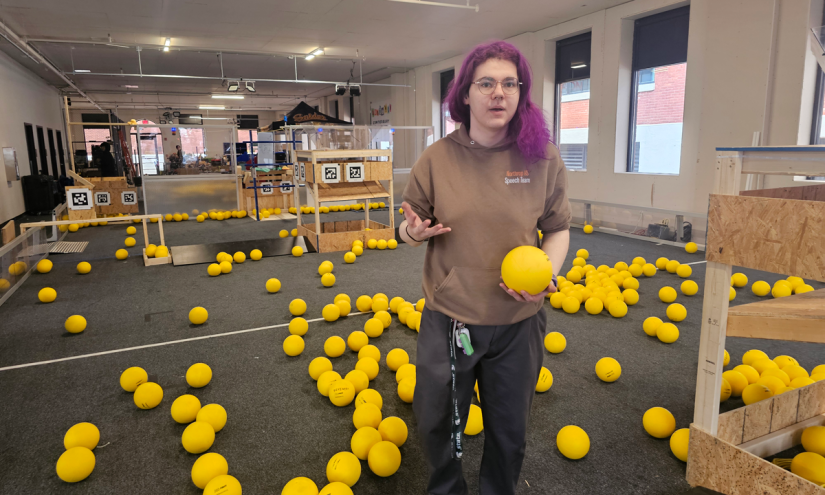
Those include a health clinic, an advertising agency, a manufacturer of steel decking and the nonprofit REFINERY — Robotics Education, Fabrication and Innovation Nexus: Entrepreneurship for Rising Youth — a giant open maker space that robotics teams from local high schools can use as a workshop. It also serves as a central bulk purchaser for those teams.
Interns like senior Alfy Krider, a member of the robotics team of Northrop High School where he goes to class every morning, spends his afternoon Amp Lab time organizing equipment and the space for teams to test their robots, even 3D printing parts or ordering parts for them.
He doesn’t mind helping competitors as his job.
“Robotics really promotes gracious professionalism, which is helping out other teams as much as you can,” he said. “It’s just so much of a culture of helping everyone out, because when you need help, they’ll be there for you.”
Along with letting Krider immerse himself in the business of robotics, the company benefits hugely from student help.
“They’ve been instrumental in getting everything, honestly, built up,” said Briana Hedberg, vice president of BioNanomics, the nonprofit in charge of the space, before rattling off a list of jobs interns accomplished. “The students built all of this”
Johnson said internships like this — that let students interact with others and fill a professional role — matter as much as any class or credential.
“The resume portfolio is as powerful of a tool as anything,” he said. “We found having something like this as a door opener and as a networking tool is just as valuable as as any other currency.”
Did you use this article in your work?
We’d love to hear how The 74’s reporting is helping educators, researchers, and policymakers. Tell us how
