

Listen to the article
This audio is auto-generated. Please let us know if you have feedback.
Dive Brief:
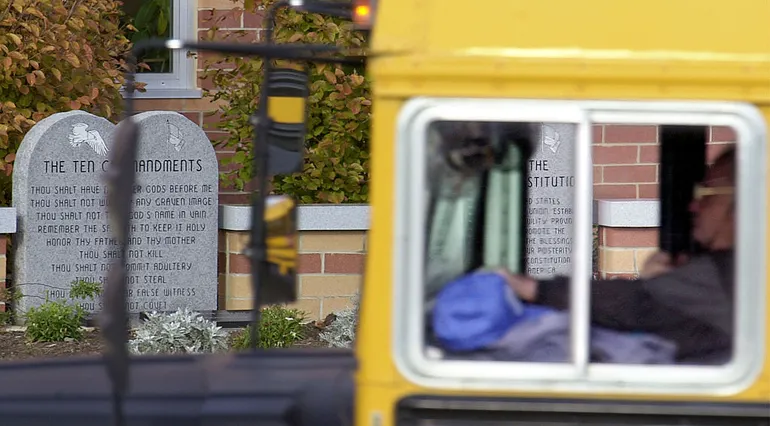
- The 5th U.S. Circuit Court of Appeals on Friday reversed a lower court’s pause on a Louisiana law requiring public schools to permanently display the Ten Commandments in every classroom.
- The appeals court’s decision in Rev. Roake v. Brumley vacated a federal district court’s November 2024 preliminary injunction, saying classrooms have not posted them yet and, as such, it is too early for the courts to decide whether the displays violate the First Amendment.
- The decision allows the nation’s first such Ten Commandments law to move forward for now, but says that could change “once the statute is implemented and a concrete factual record exists.”
Dive Insight:
The Louisiana law was meant to take effect over a year ago, on Jan. 1, 2025. It was challenged, however, under the First Amendment’s establishment and free eExercise clauses in a lawsuit filed by civil rights groups representing parents from various faiths, who said the displays would violate their rights.
An initial court order in July 2024 required state officials to take a temporary step back from rolling out the law. That order was followed months later by another from the U.S. District Court for the Middle District of Louisiana, pausing the law while the lawsuit is pending.
In the Feb. 20 decision, judges for the 5th Circuit said that a decision on the law’s constitutionality “would oblige us to hypothesize an open-ended range of possible classroom displays and then assess each under a context-sensitive standard that depends on facts not yet developed and, indeed, not yet knowable.”
“That exercise exceeds the judicial function,” they said. “It is not judging; it is guessing.”
Ten Commandment displays could, for example, have accompanying materials that teachers could reference during instruction. The statute allows additional content such as the Mayflower Compact, the Declaration of Independence, and the Northwest Ordinance to be displayed alongside the Ten Commandments, judges said. Since Louisiana’s passage of its law, other Republican-leaning states have since modeled their own proposed or passed laws, including Texas’, which also has a case pending in the 5th Circuit challenging its version of the law.
The 5th Circuit heard both the Louisiana case and the Texas case, Rabbi Nathan v. Alamo Heights Independent School District, together on Jan. 20. However, the Friday decision did not address the Texas case.
The American Civil Liberties Union, one of the civil rights groups representing the parents suing in Louisiana, said in a statement that the plaintiffs’ legal counsel “is exploring all legal pathways forward to continue the fight against this unconstitutional law.”
