

Key points:
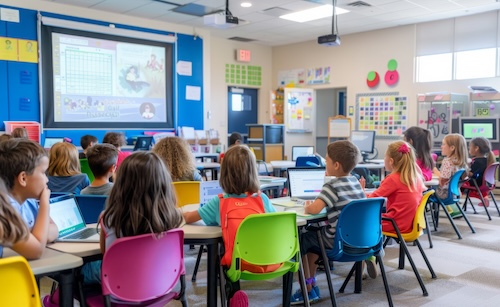
Today, about 80 percent of K-12 students use computers or tablets at school–up from about 50 percent before the pandemic. Even as parents worry about too much “screen time,” schools are ramping it up.
At RAND, we recently surveyed more than 8,000 K-12 teachers about their use of digital instructional materials. Their responses show just how deeply technology has become woven into classroom life–and how uncertain educators remain about its impact on learning.
Schools have gone all-in on digital learning, particularly since the COVID-19 pandemic. But without clear guidelines on how much screen time is too much, or how technology is used most effectively, schools risk undermining student engagement and learning rather than improving it.
One in three teachers reported that they are required by their district or school to use mostly or entirely digital instructional materials. High school teachers (50 percent) and science teachers (46 percent) are especially likely to report such requirements.
In primary schools, about 10 percent of elementary teachers said their students spend no class time at all on digital activities. These findings reveal a wide range of practices and a lack of consensus about best practices. The role of technology in schools is even being debated in Congress.
The question raised isn’t whether technology belongs in schools at all. Rather, it focuses on how schools can best incorporate it into the classroom. Right now, teachers and students alike are receiving mixed messages about what is most effective and appropriate.
Many education leaders see digital tools as a way to modernize instruction. The National Education Association has argued, for instance, that technology can expand learning opportunities and improve instructional quality. It can help teachers tailor lessons to individual needs, engage students through interactive content, and support English learners in building language skills.
But such enthusiasm is tempered by growing unease. A recent New York Times article highlighted educators’ concerns about digital distraction and overuse. The National Telecommunications and Information Administration even launched a review of how federal connectivity goals may be encouraging schools to rely too heavily on digital devices. Using screens can also lead to student distraction and trouble paying attention in the classroom. RAND research shows that one-half of middle and high school students were bored in math classes for a majority of class time and want fewer online activities.
Technology can enhance learning, but it has to be thoughtfully integrated into instruction. When screens replace meaningful interaction or hands-on learning, that can hinder engagement and deepen inequities.
School is an environment where students can learn how to effectively use the digital technologies that they are exposed to every day. Teachers can model how students should properly use technology.
So, what can schools do to make digital learning work for students as opposed to getting in the way of their learning?
Play to technology’s strengths. Choose digital activities that are engaging, personalized, and provide extra practice. Technology should supplement–not substitute–human interaction and creativity.
Vary the format and mode of instruction. Try a mix of small-group and whole-class activities. Combine digital and physical materials. Not all digital lessons need to be solo activities.
Have adults engage with students while students use screens. Teachers and parents can play an active role by monitoring how students interact with technology and guiding them toward productive use.
Select high-quality digital materials. Decisionmakers should apply the same rigor they use when selecting textbooks–checking whether materials are standards-aligned and support diverse learners.
Minimize digital distractions. Districts can use site blockers or other tools to keep students focused on learning rather than unrelated online content.
Train teachers. Professional development should help educators use technology effectively for their specific student populations.
Students today must learn to navigate technology-rich environments, but they also need guidance on how to use digital tools responsibly and effectively. The goal isn’t to roll back technology in schools–it’s to make it work better for learning. As educators experiment and refine their approaches, they can develop best practices that ensure digital learning fulfills its promise rather than amplifies its problems.
Emma B. Kassan, Sy Doan, and Julia H. Kaufman, RAND
Emma B. Kassan is a policy analyst, Sy Doan is a policy researcher, and Julia H. Kaufman is the director of the Education and Employment Program at RAND. They study education policy and teachers’ instructional resources.
Latest posts by eSchool Media Contributors (see all)
