

Get stories like this delivered straight to your inbox. Sign up for The 74 Newsletter
“School is safe. It’s the journey between home and school that is causing people to stay home, including U.S. citizens.”
That was one local district administrator’s swift reply when asked what she wants people to know about educating kids in the Twin Cities right now.
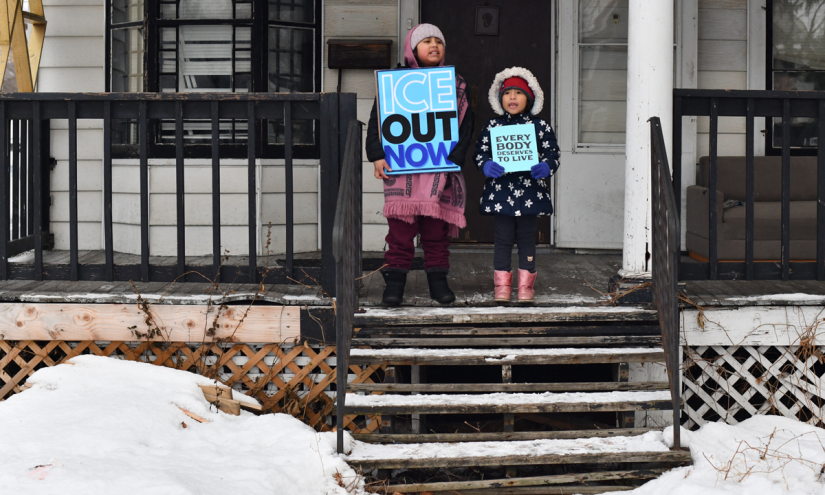
Two weeks after federal agents killed Minneapolis mother Renee Good, virtually every aspect of schooling throughout the region is being shaken by the presence of some 3,000 Immigration and Customs Enforcement and Border Patrol officers.
“We’re being impacted on a basis that well outpaces targeted immigration enforcement,” says Heather Anderson, a Minneapolis Public Schools parent who runs a nonprofit education-related program for students of color. “It’s pervasive. Everybody is being affected. Nobody can go to work. Nobody can use the school bus. …. I literally just dropped a load of groceries off to a family who can’t leave their house.”
At one of Anderson’s neighborhood schools, an estimated two-thirds of students are enrolled in distance learning, she says, but many families lack wifi or hotspots. The number of students participating in her in-person program has dropped by half.
Minneapolis Schools Shut Down for 2 Days in Wake of ICE Clashes, Fatal Shooting
“The kids who did come, several gave reports that ICE had been in their apartment complex, in their buildings, on their streetcorners,” she says. “We worked really hard at just creating a bubble of joy for them.”
Educator Kara Cisco lives a couple of blocks from where Good was killed. “My daughters are terrified even though they don’t fit a category that would fall under those that are targeted,” she says. “They’re both carrying their own passports. That’s scary.”
On the first day of distance learning, attendance in one of her daughter’s classes dropped from 25 students to nine, even though most are citizens. “It’s the general sense of fear,” says Cisco. “I’ve got one daughter that’s texting me pretty much every hour on the hour to notify me of the ICE presence around school.”
Federal agents outnumber the officers employed by the metropolitan area’s 10 largest police departments combined. They are roaming neighborhoods — often in convoys of unmarked SUVs — detaining U.S. citizens and legal residents along with people whose status is unknown. Suburban police departments have reported ICE stopping local law enforcement, in at least one instance at gunpoint.
St. Paul Public Schools reported that two vans carrying students and educators were stopped by ICE last week. Students and parents in urban and suburban school systems have been detained while waiting for school buses or public transit. A Hiawatha Collegiate High School senior was picked up at a Minneapolis bus stop Jan. 15. A parent waiting with multiple Robbinsdale Area Public Schools students was detained the day before.
The Department of Homeland Security claims to have detained 3,000 people so far. On Friday, a federal judge ordered the agents to stop using pepper spray and non-lethal munitions and detaining protesters and observers unless they obstruct the officers or there is reason to believe a crime has been committed. The U.S. Department of Justice this week appealed the order, even as residents continue to report observer detentions.
Amid Fed Ramp-up and New Fears, Twin Cities Schools Offer Online Classes
Several labor unions — including educator unions in St. Paul and Minneapolis — have called for a general strike Jan. 23, and some students have said they plan to join what’s being described as an economic protest. St. Paul schools will be in session. In Minneapolis and many Twin Cities charter schools, the strike will coincide with a long-scheduled teacher record-keeping day.
Asked at a news conference what it feels like to attend classes now, a teen in a T-shirt emblazoned with the name of Roosevelt High School — where ICE agents pepper-sprayed and tackled parents, educators and students the day Good was killed — said it was hard seeing how many kids were not there.
“When I came to school and I found lots of friends and classmates missing, it was scary,” he said. “I couldn’t imagine what they were going through.”
The chaos has made it hard for schools to create and communicate contingency plans. The St. Paul district closed Jan. 20 and 21 to allow educators to organize distance learning options. Parents and teachers in other districts, however, are reporting school-by-school ad hoc arrangements.
A parent at a high-poverty Minneapolis school in a neighborhood where an ICE agent last week shot a second resident says her child’s in-person classes are overstuffed as some teachers are temporarily reassigned to teach groups of kids online. Like many parents and educators, she asked not to be named for fear that her child’s school would be targeted.
Adding to the strain, it’s unclear whether kids who are technically enrolled in remote instruction are actually online. Numerous students at her child’s school are simply no longer attending any classes because a parent or sibling has been detained, the parent says.
“It’s happening at such breathtaking speed,” she says. “What are you even going to do?”
Threats of violence forced the small, social-justice themed charter school attended by Good’s 6-year-old to move entirely online, according to Sahan Journal, a Minnesota news outlet focused on immigrants and people of color. Good had been appointed to the Southside Family Charter School’s board in August, according to the news site.
Residents not at risk of deportation are waiting outside schools and at bus stops before and after classes, but parents and advocates say many families are still too fearful to leave their homes.
“Parents don’t even want rides,” says one St. Paul education advocacy group leader who did not want their name used because they are at risk of detention. “They’re like, ‘I’m not going nowhere.’ … With COVID, we feared the disease itself, but it still wasn’t like if you walked outside your door there might be a masked man that jumps out at you.”
“This is no longer about immigration enforcement,” says Josh Crosson, executive director of the advocacy group EdAllies. “It feels like we’re all in a collective trauma.”
Twin Cities schools are still grappling with the impact of the pandemic and of unrest in the wake of George Floyd’s murder in 2020, he adds. “Students are witnessing their classmates and friends being abducted or removed from their school communities. The direct and indirect trauma is resulting in increased behavioral incidents with students, withdrawal and disengagement, difficulty concentrating.”
Like many other parents and teachers, Anderson is frustrated that inequities in distance learning and community support persist even after COVID. “Schools with lots of resources are mobilizing quickly, and schools without resources have nothing,” she says. “We really aren’t in distance learning. We are really just not having kids in school if they’re poor.”
Cisco echoed this, noting that a big difference from pandemic remote instruction is the lack of an official coordinated response.
“A great deal of federal funding helped pay for things during COVID such as hotspots,” says Cisco. “It’s never been a foregone conclusion that every family has access to the internet — particularly those that are in sanctuary settings. … It’s absurd to expect a scholar to learn under these circumstances.”
“Creating the conditions for real learning to take place, that is completely lost when half your class is suddenly gone.”
—Kara Cisco
Teachers, she adds, spend a lot of time building community and a sense of psychological safety, especially with students who are homeless or face other kinds of instability: “Creating the conditions for real learning to take place, that is completely lost when half your class is suddenly gone.”
In a message to families, Rochester Superintendent Kent Pekel said people of color and immigrants in his community — including citizens and district staff — are fearful of leaving their homes.
“I have no doubt that how each of us responds to this present moment will have a powerful impact on how our students see themselves and our society in the years ahead,” he said.
As horrific as the violence has been, Anderson says, she also is proud that young people are watching the community organize. “My kids have lived with this through many iterations,” she says. They know this is what their parents are going to do when their neighbors need us.
“They have gotten to see us love with our feet and our hands.”
Did you use this article in your work?
We’d love to hear how The 74’s reporting is helping educators, researchers, and policymakers. Tell us how
