

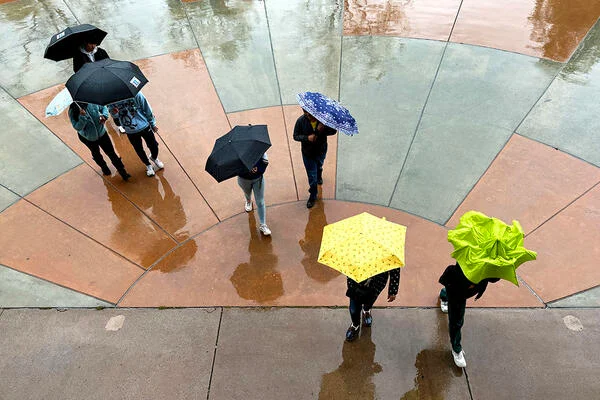
Students tour a rainy Cal State Fullerton in 2023.
Jeff Gritchen/MediaNews Group/Orange County Register/Getty Images
As if the list of factors that go into a student’s college decision wasn’t already long enough, researchers at Amherst College have added yet another: weather.
Not the general weather of the area where the college is located—though, famously, many students enroll at Southern colleges at least in part in hopes of enjoying sunnier climes. Rather, in a working paper published this month by the National Bureau of Economic Research, the researchers used data from an unnamed Northeast college to investigate whether weather conditions on the day a student toured the campus can affect their choice to apply.
They found that students who toured on a rainy or excessively hot day were 8.3 percent and 10.1 percent less likely to apply, respectively, than someone who toured on a moderate day. Cloudy and cold conditions also lessened the likelihood that a tour participant would apply.
Joshua Hyman, an economics professor at Amherst and one of the study’s authors, said he was interested in examining the impact of weather on students’ college choices as part of his larger research into understanding how improving the college-search process can reduce inequality.
“Given how important this decision of where students go to college is, as far as their future earnings, I think it’s important that we have an understanding of the factors that are affecting these decisions,” he said.
The report notes that their results might be somewhat confounded by students and parents specifically booking tours on fairer days. Those who are significantly invested in an institution might be more inclined to check the forecast and visit on a day with good weather, meaning those attending on rainier or hotter days might be those less invested in the university.
Amherst senior Olivia Feldman, who was Hyman’s research assistant on the project, said she was unsurprised by the results of the study; they validated her own experience touring colleges four years ago.
“When you take a tour—at least, when I took a tour—I really tried to imagine myself at the school. What you’re trying to do on a tour is not just examine the factors about the school that you could see online, but to really envision yourself there and get an impression of what life would be like there,” she said. “When I took a tour of a school and it was particularly rainy, that certainly affected my impression of what life would be like at the school, even if that’s sort of irrational … so it was really interesting to be able to examine whether that’s actually an empirical phenomenon.”
Robert Massa, a longtime enrollment dean, said he isn’t surprised that weather appears to have a measurable impact on students’ college choice.
If a prospective student is “uncertain about the institution, any small thing can turn them off. It doesn’t have to be the weather—it could be a student they met in the cafeteria that they thought was arrogant. It could be a staff member or a professor that gave them what they interpreted to be a flippant answer,” he said. “There are so many little factors that go into a student’s perception of campus based on a visit, and I would propose that the weather is just one of them.”
But the reasons that weather can affect tour participants could go beyond students simply disliking rain or heat. Extreme weather conditions can impact people’s moods, with heat causing heightened levels of irritability and trouble concentrating; that is to say, a student taking a tour in the heat might be more irked by other minor annoyances than they would have been on a nicer day.
The report notes that institutions could shift how they deliver tours based on the findings, such as nudging tour participants toward time slots with milder weather forecasts.
Matt McGann, Amherst’s vice president and dean of admission and financial aid, said he’s been considering whether it would be worthwhile to share the findings of the study with students touring on hot and rainy days.
“What happens when you point it out to students and families? Might they internalize that and say … ‘I should recognize my own perceptions here’?” he said. “And maybe that helps us out a little bit on a rainy day, that families might take an extra moment to say, ‘Did I really not like that college or was it because it was rainy? I might be one of those people they were talking about in that Amherst economics study.’”
