

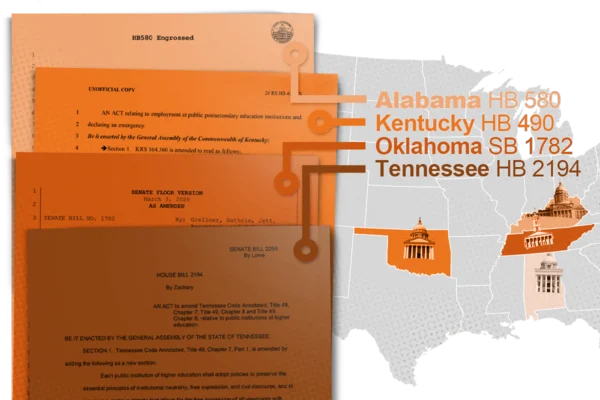
Many state legislatures are wrapping up their legislative sessions this month, and swaths of bills will be sent on to governors’ desks in the coming days and weeks. At least four states have moved on comprehensive legislation that, if enacted, will have significant impacts on tenure, academic freedom and shared governance at public colleges and universities.
Last year, Florida, Ohio and Texas were in the spotlight for new laws that brought big changes to higher ed, but this time around Alabama, Kentucky, Oklahoma and Tennessee are the states to watch. Several of the bills would weaken or even eliminate tenure at public institutions. Others hand curricular control to governing boards or limit faculty senates only to advisory capabilities. Sponsors of the legislation say the bills will help keep higher education institutions accountable to taxpayers. None of the legislation has garnered any public faculty support.
Inside Higher Ed highlights the bills from each of the four states here.
Alabama House Bill 580
In the Yellowhammer State, lawmakers are advancing legislation that would hand governing boards nearly absolute control over tenure, shared governance and curriculum at many state colleges and universities. If enacted, House Bill 580 would require governing boards to adopt post-tenure review. It also introduces clear grounds for the dismissal of tenured faculty, including “professional incompetence,” failure to perform duties and engaging in “unprofessional conduct that adversely affects the institution”—broad language that University of Alabama American Association of University Professors chapter leaders said leaves faculty vulnerable to political persecution.
The bill’s sponsor, Republican representative Troy Stubbs, said it will bring accountability and transparency to faculty senates, post-tenure review and curriculum, AL.com reported. Rep. Danny Garrett, also a Republican and a supporter of the bill, said it “appropriately shifts authority upward away from faculty senates, toward boards of trustees, university leadership.”
The University of Alabama and Auburn University are exempt from the bill—including them would require changes to the state’s Constitution—but Stubbs has indicated that the Legislature could use its discretion to appropriate funding to both universities to compel compliance, 1819 News reported. The UA AAUP called the legislation demoralizing and said that, if passed, it will “seriously damage” UA and higher education across the state.
Echoing similar legislation in Texas that passed last year, HB 580 would also abolish faculty senates and replace them with board-approved advisory bodies that could provide “confidential” recommendations to leadership. Institutional leaders would not be able to delegate any decision-making power to the bodies, effectively ending real shared governance in the state. The advisory bodies would be capped at 60 members—half of whom would be appointed by the institution’s president—and they would not be allowed to issue public statements “on behalf of the institution or represent institutional positions.”
In addition, HB 580 wrests curricular control from faculty and gives it to board members. The legislation states that “the courses or curriculum required to obtain a degree at a public institution of higher education must be approved by the institution’s governing board,” and it also gives the boards control over “any course or subject taught” at a public institution. This power may be delegated to the institution’s president, the bill states. The effort mirrors similar legislation that passed recently in Ohio and Florida, but Alabama’s bill is far less detailed—it does not distinguish between core and elective courses or clarify what type of content could be policed.
HB 580 passed the house at the end of March and is awaiting a vote in the Senate. The legislative session is expected to wrap up by the end of this week.
Kentucky House Bill 490
A bill that would make it easier to dismiss faculty at state colleges and universities currently sits on Kentucky governor Andy Beshear’s desk. Beshear, a Democrat, could veto the bill, but the Republican-controlled Legislature can override that veto.
House Bill 490 introduces a quadrennial faculty performance review process, the details of which would be determined by each institution’s board. It also allows the board to remove any faculty member—including tenured faculty—“for cause,” which includes “incompetency, neglect of or refusal to perform his or her duty, immoral conduct, or failure to meet college or university performance and productivity requirements.” The board would also be permitted to dismiss faculty for “bona fide financial reasons,” which includes financial exigency—a status that typically permits faculty layoffs—as well as low program or major enrollment or “misalignment of revenue and costs in a particular college, department, program, or major.”
Republican representative Aaron Thompson, one of the bill’s sponsors, said the bill is “not about firing faculty—it’s about establishing a clear, fair standard for common-sense decisions when institutions face legitimate financial pressures. We’re giving each entity’s board of trustees or regents a tool to help strengthen their ability to educate and serve students.” Meanwhile, national AAUP president Todd Wolfson has warned the bill “could be weaponized for purposes that have nothing to do with genuine fiscal emergencies.”
If the bill is going to become law, it will likely happen next week as the Legislature aims to wrap their legislative session.
Oklahoma Senate Bill 1782
The Oklahoma Senate is considering a bill that would prohibit any public college and university in the state from granting any new tenure awards on or after Jan. 1, 2027. In addition, all new faculty contracts would be capped at five years. Senate Bill 1782, which passed the Senate Education Committee and now awaits a vote in the full Senate, expands on a February executive order from Gov. Kevin Stitt that banned new tenure appointments at all public institutions except for the University of Oklahoma, Oklahoma State University and their health sciences institutions.
Supporters say the bill will help hold professors accountable for poor performance.
“No taxpayer-funded job should be exempt from honest evaluation and consequences,” state Sen. Randy Grellner, a Republican and sponsor of the bill, told the conservative think tank Oklahoma Council of Public Affairs. “Oklahomans like myself find it hard to understand why a small percentage of professors can be paid for decades and potentially not provide any value.”
Oklahoma’s legislative session is scheduled to run until mid-May, leaving plenty more time for debate on the bill before the Legislature decides whether it’ll sink or swim. Many faculty have spoken out against the bill, including University of Oklahoma AAUP president Michael Givel.
“Abolishing tenure cripples and compromises scientific and creative research that benefits all Oklahomans. For example, in healthcare,” Givel told the OU Daily in an email. “It also sends a strong message that top-tier academics seeking employment at Oklahoma universities should look elsewhere immediately.”
Tennessee House Bill 2194
Tennessee’s House Bill 2194 would require institution governing boards to create policies that “clearly distinguish between tenure decisions and disciplinary actions for faculty members,” which supporters of the bill argue will prevent tenure from shielding professors against misconduct.
These bill-mandated policies would need to ensure that “awarding, denial, or revocation of tenure is not used as a form of discipline” and that disciplinary procedures are the same for tenured and nontenured faculty members. Also, these disciplinary procedures should not “alter or suspend” a faculty member’s tenure status “except as provided by institutional policy and after providing the faculty member due process.”
The bill also stipulates that board leaders, presidents or provosts would have the power to suspend or terminate faculty members who “violate institutional policies or professional standards, regardless of whether the faculty member is tenured or non-tenured.” Disciplinary decisions in response to misconduct must be made without recommendation or vote from any other faculty members—in other words, faculty senates or councils could not be made the final arbiter of disciplinary outcomes.
Critics of HB 2194 say it will weaken tenure protections by eliminating due process and preventing faculty from being able to push back on disciplinary decisions that tenure would typically protect against.
The bill cleared the Legislature and was sent to Gov. Bill Lee on Tuesday. Tennessee’s legislative session is scheduled to end April 24.
