

Get stories like this delivered straight to your inbox. Sign up for The 74 Newsletter
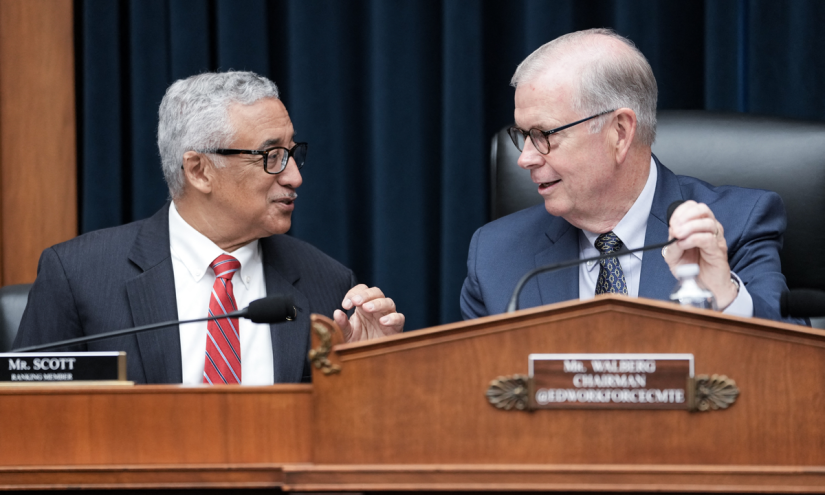
States receiving federal literacy grants would have to follow the science of reading, under a bill the House education committee passed Tuesday.
Members unanimously approved the legislation, another sign that improving reading outcomes is a goal shared by both Republicans and Democrats.
Rep. Lucy McBath of Georgia, a Democrat, spoke in support of a bipartisan bill to require states receiving federal literacy grants to follow the science of reading.
“This is how I learned how to read in the 1960s,” said Democratic Rep. Lucy McBath of Georgia. “When implemented correctly, the science of reading has been proven to help children learn to read and to write more effectively.”
The bill defines the science of reading as instruction that teaches phonics and phonemic awareness, and also builds vocabulary, fluency, comprehension and writing skills. The legislation would prohibit grantees from allowing three-cueing, the practice of prompting students to identify words based on pictures or other clues in a sentence. The bill now moves to the full House.
“We should not be using federal literacy funds to promote discredited approaches to literacy,” said Rep. Kevin Kiley of California, a former Republican now running for reelection as an independent.
5 Things the Government Can Do to Help Make Reading Cool Again
The committee’s passage of the bill follows a recent hearing before House appropriators in which both Democrats and Republicans recognized the growth in reading outcomes in southern states like Mississippi and Alabama and asked experts how to spread that progress more broadly. The House proposal, however, is not the only effort underway to revamp the long-running Comprehensive Literacy Development Grant program. Some advocates say updated legislation should also require schools receiving grant funds to screen children for reading difficulties, inform parents whether their children are reading below grade level and assign reading coaches to low-performing schools.
“If we’re going to update it, let’s do it right,” said Ariel Taylor Smith, senior director of the National Parents Union’s Center for Policy and Action. She expects that a Senate plan would also ensure that teacher preparation programs follow the science of reading. “Let’s actually check in on whether teacher preparation programs are doing right by kids and using the most recent research.”
The nonprofit will dig further into those issues next week at a briefing on Capitol Hill featuring leaders from Tennessee and the District of Columbia, both of which have implemented reading reforms, like pointing districts to evidence-based curricula and providing in-depth training to teachers on how students learn to read.
An ‘implementation war’
Experts welcome Congress’ interest in the issue. But broad agreement that students need phonics-based instruction doesn’t mean the debate over the best way to teach reading is settled.
There’s still a reading war, but not between the phonics and whole language camps, said Karen Vaites, a literacy advocate who highlights lessons on reading reform from states that have seen growth on the National Assessment of Educational Progress.
Now, she said, there’s an “implementation war.”
“Everybody agrees on phonics, but how much phonics? How much instructional time should it get?” she asked. “Do you do teacher training first or do you do curriculum paired with teacher training?”
Another proposal under consideration would require the U.S. Department of Education to reserve 10% of the grant awards for states whose fourth grade reading scores on NAEP rank in the lowest 25% for two consecutive administrations of the test. Vaites questioned whether such states would make the best use of the funds.
“I worry a lot about throwing dollars toward the people that by demonstration have the least leadership capacity,” she said.
Striving Readers, part of a 2010 federal budget agreement, was the first iteration of the state literacy grant program. An evaluation, tracking awards to 11 states in 2017, found that not all states directed funds toward the highest poverty schools or used the money to buy reading programs based on research. Overall, the study found no significant differences in reading performance between schools that received the funds and those that didn’t, but there were small positive effects in Louisiana and Ohio.
Striving Readers preceded the Comprehensive Literacy State Development grants, last awarded in 2024. But the program hasn’t been revised in a decade. Smith, with the National Parents Union, said the program should reflect the latest knowledge about what’s working in classrooms.
“We’ve learned a ton about the science of reading,” she said.
Kari Kurto, national director of policy and partnerships for the Reading League, a national nonprofit promoting the science of reading, said the grant program is important because it’s one of the only ways state education agencies “can truly influence” what happens in classrooms. She said she appreciates that the bill includes her suggestion that instruction should also support students’ oral language skills.
“This legislation will go a long way toward solidifying our nation’s commitment to evidence-based literacy instruction,” she said. “As a Democrat, I am so thrilled to see this movement finally receiving the bipartisan support we always dreamed of.”
Concerns over local control
While every state has taken some action to improve reading instruction, recent examples in two states show that concerns remain over one-size-fits-all approaches.
California passed a reading reform bill last year, but not before lawmakers agreed to a compromise that kept the state from mandating teacher training and state-approved curricula. The California Teachers Association said an earlier version of the bill would have interfered with local control and advocates for English learners worried the plan overemphasized phonics at the expense of other literacy skills.
In Massachusetts, superintendents and school administrators object to portions of a bill “that attempt to legislate the specific curriculum that schools would be expected to purchase and implement.” The Massachusetts Education Association is also opposed.
Any federal legislation won’t delve into specific reading programs. The law prohibits it, but Vaites said there are still ways to strengthen the grant program.
“I think we’re all trying to figure out the mechanism that is going to hold state leaders accountable in a way that isn’t just sprinkling dollars around,” she said.
Did you use this article in your work?
We’d love to hear how The 74’s reporting is helping educators, researchers, and policymakers. Tell us how
