

Get stories like this delivered straight to your inbox. Sign up for The 74 Newsletter
Duane Wilson never liked that a shiny, refurbished Boys and Girls Club he oversees in South Bend was vacant all day, with its gym, computer lab and craft spaces unused until kids came in after school.
That feeling increased after the club, known as the O.C. Carmichael Youth Center, was used as an all-day learning pod during the pandemic for kids that needed help taking classes online, a role clubs in many cities took on.
“This building sits empty,” Wilson, now CEO of the Boys and Girls Clubs of the Northern Indiana Corridor, remembers thinking at the time. “We want every inch of this space to be utilized as much as possible for kids.”
So Wilson found an unusual way to get more use out of the building.
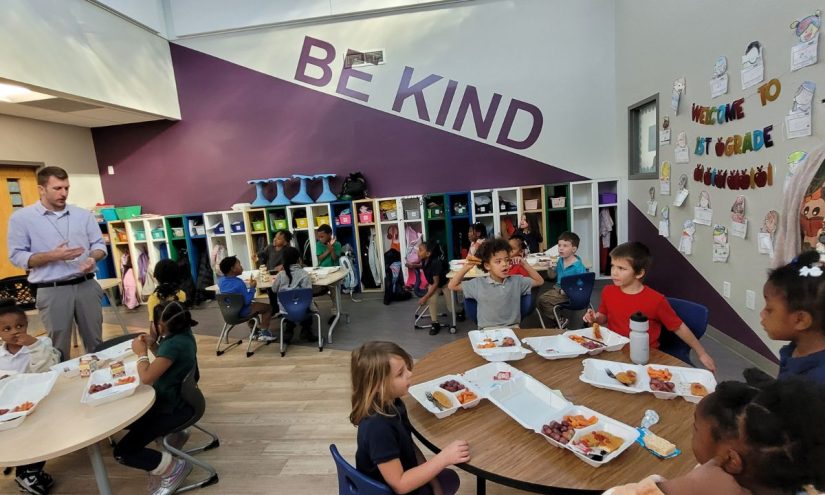
After first considering loaning the 15,000 square foot space to a preschool, Wilson struck a deal with a charter school that builds many of its lessons around projects or field trips. The Career Academy Network of Public Schools, which has four other schools in the area, opened a K-5 elementary school with just over 110 students in the club at the start of the 2023-24 school year.
The partnership gives the Success Academy at Boys and Girls Club — which is not affiliated with the New York-based Success Academy charter schools — use of the building until 3 p.m. when the doors open to kids from other schools for the afternoon. Many of the school’s students stay for sports, crafts, and extra academic help with the same club aides that were in their classrooms.
“They stay with the cohort that they’re with during the day,” said Wilson. “That’s the whole idea, so that they can have that continuity of care. They know the strengths of the students that they’ve been working with all day.”
Career Academies Superintendent Candida Van Buskirk called the afterschool lessons “an additional power punch of literacy.”
“There’s no acclimation of a new leader,” said Van Buskirk. “There’s no acclimation of a new curriculum. This is the work that we do all day long, and we’re just getting an extra dose after school.”
Partnerships with schools are common for Boys and Girls Clubs, who run before and after-school programs across the country. Clubs are usually separate sites, but are often located at schools that have extra space.
But clubs hosting schools are rare. Van Buskirk said club leaders looked for clubs with similar arrangements when negotiating the partnership, but had no luck.
“We were unable to find one where it was fully enmeshed like this,” she said.
The partnership helps the charter school in several ways. The school and Boys and Girls Club have jointly applied for grants together, which they say has helped win some.
In addition, the Boys and Girls Clubs nationally include teaching about careers a priority of their afterschool programs, which matches a focus of the Career Academies charter chain. As part of the partnership, Katie Rodriguez, the regional workforce development coordinator for the Boys and Girls Clubs, works with the school to arrange field trips that teach students about careers and also
Those trips also fit the school’s experiential learning model. Students have visited community organizations like the local food bank, local colleges, the local library so students could take home their first library cards and a theater so students could see a play and learn about all the jobs there, from actors to lighting technicians to ticket sales.
The school also invited a judge to preside over a mock trial of the Big Bad Wolf for blowing down houses of the Three Little Pigs.
One week last fall, students visited the meteorologist at a local television station after learning about weather and how meteorology works in class.
Teaonna Miller, a school employee who works with Rodriguez to set up visits, said the hope is that students connect what they learn in class to the rest of the world.
“If they’re learning about weather inside the classroom, we find destinations that we can take them to that would relate to and correlate with the weather,” she said.
Mary Donlon, the school’s literacy coach, said the trips give students perspectives they otherwise miss out on.
“They don’t go out of their neighborhoods very often,” Donlon said. “They don’t go to museums. They don’t go to zoos on a regular basis. Generally, those experiences only happen in the school setting, and connecting it to academic things is really powerful.”
How well the school is doing is hard to say, since it is only in its third year and draws students from a low-income part of the city. School officials are proud of its giant leap from 2024 to 2025 in third grade reading proficiency from 33% of students to 70% on state tests, after participating in a state literacy effort credited with boosting scores statewide.
New tests this spring will show if gains continue.
But Wilson said he tells other club officials to consider placing schools in their clubs. He said contributing to any gains by students just furthers goals of the clubs.
“We want what’s best for kids,” Wilson said. “So it’s well worth it.”
Did you use this article in your work?
We’d love to hear how The 74’s reporting is helping educators, researchers, and policymakers. Tell us how
