

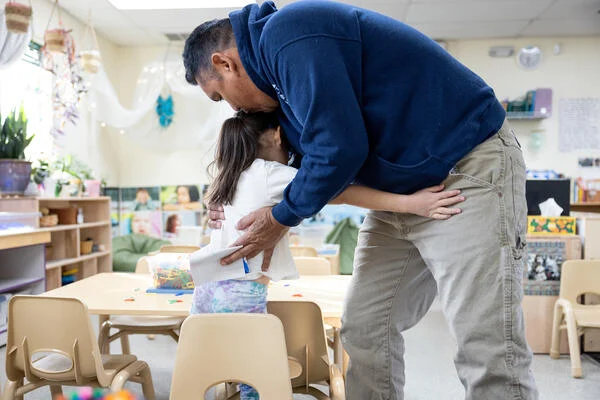
California is aiming to increase the number of residents with bachelor’s degrees to strengthen the regional workforce and economy. However, a new report from California Competes finds that among the population without a degree, parents raising young children face some of the most significant barriers to enrolling in and completing college.
Among residents ages 25 to 54 without a college degree, 42 percent have a child under the age of 18, totaling about 2.7 million people statewide, the report found. In the Bay Area—which encompasses Alameda, Contra Costa, Marin, Napa, San Francisco, San Mateo, Santa Clara, Solano and Sonoma Counties—more than 100,000 adults with dependents who said they intend to enroll cited childcare as a significant obstacle to doing so.
Su Jin Jez, chief executive officer of California Competes, said Bay Area parents without degrees earn about $33,765 annually, compared to $106,190 for parents with degrees. Childcare costs in the region average about $49,800 per year for families with young children, highlighting a major financial barrier to returning to college.
“You have more mouths to feed, you’re housing more people,” Jez said. “College already feels very unaffordable for so many Californians, so when you add on [childcare] costs, it becomes even more out of reach.”
The report draws on data from the American Community Survey, a nationally representative survey conducted by the U.S. Census Bureau, using 2019–23 five-year estimates.
It defines parents without degrees as those with children under age 3 who have a high school diploma or equivalent but do not hold an associate degree or higher and are not currently enrolled in a college program. More than 87,000 Bay Area parents fall into this category, and nearly half have completed some college—suggesting many could re-enroll and finish a degree with the right support.
“That’s huge,” Jez said. “One thing we really need to focus on is reshaping how we view who a college student is and who they could be.”
“What we’re seeing from this data is that parents want to and intend to go to college, but the cost and availability of childcare is a real barrier,” she added. “With the state needing more college-educated adults and institutions facing declining enrollment—including in the Bay Area—this is something policy and education leaders should really prioritize.”
Barriers and pathways: The report found that about 76 percent of parents without degrees are people of color, compared with 61 percent of parents with children under age 3 who hold a degree. Latino adults make up 45 percent of parents without degrees.
Nearly half of all parents without degrees have completed some college education. About 15 percent completed up to one year of college, while another 34 percent were enrolled for more than a year at some point—indicating that more “family-responsive systems are needed to support their persistence,” the report found.
“These are folks who have already made a commitment to higher education,” Jez said. “You don’t want to re-enroll someone only to have them face the same barrier that led them to leave before. I firmly believe that institutions need to make changes, and we shouldn’t put it on the students to mold themselves into an institution.”
About 74 percent of parents without degrees are working, while 21 percent are neither working nor seeking work, compared with 14 percent of parents with degrees. They are also slightly more likely to be unemployed—4 percent compared with 2 percent of those with degrees.
The report finds that many parents who intend to enroll but face childcare barriers indicated they would likely pursue programs aligned with high employer demand in the region and across California—including health care, education, cybersecurity and information technology. The region is expected to see nearly 1.4 million job openings across those sectors by 2032.
“It’s a no-brainer in many ways,” Jez said. “We have residents right here in the Bay Area who want to go to college, and we need more skilled workers. There are a few things today that feel very straightforward and a win for all, and this is one of them.”
Supporting parents: Jez said many student parents without a credential are closer to completing their degrees than new students, and tailored support could help colleges re-engage them and boost graduation rates.
She praised institutions like Shasta College for addressing childcare for student parents by helping them forecast their course schedules so they can balance work and caregiving.
“There are institutions really making sure they are adapting to why they lost these students in the first place,” she said. “They’re responsible for addressing this because college is hard already—let’s not make it even harder for all the wrong reasons.”
Beyond the Bay Area, Jez said the best first step for state legislators and colleges to help parents enroll and complete college is to tackle the affordability of childcare.
“Putting your mask on yourself first before your child on the plane is the smart thing to do, but it’s really hard for parents not to want to put the mask on their child first,” she said. “So tackling that childcare piece and being able to say to a parent, ‘Hey, if you come to our college, we have affordable, high-quality childcare,’ I would say there are probably few parents who wouldn’t give that conversation their time and effort.”
Get more content like this directly to your inbox. Subscribe here.
