

A professor encouraged Mitchell Gregorovic, a graduate student in secondary education at Hunter College, to take a course in constructive dialogue—training he soon discovered would shape how he approaches teaching.
As a high school teacher’s aide, Gregorovic found the subject of one lesson especially relevant: “warrior’s mindset,” a term for a rigid, must-win way of thinking that can escalate conflict when emotions run high. Understanding the concept has helped him better support students, he said, and he plans to carry it with him as he graduates this spring and becomes a special education teacher.
“Warrior’s mindset is prevalent with a lot of my students, where they always have to be right no matter what,” Gregorovic said. “This training has helped me learn strategies to defuse the situation and bring them away from that emotional outburst.”
Gregorovic is one of more than 5,000 students, faculty and staff who have trained at the City University of New York’s Constructive Dialogue Initiative, which equips participants with practical skills to lead respectful conversations.
Launched in 2024, the program at CUNY—the nation’s largest urban public university system, spanning 26 campuses—trains participants to navigate conflict and misunderstanding, build trust and connection, and engage in more intentional conversations.
Rachel Stephenson, CUNY’s chief transformation officer, who oversees the Constructive Dialogue Initiative, said disagreement and difference are a natural part of campus life, making it important for the university system to proactively enhance communication skills across its community.
“We decided that we really wanted to build skills and frameworks and expectations that allow all the members of our community to navigate their differences productively and, ultimately, with curiosity, respect and intellectual humility,” Stephenson said. “We don’t want to avoid hard conversations—we want to give our students, faculty and staff the tools to engage in them thoughtfully.”
Stephenson said campuses have had the flexibility to adapt the training to local needs, with programs showing up in multiple formats—from stand-alone courses for students to first-year seminars and faculty development workshops.
To ground the work in research, CUNY partnered with the Constructive Dialogue Institute, a national nonprofit organization that draws on behavioral science to help individuals and institutions communicate across differences.
“Our vision is that constructive dialogue should happen in classrooms and conference rooms and community spaces,” Stephenson said. She added that more than 90 percent of student participants report learning valuable skills and using them in their daily life.
“Anecdotally, students describe increased confidence, stronger communication and a greater ability to engage with peers across differences,” she said. “Faculty and staff tell us the tools have been immediately useful in classrooms and student-facing settings.”
Training on the ground: Gina Riley, an associate professor of special education at Hunter College, a CUNY campus that has implemented the program, said the training has helped her students build deeper relationships, more empathy and stronger communication with their peers.
Riley, who oversees and has helped lead the training on campus, said Hunter has used it as a foundation for how the college approaches lesson planning, student dialogue and classroom pedagogy.
“The most important part of constructive dialogue is really pausing to listen and to hear what others are saying,” Riley said. Because she teaches in the school of education, she added, the approach has been especially useful to her students as they work with K–12 students and families.
She also pointed to campus events like the popular “Real Talk” series, which introduces constructive dialogue in a more casual, lunch-and-learn format, where students discuss case studies over pizza. She said they hosted two sessions last fall and plan to continue the series.
“It’s really changed the way students think about dialogue across differences—whether they’re talking with other students or with faculty and staff,” Riley said.
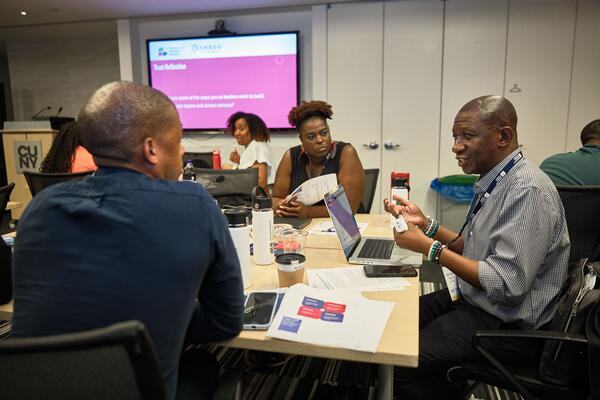
Emma Jones, part of the Constructive Dialogue Institute team, leads a training at the CUNY Leadership Institute in summer 2025.
Marcus Beasley/City University of New York
Signs of progress: Riley said Hunter College—and CUNY as a whole—serves a highly diverse student population, making disagreement inevitable and proactive dialogue training essential.
“It’s about giving our students different perspectives and really centering belonging, cohesion and the idea that we all have differences—and that it’s healthy and meaningful to talk them through,” Riley said. “I don’t think our campus is unique in experiencing division, but I do think we’re being proactive in how we’re using CDI.”
She added that her background in educational psychology and special education shapes her approach to dialogue, emphasizing the importance of engaging with an “open heart and open mind.”
“It’s always been a core tenet of my work, and it’s also a core tenet of CDI that I’ve really been drawn to,” Riley said.
Gregorovic echoed that sentiment, saying the training has reminded him—as a future special education teacher—to approach conversations as a person first.
“If you see a student who feels like, ‘They never listen to me,’ you give them that time,” he said. “You never know how much it can mean just to acknowledge their contribution and say, ‘That’s a great point.’”
Get more content like this directly to your inbox. Subscribe here.
