

Get stories like this delivered straight to your inbox. Sign up for The 74 Newsletter
Nearly 44,000 first-generation and low-income students no longer receive assistance with financial aid, tutoring, campus visits or dual-enrollment courses after a national college-access organization lost federal funding last fall.
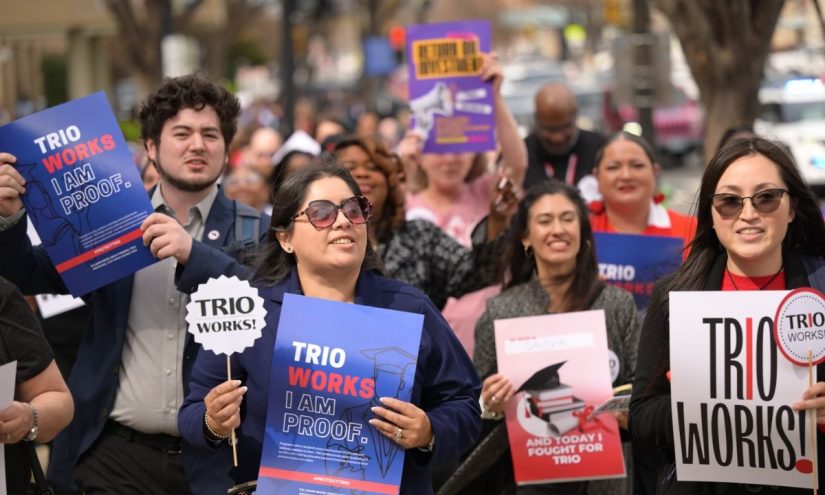
It was the first-ever cancellation of grants for TRIO, a federal program that has helped disadvantaged students across the U.S. enter college and graduate since 1964. While a district court judge recently ruled the Trump administration’s move illegal, TRIO staff and advocates say the loss of funds is hindering thousands of students’ chances to have a successful future after high school.
More than 100 TRIO programs at various colleges around the country shuttered after the Trump administration canceled $40 million in grants in September. The Council for Opportunity in Education, which represents 1,000 colleges and nonprofits that participate in TRIO, sued the government weeks later.
“TRIO comes under existential threat about once every 10 to 15 years,” said Kimberly Jones, the council’s president. “Even during the first Trump administration, there were calls for cuts to the program. But this is the first time we’ve seen grants canceled within our programs and canceled without going through the due process that should be afforded to them.”
In January, a district court judge ruled in favor of the council and ordered the administration to reconsider the grants for colleges that joined the lawsuit. Jones said the government still needs to comply and that there’s no timeline for when funding might be restored.
The Trump administration canceled funding for a variety of local TRIO programs, including Talent Search, which exposes students in grades 6-12 to colleges and future career options, and assists high schoolers with college entrance exams, financial counseling and tutoring. Funding for Upward Bound, which brings high schoolers to universities for intensive courses during the school year, was also halted. The other half of TRIO’s services are programs for college students, veterans and adult learners.
In 1980, TRIO was standardized in the Higher Education Act and Congress mandated that two-thirds of participants come from low-income families in which neither parent graduated from college. The organization currently serves around 875,000 students in 3,500 programs.
Jones said the affected programs were targeted because of the federal government’s crackdown on diversity, equity and inclusion. Some were flagged solely because staff worked from university DEI offices.
The University of California Berkeley’s Talent Search program closed last fall, affecting more than 1,500 students from 14 public schools.
“My team had already gone into schools, done introductory meetings, created workshops, and we had already started helping seniors with their college applications and everything,” said Keyanna Hatcher, the university’s TRIO director. “The immediate pause on the program was completely detrimental to everything that we had already established with our school sites and partnerships.”
Seniors were in the middle of completing college applications when Talent Search shuttered. Low-income and first-generation students were suddenly without key resources before applications were due Nov. 30 — the deadline for California state universities.
Middle school students lost access to STEM projects and university visits. Ninth graders no longer have TRIO workshops on how to be competitive for college. Berkeley staffers who were a permanent fixture in local middle and high schools are gone.
“We were actually helping to supplement school staff, because some of our schools have counselors with caseloads of 700 students,” Hatcher said. “We were taking some of that load off and were helping meet with students so that they actually get more individual attention.”
The University of New Hampshire closed its Talent Search program in October after losing grant money, affecting more than 1,200 students from sixth to 12th grades in 29 schools. Close to a dozen staffers who worked with students in their schools were fired.
“It’s going to affect how many students are applying to colleges here in New Hampshire,” said Jes Crowell, the university’s TRIO director. “They aren’t going to have the assistance from (the staff) who normally sit down with them and help them apply, help them with financial aid and scholarships. That’s just not going to be done.”
Nearly 68% of Talent Search students enroll in college immediately after high school, compared with 56% of low-income students not in the program, according to a 2022 federal education data report. Upward Bound produces similar positive results, with 74% of the 19,549 participants who graduated high school in 2022 enrolling in college.
The report shows that nearly 43% of Upward Bound students in 2022 received a bachelor’s degree within six years, compared with 11% of low-income students not in the program.
Junior Angelina Dang said she had never imagined a future that included college until she joined Upward Bound two years ago through South Seattle College in Washington state. As a first-generation student, Dang figured she’d enter the workforce right after high school, like the rest of her family.
“Coming from a low-income family, if I hear other low-income families are telling me that this is helping them, I’m obviously interested,” she said. “When I first joined, I was like, ‘This isn’t probably going to help me.’ But I’ve had so much support — I know what I want to do for my future. I know what I need to do for my future.”
Dang said South Seattle College’s TRIO office has provided food that her family can’t buy, staff who support her through decisions about her college future and academic services that have improved her skills in the classroom.
South Seattle College — which lost funding for its adult learner TRIO services — is where she takes dual-enrollment courses through Upward Bound. The program also helped her visit potential colleges. She plans to transfer to the University of Washington to pursue studies in wildlife biology.
“The support of being able to be at South Seattle College and also visit other schools — it was like, there’s a world outside of high school,” she said. “I don’t want to exaggerate, but I think if I never joined Upward Bound, I don’t know where I would be.”
Did you use this article in your work?
We’d love to hear how The 74’s reporting is helping educators, researchers, and policymakers. Tell us how
