

As junior faculty, our department, school, and university standards for tenure and promotion may feel daunting, ambiguous, and create stress in trying to meet the requirements. Additionally, feelings of isolation exacerbated by one’s specialty field of research and/or position description contributes to stress. As a result, junior faculty may experience maladaptive mindsets like burnout and imposter syndrome. In my experience, seeking collegial support is a potential disruptor to stress and uncertainty; not only from motivational support but also collaborative efforts.
Within my department, I received excellent support for my disciplinary (science) research. I was fortunate to have a mentor for my teaching, service, and scholarly activities. Additionally, Stockton University’s Center for Teaching and Learning Design (CTLD) provided extensive orientation activities offering access and support from colleagues across departments. Seeking this support served to improve my morale and comfort with the requirements for tenure and promotion. As the result of a CTLD pilot study to promote scholarship in junior faculty, I experienced meaningful collaboration that introduced me to pedagogical research studies and interdisciplinary engagement.
Examining Student Engagement and Participation
A primary objective of my pedagogy is to promote student engagement. The remote-learning years highlighted how critical student engagement is for learning but also to the morale of faculty. Student participation is critical for learning. Likewise, student engagement contributes to faculty feeling more effective, useful, and fulfilled (Wang, 2023; Brandmiller et al., 2020). Science classrooms are especially difficult to implement engagement tactics, partly because of the vast amounts of material needing to be covered and thus time limited to activities. More modern studies are needed on best and most practical practices for student engagement in science courses, but also on how these differ from other subjects, grade levels, and class sizes. Prior to my experience with orientation activities, I had not fully considered the benefits of research focused on the scholarship of teaching and learning (SoTL). For junior faculty, the scientific study of pedagogical methods contributes to meeting standards for both scholarship and teaching, and offers critical insight into the pedagogical methods selected and the outcomes achieved.
Interdepartmental Collaborative Research Pilot Program
Stockton University’s Center for Teaching and Learning Design (CTLD) is a collaboration-fostering machine. In a pilot SoTL program, the CTLD facilitated pedagogical research for a group of six junior faculty. This program introduced me to faculty from varied disciplines who were interested in conducting research on the use of active lecturing to promote student engagement and learning. The program offered much needed encouragement and would assist me in achieving and surpassing a variety of standards in the tenure-track process.
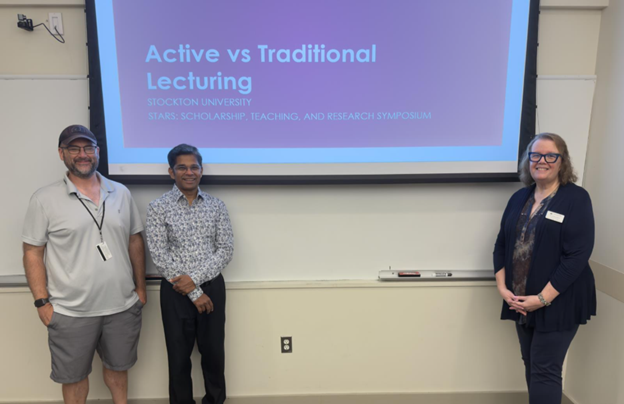
Colleagues in Figure 1, SoTL Pilot Program Colleagues: Adam Aguiar, Associate Professor of Biology, Rania Almajid, Assistant Professor of Physical Therapy, Sunny Mathew, Assistant Professor of Social Work, Kathleen Klein, Executive Director of the Center for Teaching and Learning Design
Colleagues not shown in Figure 1: Jennifer Aarons, Assistant Professor-Hospitality, Tourism & Event Management and Esports Management, Kimoni Yaw Ajani, Assistant Professor of Africana Studies, Jennifer Calabrese, Assistant Professor of Occupational Therapy
The CTLD Executive Director (tenured faculty) and 6 junior faculty members developed a research study protocol that would be implemented in four undergraduate courses (African Studies, Biology, Hospitality & Social Work) and two graduate courses (Occupational Therapy and Physical Therapy) following IRB approval. IRB approval was obtained. Faculty taught their respective classes with a traditional lecture approach and later using an active lecture approach. Sessions’ topics were of comparable rigor and pre- and post-lecture quizzes were employed to determine the learning effectiveness of each session, as well as a student opinion survey. The group worked together to discuss and analyze results and with the guidance of the CTLD Executive Director, we wrote a manuscript. The results of the study were published in the Journal of Empowering Teaching Excellence (Klein et al., 2023).
Through this experience, I learned about differences in disciplinary teaching methods, the impact of SoTL approaches, effective strategies to meet tenure and promotion standards, and a very personalized experience of developing and understanding a new pedagogical paradigm. Specifically, I became aware of the nuances in active learning techniques. Instead of a binary paradigm of active vs traditional lectures or activities, I gained new insight into the continuum, or even a landscape, where different pedagogical techniques vary in their “activeness” or student-engaging potential. In addition to my paradigm shift, I recognized that I had discipline-specific pedagogical information to share with colleagues, so my participation in the pilot program led to a second publication (Aguiar and Calabrese, 2025). The interdepartmental collaborative research pilot program was a much needed antidote to the stress, uncertainty, and loneliness experienced as a new faculty trying to meet standards for tenure and promotion.
Figure 2: Active Learning Student Poster on DNA Replication
Figure 3: Active Learning DNA Replication Handout
Combined with my teaching experience and evaluation, I confirmed that students enjoy, benefit from, and engage with Kahoot quizzes and short duration group presentations as active learning. The short duration of these active learning experiences still allows students to learn appropriate amounts of material in science courses such as introductory biology.
Benefits to SoTL Research
In addition to studying pedagogical effectiveness, my collaborative SoTL research experience provided opportunities to present my research and scholarship which extended beyond disciplinary conferences and symposia. My institution provided many opportunities to present research even prior to its completion. I engaged in these opportunities with colleagues which gave me practice presenting and organizing ideas in a lower-pressure environment. The lead up to these events also gave me experience with application processes and poster-printing procedures. Finally, these are things to bolster one’s curriculum vitae and application to tenure.
Figure 4: My Students Presenting Our Disciplinary Research Poster at One of the Many Internal Symposia Opportunities
Speaking of scholarship standards for tenure, almost all require peer-reviewed publications. One collaboration with a faculty member in a closely related field garnered me a publication on my disciplinary research (Christensen et al., 2024). And as mentioned, the larger cross-departmental collaboration helped me generate a manuscript on my primary pedagogical efforts (Aguiar and Calabrese, 2025) and another on the cross-subject student engagement project (Klein et al., 2023). These, and others papers in prep, would only be possible with the help, guidance, expertise, and contribution from my colleagues, for which I am forever grateful.
Biggest Takeaways to Share
The investment of stepping outside of my comfort zone and seizing opportunities to work with others, especially those in other subjects, paid big dividends. Demonstrated by the results laid out in the prior section, collaboration is not an additive phenomena but has a synergistic compounding effect on one’s productivity and output. It also provided opportunities to share teaching hurtles and tips, and to support each other through the tenure-track process, and created reliable relationships for future collaboration and support. I initially intended this article to be focused primarily on student engagement and scholarship, but both of those things are highly reliant upon the sources of which we get support and ideas. And the wellspring for that is collaboration, which I highly encourage junior faculty to seek out. I cannot thank the CTLD, my mentor, and other collaborators at my institution enough!
Dr. Adam Aguiar received his PhD in molecular biology and genetics while doing his dissertation research on prostate cancer progression and metastasis at the University of Delaware. Since then, he has taught a variety of science courses at multiple colleges and universities. In his 15 years at Stockton University, Dr. Aguiar started as a part-time assistant professor before assuming a tenure-track associate professor position. There, he teaches courses like Genetics, Cells and Molecules, Biodiversity and Evolution, Cell Biology, Anatomy and Physiology I and II, and his own self-constructed general studies course on Ecology and Saltwater Fishing. In all of his courses, he tries to employ various teaching strategies to address different modes of learning among the students in class. Dr. Aguiar focuses his teaching and pedagogical research efforts on student engagement. His work on this and breaking the binary paradigm of active vs traditional teaching strategies is published in multiple peer-reviewed pedagogical research journals. The biggest tool Aguiar uses, though, is simply his enthusiasm for the material—it’s said to be infectious and gets students more engaged and to care more about the material.
References
Wang X. 2023. “Exploring positive teacher-student relationships: the synergy of teacher mindfulness and emotional intelligence”. Front Psychol. (Nov 29): 14:1301786.
Brandmiller C, Dumont H, Becker M. 2020. “Teacher Perceptions of Learning Motivation and Classroom Behavior: The Role of Student Characteristics. Contemporary Educational Psychology”. (Oct 1): 63:101893.
Klein K, Calabrese J, Aguiar A, Mathew S, Ajani K, Almajid R, et al. 2023. “Evaluating Active Lecture and Traditional Lecture in Higher Education.” Journal on Empowering Teaching Excellence. Available from: https://digitalcommons.usu.edu/jete/vol7/iss2/6
Aguiar AA, Calabrese J. 2025. “Broadening the perspective of traditional lecturing vs. active learning in introductory college biology.” Discover Education. 4(1). Available from: https://link.springer.com/epdf/10.1007/s44217-025-00729-7
Christensen D, Aguiar A, Handelman J. 2024. “Comparisons of Morone saxatilis catch variables from a research effort intended to bridge the scientific and angling communities: From the lens of environmental sustainability education.” Sustainable Environment. Dec 31;10(1):2391615.
