

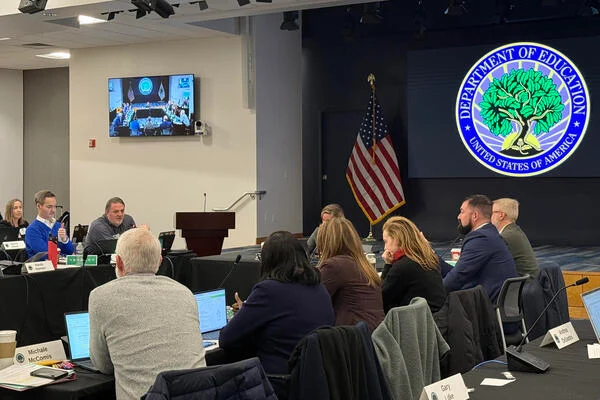
A limited number of short-term job training programs may be able to access the Pell Grant starting July 1, 2026 if they pass the regulatory guardrails established under proposed regulations signed off on Friday by the Department of Education and its advisory rule-making committee.
The department will next post the draft regulations on the Federal Register and take public comment. After that, officials will have to review and respond to the public comments before finalizing the rule. Once that happens, governors can start the process and approve certain in-demand certification programs for Workforce Pell.
When Education Under Secretary Nicholas Kent took to the podium to deliver his closing remarks, he spent some time applauding the committee’s work on the Pell Grant expansion. Then, he turned his attention to the next order of business—establishing accountability metrics for programs of all lengths.
“For over a decade, certain programs and institutions have been singled out for accountability with nondegree programs and proprietary institutions facing the brunt of that scrutiny. Meanwhile, degree programs at nonprofit and public institutions have often been given a free pass,” Kent said. “That ends now.”
The committee’s discussion in the first week of January will center on revisiting an existing and highly contested earnings metric, known as the gainful-employment rule, while also standing up a new one called the Do No Harm standard. Knowing the complex nature of both programs and Kent’s goal of “parity” across all programs, outside policy experts and committee members expect the second week of negotiations will likely be more contentious than this past week.
In an apparent nod to that prediction, Kent asked that when negotiators “come to next month’s session, [they] continue to keep students, not entrenched systems, at the forefront of [their] work.”
That said, the consensus vote for Workforce Pell wasn’t without its own moments of tension.
Committee members began the last day of negotiations under the impression that they had the whole day to talk through the proposal before taking a final vote; the meeting was scheduled to end at 4 p.m. But at about 10:40 a.m., Jeff Andrade, the deputy assistant secretary for policy, planning, and innovation, announced the call for consensus would be held at 11:05 a.m. with “no further discussion.”
“What we have is what we have and that’s what we are going to call for the vote on,” he said.
Tamar Hoffman, the committee member representing legal assistance groups, pushed back, noting that though the negotiators had been provided a document with all the suggested amendments, they had yet to receive the full and final text.
“I don’t think that we can, in good faith, come to any kind of consensus vote right now without even having seen a full text,” she said.
Discussions ended up lasting nearly an hour. The department made a small technical change and agreed to add several guidance notes to the preamble. In the end, Hoffman voted for it. Multiple outside policy experts, however, voiced frustration with the administration, saying it was reasonable to ask for more time to review the full text.
“Cutting off negotiations early, with half a day still left on the committee’s schedule, undercut the process,” said Wesley Whistle, a former department appointee under the Biden administration who now works as a project director for student success and affordability at New America, a left-leaning think tank. “Simply asking to see all of the edits in one document is not obstruction; it’s doing the job of a negotiator.”
What’s in the Final Proposal?
And while Kent touted the fact that the committee reached consensus in four and a half days, outside policy experts, committee members and institutional lobbyists said that reaching consensus doesn’t mean the issue of establishing and implementing the short-term grant program has been put to bed.
At a high level, the proposal says that in order to be eligible for federal student aid, programs must:
- Have existed for one year prior to approval;
- Be eight to 14 weeks in length and 150 to 599 clock hours;
- Lead to a recognized postsecondary credential including a certificate or license;
- Be deemed part of an in-demand, high-skill or high-wage industry by the governor in the state where students will be studying;
- Count as credit toward a subsequent degree at one or more institutions in a written agreement;
- Not outsource more than 25 percent of the program to an unaccredited provider;
- Pass a federal value-added earnings test that says tuition rates cannot be higher than the difference between a graduate’s average earnings and 150 percent of the poverty line;
- Pass a 70 percent completion and 70 percent job placement test using state-collected data.
Under the regulations, job placement will initially be defined broadly as placement in any job until at least 2028–29. Then, it will be narrowed to placement in a job specific to a student’s field of study.
Still, Clare McCann, a former policy adviser under President Biden and now the managing director of policy at American University’s Postsecondary Education and Economics Research Center, says, “questions remain around how, exactly, states will calculate key measures like completion rates and job placement rates, and whether states will consider the earnings of workforce programs.”
Technically, programs won’t have to pass the value-added earnings test to become eligible because there may not be enough data from graduates, but that metric will kick in after at least three years. Language in the proposal suggests that until then, state governors should evaluate the earnings, but it’s unclear how the states will do so or if they will be held accountable.
Further, higher education experts say it’s unclear how many programs will be eligible for Workforce Pell, at least for now.
“There is no doubt that there will be schools that successfully establish Workforce Pell programs and serve students well through this new opportunity. That said, it will require significant effort by schools to secure and maintain eligibility for these programs,” one committee member said. In the end, it “may not be what some institutions or employers expected.”
A lot of that, the member added, has to do with the number of proposed guardrails. Increased regulation is a shift for the Trump administration; during the president’s first term, the department prioritized deregulation. But this time around, both the president and Republicans in Congress have sought to hold higher education institutions accountable for the outcomes of their students. Many of the regulations for Workforce Pell were explicitly outlined in the law.
“Neither the agency nor the negotiators were authorized to waive or modify these standards,” the negotiator explained. “Our job was to try to build a regulatory infrastructure around these standards that would assist with their implementation.”
Throughout the week, department officials did agree to make a number of changes to its initial proposal. But Alex Holt, a senior adviser for higher education at the Committee for a Responsible Federal Budget, said he noticed more amendments made in favor of certain constituent groups over others.
“[The Trump administration] is extremely worried about gaming and costs and basically leans toward protecting students and taxpayers on every question. They’re very deferential to states, but they are not deferential to institutions,” said Holt, who served as the taxpayer representative on the last negotiation committee in November.
Holt added that looking at the past week and the department’s approach in the recent student loan negotiations, “you can see a huge focus on close statutory reading and protecting the federal [finances], which is a very welcome development.”
Lingering Concerns
Despite key changes on certain issues such as requiring online programs to gain governor approval in every state they serve, some of the groups that advocate on behalf of students and for strong regulatory protections still have concerns.
“Overall, the department’s proposed regulations are in a much stronger place than I expected. However, better than expected is a low bar,” said Whistle from New America. “What’s still missing is a clearer, more substantive role for accreditation. There is a big risk of wasting the federal investment and the time, effort and money students put into their training.”
David Baime, senior vice president for government relations at the American Association of Community Colleges (AACC), was cautiously optimistic about the proposal.
Community colleges will likely be among the institutions most affected by this new program, but they lacked an explicit seat of their own at the negotiating table.
“To be clear, not every element of the draft regulations is what we would have desired, despite extensive negotiations, and AACC will be pushing for improvements in the formal regulatory process,” he said. “However, the underlying law itself is overwhelmingly positive for students and the economy, and we look forward to Workforce Pell grants taking root by the middle of next year.”
