

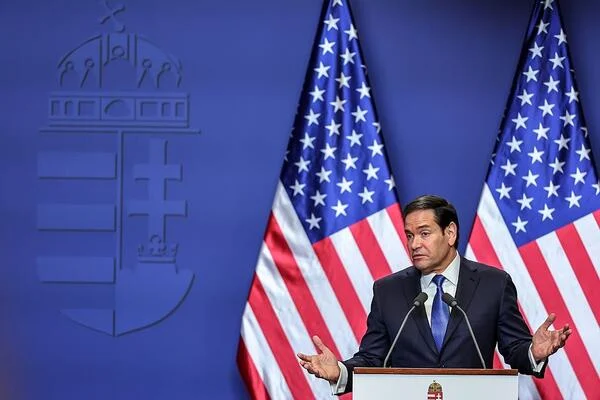
The State Department will help collect the required information from colleges, while the Education Department will “maintain all statutory responsibilities and oversight of the program.”
Anadolu/Contributor/Getty Images
The Education Department has announced more agreements to transfer responsibilities to, or share duties with, other federal agencies. They include a partnership with the State Department to track foreign gifts and contracts that U.S. colleges and universities receive.
But the collaboration with State doesn’t appear to be ED just offloading more of its congressionally required duties to another department. It could expand the federal government’s crackdown on universities, experts worry.
ED said in a news release Monday that State will “use its national security and foreign national academic admissions expertise to review and assess the industry’s compliance with the law, share data with the public and federal stakeholders, and identify potential threats.” But the law that ED says the partnership will help enforce—Section 117, which requires higher ed institutions to report large foreign gifts and contracts—doesn’t focus on reporting regarding foreign student admissions. Colleges and universities do have to report “conditions or restrictions” in grants, including regarding admissions and scholarships. Spokespeople for ED and State didn’t provide Inside Higher Ed additional information.
Education Secretary Linda McMahon said in the release that “foreign gift data reported by universities should be readily accessible to our top national security experts, allowing for proactive and decisive action to protect America’s critical interests, as this partnership with State enables.”
Jeremy Bauer-Wolf, investigations manager for the higher education program at New America, a left-leaning think tank, wrote in an email to Inside Higher Ed that he’s “seriously concerned that moving this to State will give Section 117 investigations an ideological bent.”
“State is stocked with political appointees that will want to see Section 117 weaponized, similar to how we’ve seen other federal agencies use their civil rights divisions to launch investigations and pressure colleges,” he said.
The Trump administration hasn’t dropped its push to eliminate ED, but it can’t legally erase the department without Congress’s blessing. Congress has refused so far to go along, but the administration has used a series of interagency agreements to transfer its responsibilities elsewhere. Last year, it signed an agreement to outsource most of its higher education programs. Critics have questioned the legality of these agreements and their effectiveness.
Rachel Gittleman, president of American Federation of Government Employees Local 252, which represents ED employees, said in a statement that McMahon is “unlawfully dismantling” the department “despite a clear warning from Congress that she lacks the authority to do so.” Gittleman said the Trump administration is trying to shift employees’ “critical work across multiple federal agencies with no educational expertise.”
Even if the department were to go away, federal laws such as Section 117 of the Higher Education Act still require federal involvement in higher ed. Under that law, if a foreign source provides a higher ed institution more than $250,000 in a year, the college or university must report the payment to the education secretary.
Republicans have argued for years that colleges have failed to sufficiently comply with the law and have pushed for more transparency related to foreign gifts and contracts. The first Trump administration made Section 117 compliance a priority, launching investigations into institutions and putting new reporting requirements in place. After retaking office last year, President Trump directed ED to ensure it’s enforcing the law. According to ED, U.S. higher ed institutions received $5.2 billion total in these large foreign gifts and contracts in 2025.
In a fact sheet on the partnership, ED said, “State will provide vital support in administering Section 117’s biannual reporting and information collection provisions, public inspection requirements, enforcement activities, and implementing programs and other initiatives promoting lawful compliance.” But ED’s Office of the General Counsel currently manages these programs, and that office “will continue to maintain all statutory responsibilities and oversight of the program,” according to the document.
State will also help manage a new public reporting portal for the foreign gifts and contracts data. Palantir, a controversial artificial intelligence and data analysis company that also serves the U.S. military and Immigration and Customs Enforcement, helped the department develop it. According to ED, the portal “has been designed to be fully compatible with ED and State technological systems.”
In its fact sheet, ED says it “has found ample evidence that many large and well-resourced institutions of higher education have aggressively pursued and accepted foreign money while failing to comply with Section 117, while higher education industry trade organizations have argued against donor transparency and sought to block disclosure of strings attached to foreign funds. This poses a national security risk.” ED didn’t name the institutions or trade organizations it was accusing.
“We have not argued against donor transparency,” said Sarah Spreitzer, vice president and chief of staff for government relations at the American Council on Education, one of the major college and university membership organizations.
Spreitzer said she’s worried about the reference in the announcement to State’s “foreign national academic admissions expertise.”
“I don’t think about the Department of State as having foreign national academic admissions expertise except when it comes to granting student visas,” Spreitzer said, adding that she wonders, “Are they somehow going to layer Section 117 onto student visa data?”
She said her “real concern” is “where do my institutions call if they have questions about Section 117 compliance?”
ED noted in the fact sheet that universities “should continue to remain in contact with compliance officials in the same manner and through the same contact information found at ED’s Federal Student Aid’s Knowledge Center,” where future announcements will be made.
To Bauer-Wolf, the Trump administration is “misrepresenting a couple of issues.”
“While it’s true that during Trump’s first term colleges were not completely keeping up with Section 117, virtually no one was at the time,” he said. “Congress, institutions, even the Education Department had all essentially allowed compliance to fall by the wayside.”
After the first Trump administration “began making political fuss about Section 117, colleges and their representatives made good faith efforts to report the necessary contracts and donations, and that continued through the Biden administration,” Bauer-Wolf added. And while the second Trump administration is criticizing colleges for noncompliance, he said, it “cut down the very agency that was supposed to be handling Section 117 reporting.”
