

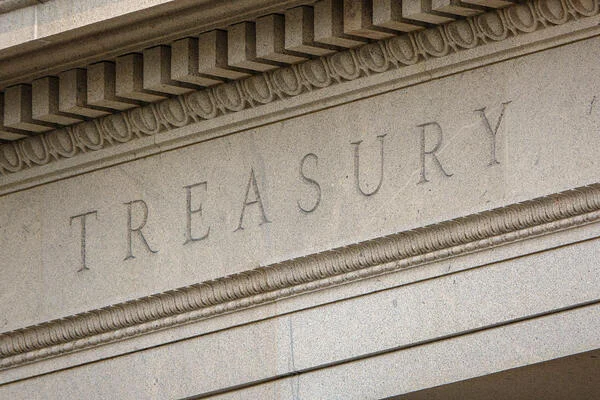
With roughly nine million student borrowers in default, the Treasury Department will “assume operational responsibility for collecting” on those loans, the Education Department announced Thursday.
The move is ED’s latest effort to render itself obsolete as part of the Trump administration’s plan to eliminate the department. This is the 10th interagency agreement it has signed to share with or spin off functions to other federal agencies.
But the ultimate scope of the agreement with Treasury isn’t immediately clear. Officials outlined a three-part plan to shift most non-policy-related responsibilities over the $1.7 trillion student loan portfolio to Treasury “to the extent practicable and permitted by law,” but the timing of the second and third phases wasn’t specified. For now, Treasury is just taking over debt collections on defaulted loans.
However, the announcement raised concerns about the future of the student loan program among consumer protection advocates as well as Democrats in Congress. President Trump said a year ago that the Small Business Administration would take over the student loan program “immediately,” and ED has explored selling off part of the portfolio to private companies.
But critics of ED who want to see the agency closed welcomed Thursday’s announcement. Several outside experts have said figuring out what to do with the financial aid program is a key barrier to overcome if any administration wants to ultimately shutter ED.
Yet only Congress, which created the department by law decades ago, has the power to delete it. It didn’t do so when Republicans had stronger majorities last year, and it will likely be less inclined to kill it if Democrats gain seats in this year’s midterm elections.
Washing Hands
The partnership will increase Treasury’s already-established presence in student financial aid, while ED moves toward the exit signs and away from ownership of long-standing controversies over the huge student debt portfolio. Treasury already disburses federal student loan money, and ED uses its tax data for income verification for student borrowers.
“For decades, ED has demonstrated it is ill-equipped to manage a portfolio of this size or complexity,” the departments wrote in a joint fact sheet accompanying the announcement.
For now, as part of the interagency agreement, Treasury said it intends to revoke a 25-year-old exemption allowing ED’s Federal Student Aid office to service its defaulted federal student loan debt. Treasury is also assuming operational responsibilities for FSA’s Default Resolution Group, which supports defaulted borrowers and operates the Default Management and Collections System. But ED plans to offload more responsibilities to Treasury in the future.
One senior FSA official who does not specialize in loan default told Inside Higher Ed that they and their colleagues received little advance notice of the interagency agreement prior to a briefing held 10 minutes before the announcement went public. The official added that they would be surprised if ED transferred additional financial aid functions any time soon.
Rachel Gittleman, president of American Federation of Government Employees Local 252, a union representing ED workers, denounced the moves in a statement.
“The Trump Administration continues to unlawfully dismantle the Education Department by moving programs and offices to other federal agencies despite clear warning from Congress that Education Secretary Linda McMahon lacks the authority,” Gittleman said.
Aissa Canchola Bañez, policy director for the nonprofit Protect Borrowers, accused McMahon of attempting to “wash her hands of the unprecedented default crisis that her policies have worsened.”
“In the midst of a growing affordability crisis where American families are already struggling to make ends meet, this risks driving millions of borrowers further into financial hardship,” Bañez said in a news release. “Instead of providing relief to the millions of defaulted borrowers who have fallen behind, the department is moving a portfolio of our most vulnerable borrowers to an agency with little to no expertise in the rights and benefits afforded to borrowers under the Higher Education Act.”
But the conservative Heritage Foundation think tank, which opposes ED’s existence, lauded the move and claimed that its impact will be more far-reaching than is currently clear.
“The new plan will accelerate the process of closing the Education Department by shifting all student loan collections and other essential activities the agency can share under law to the Treasury Department,” the think tank said in a statement. “The new partnership is the most significant effort to streamline student loans since the Higher Education Act was enacted in 1965.”
Earlier this year, ED paused its plans to garnish the wages of defaulted borrowers, citing the need to implement other “major student loan repayment reforms.” Under the second Trump administration, it has repeatedly backed off plans to restart defaulted debt collections.
Leveraging Treasury’s Expertise
Melanie Storey, president of the National Association of Student Financial Aid Administrators, said having Treasury manage defaulted borrowers is nothing new, for the most part.
Although FSA staff members within the Default Resolution Group and the Default Management and Collections System were historically the point people borrowers contacted for counseling and to figure out the next steps, it was always the Department of Treasury that actually collected involuntary payments for defaulted loans under the authority of the Debt Collection Improvement Act, Storey explained.
“Withholding of tax refunds and other government benefits can only be done by Treasury,” she said. “So, this isn’t necessarily as revolutionary.”
But where things could get trickier, she added, is if the Education Department takes further steps to transfer other parts of the $1.7 trillion portfolio, as is alluded to throughout ED’s news release and fact sheet.
“The devil is really in the details” as we ask “what will happen next,” Storey added, “and that’s not clear.”
A senior ED official told reporters Thursday that “if you’re a borrower and you are making payments today, you should see no change. This should be seamless,” and then added that borrowers should see “better customer service.”
In a news release Thursday, McMahon said, “As the Federal student aid portfolio soars to nearly $1.7 trillion and with nearly a quarter of student loan borrowers in default, Americans know that the Department of Education has failed to effectively manage and deliver these critical programs.” She added that through “leveraging Treasury’s world-renowned expertise in finance and economic policy, we are confident that American students, borrowers, and taxpayers will finally have functioning programs.”
The departments say the plan is for Treasury to take on more financial aid responsibilities, beyond defaulted debt collection—in the future. A senior ED official told reporters Thursday that “this is a multiphase partnership,” but didn’t provide a timeline for the rollout.
“The second phase will be assuming operational responsibility over Federal Student Aid’s nondefaulted federal student-held loan debts to the extent lawful and practicable, including servicing such debts, and that third phase will be the review of FSA’s general administrative functions regarding student eligibility and institutional eligibility oversight and enforcement for the participation of the Federal Student Aid programs,” a senior department official said.
The department’s fact sheet noted that Treasury could eventually help to administer the Free Application for Federal Student Aid, the key form students must complete to unlock federal and many nonfederal sources of money for college.
But as with the other interagency agreements, ED will retain major control. Both departments said that “ED, through both the Office of Postsecondary Education and FSA, will maintain all statutory responsibilities including policy development.”
Jessica Blake contributed to this report.
