

The U.S. Office of Personnel Management’s controversial policy creating a new federal employee category with fewer job protections took effect this week.
The Trump administration is set to transfer an unknown number of workers into this classification. Research advocates worry federal grant-making employees will be among them, making them easier to pressure and fire. The policy, released for public comment last spring, has prompted vocal pushback. By the OPM’s own count, 94 percent of the more than 40,500 public comments it received opposed the plan.
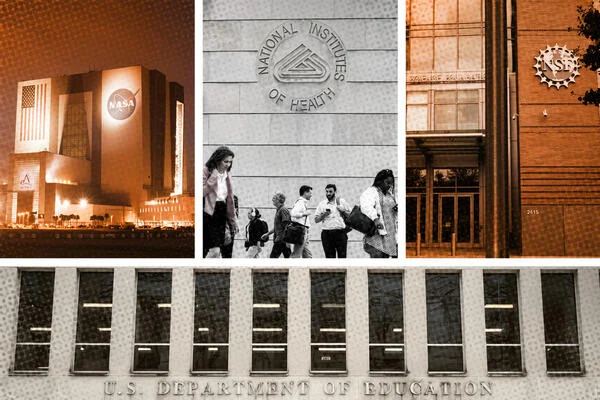
Federally funded researchers and groups advocating for them raised concerns about the category, called Schedule Policy/Career. It’s better known as Schedule F, the name the first Trump administration used for the policy, which President Biden rescinded. Employees in this new category are easier to fire, lacking due process and appeal rights. The rule is part of the administration’s sweeping effort to reshape the federal workforce—an effort that has included mass layoffs of civil servants at agencies such as the Education Department and the National Institutes of Health.
The final rule says federal research funding agencies, such as the NIH and the National Science Foundation, can—with presidential approval—move employees involved in federal grant making into this less protected group of workers. That has fed worries that the administration will further politicize billions of dollars in research funding, after a year in which it already canceled grants in droves.
Here are five things to know about the change.
1. Employees moved into Schedule Policy/Career will be at-will workers, lacking key federal civil service protections.
Workers moved into the new category won’t be protected by “adverse action” and “performance-based action” procedures, which provide many federal employees due process protections against firing and other punishments. They also generally won’t be able to appeal discipline to the Merit Systems Protection Board, an independent federal agency.
2. The policy says a range of workers involved in grant making can be moved into the new employee category.
Concerns that a wide swath of employees at the science agencies will be reclassified are “buttressed more by fear than actual evidence,” OPM officials wrote in response to public comments.
Instead, the agency expects few workers will be placed in the new, less protected category, even though the policy opens up that possibility for many employees. The president will ultimately decide, through executive order, who is transferred.
“Commenter 18409 argues that it makes no sense to reclassify all the reviewers, program officers, advisory councils, and leadership at science funding agencies as political in nature,” the agency wrote. But OPM said such positions are eligible for transfer.
“Some positions in scientific grantmaking influence public policy,” the OPM wrote. “Those positions, as well as any others that are policy-influencing, are appropriate candidates.”
But OPM also said it won’t be recommending for reclassification the many grant-making positions that don’t “determine or make agency policy.” It expects the scientific jobs that agencies identify for transfer will “reflect policy-influencing duties that, for example, directs [sic] which scientific projects should be resourced throughout the agency.”
“OPM expects that, generally, relatively few of these line scientific, cybersecurity, or technical positions will be moved into Schedule Policy/Career because most do not perform policy-influencing work,” the agency wrote. It said commenters concerned about politics eroding public trust in science “overstate the impact on agencies’ scientific missions and the scientific community as a whole.”
3. The OPM estimated 50,000 federal workers total will be in Schedule Policy/Career. But that number is contested.
The Association of American Medical Colleges, which opposed the policy, noted in its comment on the proposal that “other estimations suggest it could be four times” OPM’s estimate. Neither OPM nor three major research funding agencies—the NIH, the National Science Foundation and the Defense Department—answered Inside Higher Ed’s questions about how many workers, and which kinds, they plan to reclassify.
“NSF is going to decline to comment at this time,” a spokesperson there said in an email.
OPM’s rule says agencies have already recommended positions to convert, and it “can state that its initial estimate of 50,000 positions was a reasonable approximation.” It projected that 45,000 of those will be current employees and the rest new hires.
More than two million civilian employees make up the federal workforce.
4. The policy says it will strengthen democracy—by ensuring federal workers obey the president.
OPM’s explanation of its rule and its response to comments describe democratic accountability and obedience to President Trump as synonymous.
“Critical to the success of any presidency is the ability to implement an agenda endorsed by the American people free from antidemocratic, unaccountable bureaucratic resistance,” the agency wrote.
“This will allow agencies to quickly remove employees from critical positions who engage in misconduct, perform poorly, or obstruct the democratic process by intentionally subverting Presidential directives,” OPM said, adding that the policy “specifies increasing accountability to the President as grounds for excepting positions from the competitive service.”
At the same time, the agency says it’s fighting partisanship, arguing that the new category “will give agencies the practical ability to separate employees who insert partisanship into their official duties.” And OPM suggests the new category will still allow employees to voice dissent.
“OPM expects that employees who provide frank and candid advice, then faithfully implement agency leadership’s ultimate decision irrespective of their personal preferences, have nothing to fear from Schedule Policy/Career,” it wrote. And it said Trump doesn’t disdain federal workers.
“Commenters overlook the many times the President has praised and lauded Federal employees as a whole, including in public proclamations,” it wrote. “The President has also praised specific categories of Federal employees, such as when he told Immigration and Customs Enforcement employees ‘we love you, we support you, and we will always have your back.’”
5. Employees and their unions are trying to stop this.
A group of unions, Citizens for Responsibility and Ethics in Washington, Democracy Forward, and Public Employees for Environmental Responsibility have sued Trump, OPM and its director, asking a judge to rule that the executive order and policy establishing the new category violate the Constitution, civil service protections and other laws.
“President Trump and Director [Scott] Kupor can have whatever views they want of the career civil service,” the plaintiffs wrote in a filing in the case. “What they cannot do is ignore the law and disregard Congress’s design.”
“Without talented career employees’ expertise, presidential administrations would be significantly limited in their ability to implement their agendas, and the operations of the federal government—everything from Social Security to national parks—would grind to a halt,” they wrote.
